Hiring 2026FreshersWILPElite NLTHTurbo3.5–6 LPAUpdated 2026 · 45 min read
The definitive Wipro careers and interview preparation hub for India 2026 — covering every hiring track from Elite NLTH and Turbo to WILP work-study, off-campus drives, lateral hiring, salary bands, month-by-month recruitment calendar, NLTH online test pattern, technical and HR interview depth, role-specific guides, and 15/30/60-day preparation roadmaps with expert sample answers.
Wipro is actively hiring engineering and MCA graduates in India through NLTH, Elite NLTH, WILP, Turbo, campus, and off-campus drives in 2026. Fresher packages range roughly ₹3.5–7 LPA depending on track, with technical plus HR interviews after the online assessment and structured ILP training before project allocation.
Wipro campus hiring for 2026 runs primarily July through March across tier-1 and tier-2 colleges, with off-campus NLTH batches in Q1 and Q3. Turbo and Elite NLTH slots are limited and fill early. WILP intake follows a separate academic calendar tied to M.Tech enrollment. Lateral hiring continues year-round for 1–5 YOE profiles.
Monitor your campus placement cell and careers.wipro.com for drive-specific dates. Off-campus batches in Q1 and Q3 typically have stricter NLTH cutoffs than on-campus visits — start aptitude prep before registration opens.
Elite NLTH — Premium Fresher Track
Elite NLTH is Wipro’s highest fresher hiring band for top-performing NLTH scorers from premium campuses. Candidates receive higher CTC (typically ₹6–7 LPA), faster project allocation, and priority ILP cohorts. Selection requires exceptional aptitude percentile plus strong technical interview performance — not available at every college drive.
Elite NLTH sits above standard NLTH as a differentiated offer band for candidates who score in the top percentile of the National Level Talent Hunt and clear a deeper technical panel. Colleges with Elite tie-ups announce separate shortlists — if your campus placement cell mentions “Elite” or “Premium NLTH,” prepare for harder technical probes and higher salary negotiation floors.
The Elite track targets candidates who demonstrate not only aptitude speed but also clean coding narration, strong Core CS fundamentals, and credible project ownership. Panels may add an extra technical round or extend the combined Tech+HR session beyond 90 minutes. Elite offers often include marginally higher variable pay and earlier access to digital engineering accounts.
Do not assume Elite NLTH availability at every Wipro campus visit. When Elite slots are absent, standard NLTH remains the default path — perform at Elite level anyway, because internal re-banding to Turbo or premium project pools sometimes happens post-ILP based on training scores.
Typical CTC: ₹6–7 LPA for UG engineering
Requires top NLTH percentile at Elite-enabled campuses
Deeper technical interview than standard NLTH
Priority ILP cohort and faster project mapping
NLTH — National Level Talent Hunt
NLTH is Wipro’s primary mass fresher screening for B.Tech, B.E., MCA, and B.Sc. CS graduates in India. The online test covers English communication, quantitative aptitude, logical reasoning, and technical MCQs — shortlisted candidates proceed to combined technical and HR interviews.
The National Level Talent Hunt is the gateway for the majority of Wipro fresher hires. Register through your campus placement cell or Wipro careers portal with accurate academic details. NLTH is timed and elimination-heavy — weak aptitude performance ends candidacy before any live interview, regardless of strong GitHub profiles.
Post-NLTH, shortlisted candidates face a combined technical and HR interview (sometimes split into two sessions). Technical depth spans easy DSA, OOP, DBMS/SQL, OS, networking basics, and project walkthrough. HR probes relocation, salary band acceptance, and motivation for IT services.
NLTH scores are normalized across colleges — a 75th percentile at a tier-2 campus may outperform a 60th percentile at tier-1 depending on batch difficulty. Treat every section as scored: English communication and written modules carry weight equal to quant in many drives.
Sections: English, Quant, Logical, Technical MCQs, Written Communication
Typical fresher CTC: ₹3.5–5 LPA standard band
Combined Tech + HR after shortlist
Primary path for campus and many off-campus drives
WILP — Work Integrated Learning Program
WILP is Wipro’s work-study program where employees pursue an M.Tech while working — distinct from ILP post-offer training. Candidates are typically diploma or B.Tech holders who join Wipro, attend weekend or structured academic sessions, and earn a Wipro-sponsored postgraduate degree over 3–4 years.
WILP (Work Integrated Learning Program) must not be confused with ILP (Initial Learning Program). WILP is a multi-year employment plus education pathway: you are a Wipro employee earning a stipend or entry salary while completing an M.Tech through partner universities. ILP, by contrast, is a 2–4 month post-offer training bootcamp before your first client project — every standard fresher goes through ILP regardless of WILP status.
WILP eligibility often targets diploma holders, B.Tech graduates from specific streams, or candidates who missed standard campus NLTH but fit the work-study model. Academic schedules are rigorous — panels assess time-management discipline and long-term commitment because WILP demands simultaneous delivery work and postgraduate coursework.
Salary during WILP starts lower than Turbo or Elite NLTH bands but grows with degree progression and project allocation. Candidates who complete WILP M.Tech gain stronger internal promotion credentials for architect and specialist tracks. Ask recruiters explicitly: “Is this offer WILP work-study or standard NLTH with ILP training?”
Distinct from ILP — ILP follows every standard offer
Lower entry CTC, long-term degree and growth upside
Separate application window from NLTH campus drives
Wipro Turbo — Accelerated Fresher Track
Turbo is Wipro’s accelerated hiring track offering higher fresher packages (roughly ₹5.5–6.5 LPA) for candidates with stronger NLTH scores, coding depth, and technical interview performance. Turbo cohorts receive intensive ILP modules and faster placement on digital engineering accounts.
Wipro Turbo competes with TCS Digital and Infosys Power Programmer bands as a premium fresher track. Turbo shortlists are smaller — expect harder coding problems (easy-medium DSA), deeper Core CS follow-ups, and explicit questions on cloud or API exposure from projects.
Turbo offers include marginally higher fixed pay and branding on the offer letter that signals priority project mapping. However, Turbo is not a separate employer — you still complete ILP training, follow the same HR policies, and rotate through client accounts based on training performance and business demand.
If your NLTH score is borderline, standard NLTH may be the realistic outcome. Prepare Turbo-level depth anyway: panels sometimes upgrade strong performers from standard to Turbo bands during offer processing, but never downgrade silently — always confirm track name on the offer letter.
Typical CTC: ₹5.5–6.5 LPA fresher band
Stronger coding and CS depth than standard NLTH
Intensive ILP with digital engineering focus
Limited seats per campus / off-campus batch
On-Campus Placement Drives
Wipro visits engineering and MCA campuses July–March for NLTH-based hiring. Placement cells coordinate registration, pre-placement talks, online tests on campus LAN or portal, and interview scheduling. Tier-1 colleges may receive Elite NLTH or Turbo slots; tier-2/3 campuses typically run standard NLTH.
On-campus remains the highest-volume Wipro hiring channel. Your placement training and placement officer (TPO) publishes eligibility criteria, registration deadlines, and dress-code protocols. Missing registration by even one day disqualifies you — Wipro rarely accepts late entries for campus batches.
Campus drives compress the full pipeline into 1–3 days on-site: NLTH (sometimes pre-scheduled online), followed by technical and HR panels for shortlists. Bring printed resumes, government ID, and mark sheets even when digital copies are uploaded — operations teams occasionally request physical verification.
Multi-offer policies vary by college: some allow Wipro plus one backup; others enforce single offer acceptance. Clarify with your TPO before interviewing. Strong NLTH preparation across aptitude and technical MCQs is the differentiator — campus batches eliminate 60–70% of registrants at the online test stage.
Peak season: July–March academic calendar
Coordinated via college placement cell
Elite/Turbo slots at select tier-1 campuses
1–3 day on-site interview scheduling
Off-Campus / Open NLTH Drives
Wipro conducts periodic off-campus NLTH drives via careers.wipro.com and job aggregators for 2024–2026 graduates who missed campus placement. Open registration, online NLTH, and virtual Tech+HR interviews — timelines stretch 4–8 weeks with larger applicant pools and stricter percentile cutoffs.
Off-campus hiring serves graduates without Wipro campus visits, backlog-cleared candidates from prior batches, and tier-3 colleges outside the primary visit list. Register on Wipro careers portal, upload resume and degree documents, and monitor email for NLTH slot assignments.
Competition is fiercer than campus — thousands apply per off-campus batch. NLTH percentile thresholds are often higher because the applicant pool is national. Virtual interviews demand stable internet, quiet environment, and proctored test discipline; technical glitches are rarely retried.
Off-campus offers are identical in employment terms to campus offers at the same band — Turbo, standard NLTH, or WILP labels apply. Joining dates may batch later than campus hires due to training cohort scheduling. Follow Wipro careers LinkedIn and Naukri alerts for Q1 and Q3 drive announcements.
Open to 2024–2026 pass-outs per drive notice
Virtual NLTH + virtual Tech/HR panels
Higher competition vs campus batches
Register at careers.wipro.com
Experienced / Lateral Hiring
Wipro hires lateral software engineers, testers, consultants, and support engineers with 1–8 years experience year-round. Process: resume screen, 2–3 technical rounds (coding + system discussion), managerial fit, HR — no NLTH. Salaries range roughly ₹6–18 LPA depending on skill, city, and client account.
Lateral hiring bypasses NLTH entirely. Recruiters and employee referral programs drive most lateral pipelines. Expect online coding assessments (HackerRank-style), deep framework probes (Java/Spring, .NET, Python, Angular/React), and scenario questions on production debugging, Agile delivery, and client communication.
Wipro lateral bands map to role codes — Project Engineer, Senior Engineer, Module Lead — with CTC negotiated against current pay and skill scarcity. Cloud certifications (AWS, Azure), DevOps exposure, and domain knowledge (BFSI, healthcare) strengthen offers. Counter-offers are common; have documented delivery metrics ready.
Interview loops may include a managerial round assessing stakeholder management and offshore-onshore coordination — critical for IT services delivery. Lateral candidates should research Wipro’s account portfolio and articulate why services consulting fits their career versus product companies.
1–8 YOE typical lateral range
No NLTH — coding + system design rounds
CTC: ₹6–18 LPA band (varies by skill/city)
Year-round via careers portal and referrals
Summer & Project Internships
Wipro offers summer internships and final-year project internships for pre-final and final-year engineering students. Duration 2–6 months with stipends (typically ₹15,000–25,000/month). Strong performers receive pre-placement offers (PPO) aligned to NLTH or Turbo bands upon graduation.
Internship programs feed Wipro’s fresher pipeline with lower-risk evaluation. Interns work on supervised modules — test automation, API development, documentation — under mentor oversight. Performance reviews at internship end determine PPO eligibility; treat every sprint demo as an extended interview.
Apply through campus internship drives, Wipro careers internship portal, or programs like Wipro TalentNext. Technical expectations match junior engineer tasks: Git workflow, Jira updates, code reviews, and daily standups. Soft skills and punctuality weigh heavily — services delivery culture starts at internship.
PPO offers may skip NLTH or require a shortened assessment depending on internship year policies. Even without PPO, internship experience on your resume strengthens NLTH shortlisting and technical panel confidence. Document quantified outcomes: bugs found, APIs built, test coverage added.
Stipend: ~₹15,000–25,000/month
2–6 month duration
PPO pathway to Turbo/NLTH bands
Apply via campus or careers portal
Apprenticeship & Early Career Programs
Wipro apprenticeship programs under the National Apprenticeship Promotion Scheme (NAPS) hire ITI diploma holders and 12th-pass candidates for structured on-job training. Apprentices receive stipends, skill certifications, and conversion pathways to full-time roles after 12–24 months.
Apprenticeship tracks serve candidates outside the B.Tech/MCA NLTH funnel — ITI graduates, polytechnic diploma holders, and early-career entrants from vocational streams. Programs combine classroom skill modules with supervised project tasks, aligning with government apprenticeship frameworks.
Stipends during apprenticeship are lower than intern or fresher CTC but include EPF and skill certification. Conversion to permanent Project Engineer roles requires performance certification, internal assessments, and sometimes bridging NLTH-style aptitude tests.
If you hold a B.Tech degree, apprenticeship is not your path — pursue NLTH or lateral hiring instead. Apprenticeship suits diploma holders building credentials before WILP or standard engineering hire routes.
Target: ITI / diploma / vocational graduates
12–24 month structured training
Stipend-based with conversion option
Separate from NLTH B.Tech campus pipeline
Recruitment Calendar 2026
Month-by-month hiring intensity for Wipro campus, off-campus, internship, and lateral pipelines in India.
Wipro recruitment calendar 2026 — month, activity, and intensity
Late campus season; backlog-cleared candidate drives; pre-ILP document collection
Intensity
Medium
December
Month
December
Activity
Year-end offer batches; Q3 off-campus planning; holiday slowdown on interviews
Intensity
Low
End-to-End Hiring Timeline
From application through ILP training — the standard Wipro fresher pipeline for NLTH, Turbo, and Elite tracks.
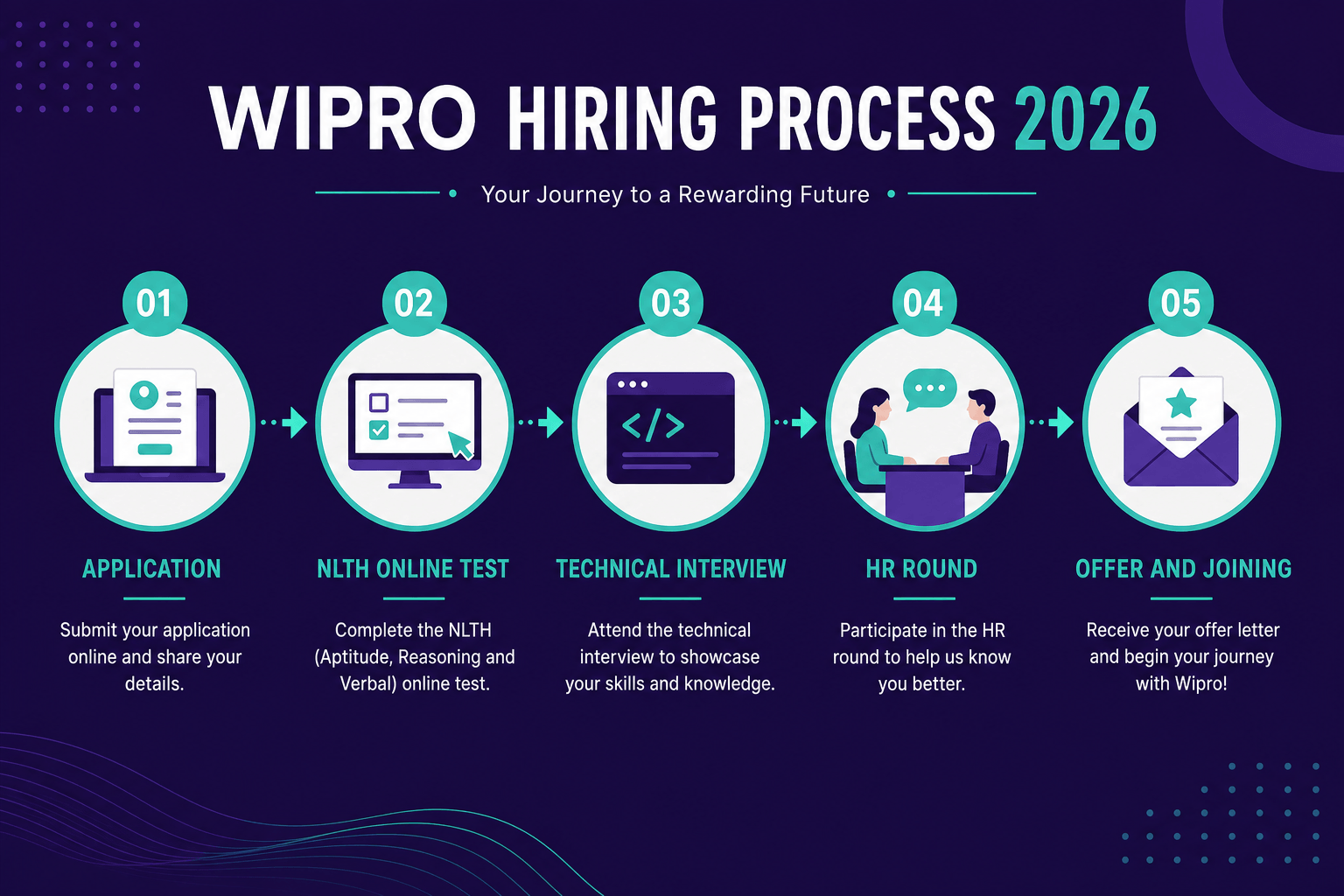
Wipro hiring process 2026 — Application, NLTH Online Test, Technical Interview, HR Round, ILP Training, and Project Allocation for campus and off-campus drives in India
Step 1 — Application & registration
Register on Wipro careers portal or through campus placement cell with accurate academic records, resume, and degree documents. Verify eligibility: 60–65% aggregate, no active backlogs, and graduation year matching drive criteria. Upload a resume highlighting projects, internships, and tech stack — recruiters screen before NLTH slots are assigned.
Step 2 — NLTH online assessment
Timed National Level Talent Hunt covering English communication, quantitative aptitude, logical reasoning, technical MCQs, and written communication. Duration typically 60–90 minutes. Top percentiles unlock Turbo or Elite bands; mass shortlist proceeds to interviews. Failed NLTH ends the pipeline — no appeal round at most drives.
Step 3 — Technical interview
Live or virtual panel testing DSA (easy-medium), OOP, DBMS/SQL, OS, networking, and deep project discussion. Combined Tech+HR sessions are common. Panels expect narrated problem-solving, complexity analysis, and honest ownership of resume claims. Turbo/Elite candidates face harder coding and follow-ups.
Step 4 — HR interview
Behavioral screen when not combined with technical: STAR stories, relocation flexibility, salary band acceptance, and “why Wipro.” Research Wipro digital engineering, sustainability goals, and ILP structure. Weak company research fails HR even after strong technical performance.
Step 5 — Offer & background verification
Selected candidates receive offer letter with role band (NLTH/Turbo/Elite/WILP), CTC breakdown (fixed vs variable), joining date, and location. Background verification checks academic credentials, identity, and prior employment. Offer acceptance deadlines are strict — typically 3–7 days.
Step 6 — ILP training & project allocation
Join Wipro and complete Initial Learning Program (ILP) — 2–4 months of structured technical, domain, and soft-skills training. ILP is post-offer onboarding, not WILP work-study. Post-ILP, project allocation maps you to client accounts based on training scores, skill demand, and location preference.
Hiring Locations
Wipro maps freshers to delivery hubs across India. Relocation flexibility during HR improves offer probability.
Bangalore
Largest Wipro engineering hub — digital, cloud, and product engineering COEs. Highest fresher intake volume.
Hyderabad
Major delivery center for BFSI and healthcare accounts. Strong NLTH joining cohorts.
Pune
Enterprise application development and testing centers. Popular joining location for campus hires.
Chennai
Legacy delivery hub with manufacturing and telecom clients. ILP training facility on-site.
Kolkata
Growing eastern India operations center. Smaller fresher batches, lower cost of living.
Noida
NCR delivery center for banking and government projects. Relocation from North campuses.
Kerala development center focusing on infrastructure and support services.
Visakhapatnam
Emerging tier-2 hub with campus hiring partnerships in Andhra Pradesh colleges.
NLTH Online Test Pattern
The National Level Talent Hunt is the highest-leverage elimination stage — balance aptitude, English, and technical MCQs rather than coding alone.
Wipro updates NLTH section weights and durations periodically. Always verify the latest pattern on your test invitation email before the assessment day.
Wipro NLTH section breakdown with focus areas and typical weight
Reading comprehension, sentence correction, synonyms/antonyms, para-jumbles, and active/passive voice. Wipro client delivery demands professional English — this section filters candidates who cannot draft clear emails or understand requirement documents.
Prep tip: Solve 10 RC passages weekly; review grammar for subject-verb agreement, tenses, and prepositions. Practice 5 sentence-correction sets daily in Weeks 1–2.
Quantitative Aptitude
Percentages, ratios, time-speed-distance, profit-loss, simple/compound interest, and basic data interpretation. NLTH quant is time-pressured — mental math shortcuts and option elimination matter more than lengthy calculations.
Prep tip: Drill 30 timed quant questions daily. Maintain a mistakes log for TSD and percentage trap questions.
Logical Reasoning
Blood relations, seating arrangements, syllogisms, coding-decoding, series, and direction sense. This section separates Turbo shortlists from mass elimination — accuracy under clock pressure is critical.
Prep tip: Practice 15 reasoning sets under 20-minute timers. Learn standard notation for linear and circular arrangements.
Technical MCQs
Programming logic, flowchart tracing, OOP concepts, DBMS normalization, SQL basics, OS process/thread, and networking fundamentals. Not language-specific syntax drilling — logic and CS theory dominate.
Prep tip: Revise OOP four pillars, JOIN types, TCP vs UDP, and trace 5 pseudocode problems daily.
Written Communication
Short essay on technology/society topics, email drafting to managers or clients, and précis writing. Evaluates professional tone, structure, and clarity — essential for offshore client communication roles.
Prep tip: Write 3 practice emails and 2 essays weekly. Use intro-body-close structure with bullet points for requests.
Coding (Turbo / Elite drives)
One or two easy coding problems — arrays, strings, basic sorting/searching. Standard NLTH drives may omit live coding and rely on programming logic MCQs instead. Turbo candidates should expect at least one array manipulation problem.
Prep tip: Solve 40 easy array/string problems on paper under 25-minute timers. Narrate approach before coding in mocks.
Technical Interview
Combined Tech+HR sessions are common in 2026 — prepare narrated coding, Core CS fundamentals, and project depth in one sitting.
DSA / Coding
High
Arrays, strings, two-pointer, binary search, linked lists, trees basics. Easy-medium with narrated approach and complexity stated.
OOP
High
Encapsulation, inheritance, polymorphism, abstraction with Java/C++ examples. Design trade-offs over textbook definitions.
DBMS / SQL
High
Normalization, JOINs, indexing, ACID. Expect one live or verbal SQL query.
Operating Systems
Medium
Process vs thread, deadlock Coffman conditions, scheduling, memory management basics.
Computer Networks
Medium
TCP vs UDP, three-way handshake, HTTP/REST basics, DNS awareness.
Java / Python
Medium–High
Syntax, collections, exception handling aligned to project stack on resume.
IaaS/PaaS/SaaS, basic AWS/Azure mentions from projects — not architecture depth for freshers.
Testing fundamentals
Medium (QA tracks)
Test types, STLC phases, automation awareness for QA-bound candidates.
System design
Low (fresher)
High-level API + DB schema on capstone only — not distributed systems at NLTH level.
HR Interview
HR probes relocation, salary band acceptance, and authentic motivation for IT services — weak company research fails candidates after strong technical rounds.
What is the Wipro NLTH (National Level Talent Hunt) and what does it test?
AptitudeEasy
View expert answer & prep guide
Suggested answer time: 2–3 min
Why interviewers ask this: Recruiters and panels verify you understand Wipro's hiring funnel before investing interview slots — confusion with TCS NQT or Infosys InfyTQ signals weak company research.
Expert answer: NLTH is Wipro's primary fresher online assessment in India. Sections include English Communication, Quantitative Aptitude, Analytical & Logical Reasoning, Technical MCQs (programming logic, OOP, DBMS basics), and Written Communication. Turbo/Elite drives may add coding. Shortlisted candidates proceed to combined technical and HR interviews — failed NLTH ends the pipeline at most drives.
What interviewers evaluate: Awareness of NLTH sections, elimination mechanics, and post-assessment interview stages.
Answer strategy: Name NLTH, list all sections in order, mention Tech+HR follows shortlist, note Turbo coding variant.
Common mistakes: Omitting written communication, confusing NLTH with ILP/WILP, or not mentioning online test as primary filter.
Follow-up questions:
What is Turbo vs standard NLTH?
How do you prepare for NLTH quant under time pressure?
02
What is the difference between abstract class and interface in Java? When do you use each?
TechnicalEasy
View expert answer & prep guide
Suggested answer time: 3 min
Why interviewers ask this: Core Java OOP question — Wipro Java and SWE panels test practical design judgment, not textbook definitions.
Expert answer: Abstract class can have state, constructors, and partial implementations — use for "is-a" relationships with shared behavior (e.g. Payment abstract class with common fields). Interface defines a contract — use for "can-do" capabilities (Payable, Serializable). A class extends one abstract class but implements multiple interfaces. Java 8+ interfaces allow default methods.
What interviewers evaluate: OOP design understanding and Java language rules (single inheritance, multiple interfaces).
Answer strategy: Contrast state/constructors (abstract class) vs contract-only (interface). Give one "is-a" and one "can-do" example.
Common mistakes: Saying interfaces cannot have any implementation (ignoring default methods), or using inheritance when composition fits better.
Follow-up questions:
Composition vs inheritance?
When prefer interface default methods?
03
Write a program to check if a string is a palindrome.
TechnicalEasy
View expert answer & prep guide
Suggested answer time: 4–5 min
Why interviewers ask this: Standard warm-up in NLTH coding sections and technical rounds — tests string manipulation without advanced algorithms.
Expert answer: Two-pointer approach: compare characters at start and end indices moving inward until pointers meet or mismatch. O(n) time, O(1) space. Handle empty string as palindrome. Wipro variants may ask case-insensitive comparison or ignoring spaces/punctuation — state your normalization approach before coding.
What interviewers evaluate: Two-pointer logic, edge-case handling, and complexity narration under time pressure.
Answer strategy: State O(n)/O(1) upfront, code two-pointer loop, mention case-insensitive and ignore-spaces variants.
Common mistakes: O(n²) substring checks, forgetting empty string, silent coding without complexity.
Follow-up questions:
Longest palindromic substring?
Check palindrome in a linked list?
04
Explain the MVC architecture pattern with an example.
TechnicalEasy
View expert answer & prep guide
Suggested answer time: 3 min
Why interviewers ask this: Wipro enterprise client projects commonly use MVC or MVC-inspired patterns — tests architecture literacy beyond syntax.
Expert answer: Model holds data and business logic (User entity, validation). View renders UI (HTML templates, React components). Controller handles input and orchestrates Model + View — e.g. login form submit → Controller validates → Model authenticates → View shows success or error. Separation keeps UI changes independent from business rules.
What interviewers evaluate: Separation of concerns understanding with a concrete web application mapping.
Answer strategy: Define M/V/C with one form-submit web app example; mention REST API layer if probed.
Common mistakes: Confusing MVC with three-tier architecture, or abstract definitions without example.
Follow-up questions:
MVC vs MVVM?
Where does a REST API fit in MVC?
05
What is a binary search tree? What are its time complexities for insert, search, and delete?
TechnicalMedium
View expert answer & prep guide
Suggested answer time: 3 min
Why interviewers ask this: DSA fundamentals — BST property and complexity reasoning appear in technical MCQs and live coding follow-ups.
Expert answer: BST: for each node, left subtree values are smaller, right subtree larger. Average-case insert, search, delete: O(log n) on balanced trees. Worst case O(n) when tree is skewed (sorted insert order). Balanced variants (AVL, Red-Black) maintain O(log n) worst case via rotations.
What interviewers evaluate: Tree property knowledge, average vs worst-case Big-O, balanced tree awareness.
Common mistakes: Claiming always O(log n) without skewed caveat, or unable to explain BST property.
Follow-up questions:
Implement BST insert?
AVL vs Red-Black trade-offs?
06
What are the different types of software testing? Which are automated vs manual?
TechnicalEasy
View expert answer & prep guide
Suggested answer time: 3 min
Why interviewers ask this: Testing literacy applies to SWE and QA tracks — Wipro QATP practice values candidates who understand test pyramid.
Expert answer: Unit, integration, system, acceptance, and regression testing. Automated: unit (JUnit, pytest), regression suites, API (Postman/Newman). Manual: exploratory, usability, ad-hoc. Wipro QATP practice favors Selenium/Tosca awareness — mention when automation ROI exceeds manual repetition.
What interviewers evaluate: Test type taxonomy and automation judgment.
Answer strategy: List unit, integration, system, acceptance, regression. Map automated (unit, regression, API) vs manual (exploratory, usability).
Common mistakes: Listing only manual types, or claiming everything should be automated.
Follow-up questions:
What is regression testing?
Selenium vs manual for smoke tests?
07
Describe a situation where you had a conflict with a team member and how you resolved it.
BehavioralEasy
View expert answer & prep guide
Suggested answer time: 3 min
Why interviewers ask this: Wipro values Respect and Collaboration — STAR conflict stories test emotional intelligence for client team delivery.
Expert answer: Use STAR. Example: disagreed on API design approach in capstone. I scheduled a 30-minute comparison session listing trade-offs for each approach, invited mentor input, and we chose the option with better testability. Both learned documentation prevents future design disputes. Wipro panels value empathy over winning arguments.
What interviewers evaluate: Empathy, communication, escalation judgment, and learning outcome.
Answer strategy: STAR format: understand other perspective, seek common ground, escalate only when needed, end with mutual learning.
Common mistakes: Blaming teammate, no resolution, or heroics without collaboration.
Follow-up questions:
What if conflict escalated to manager?
How prevent future conflicts?
08
What is TCP/IP? How does the three-way handshake work?
TechnicalMedium
View expert answer & prep guide
Suggested answer time: 3 min
Why interviewers ask this: Networking fundamentals are staple Wipro technical questions — client systems rely on TCP-based enterprise protocols.
Expert answer: TCP/IP is the foundational internet protocol suite. Three-way handshake: (1) Client sends SYN, (2) Server responds SYN-ACK, (3) Client sends ACK — establishes reliable connection with mutual sequence number synchronization. Termination uses four-way FIN handshake. UDP is connectionless without this handshake.
What interviewers evaluate: TCP connection establishment sequence and mutual synchronization understanding.
Answer strategy: SYN → SYN-ACK → ACK sequence, explain why three steps, mention four-way FIN termination.
Common mistakes: Wrong sequence order, unable to explain why three steps, confusing with UDP.
Follow-up questions:
TCP vs UDP when to use?
What is HTTP/3 over QUIC?
09
What are your salary expectations and are you aware of the Wipro package structure?
HREasy
View expert answer & prep guide
Suggested answer time: 2 min
Why interviewers ask this: HR verifies you researched bands and will accept offer without unrealistic negotiation — fresher leverage is minimal.
Expert answer: I understand Wipro fresher packages range ₹3.5–6 LPA depending on track — standard NLTH, Turbo, or Elite. I am willing to accept the offered band and focus on learning through ILP and client project exposure at this career stage. I would appreciate clarity on fixed vs variable split on the offer letter.
What interviewers evaluate: Package awareness, flexibility, and growth-oriented framing.
Answer strategy: State known bands (NLTH ₹3.5–5, Turbo ₹5.5–6.5), express willingness to accept, focus on ILP learning.
Common mistakes: Demanding product-company CTC, unaware of Turbo vs NLTH bands, or refusing relocation.
Follow-up questions:
What is Turbo track CTC?
When can salary be renegotiated?
10
Explain what cloud computing is. What are the differences between IaaS, PaaS, and SaaS?
TechnicalEasy
View expert answer & prep guide
Suggested answer time: 3 min
Why interviewers ask this: Cloud awareness is increasingly expected in 2026 Wipro panels — client projects migrate to AWS/Azure.
Expert answer: Cloud computing delivers on-demand IT resources over the internet. IaaS: raw VMs and storage (AWS EC2) — you manage OS and apps. PaaS: managed runtime and deployment (Heroku, App Engine) — you bring code. SaaS: fully managed applications (Gmail, Salesforce) — you just use the app. Wipro client migrations often start IaaS lift-and-shift.
What interviewers evaluate: Service model differentiation with practical examples.
Answer strategy: Define cloud, then IaaS/PaaS/SaaS with AWS examples and pizza analogy if helpful.
Common mistakes: Confusing PaaS with SaaS, or no real-world examples.
Follow-up questions:
AWS vs Azure for enterprise?
What is container vs VM?
11
What motivates you to work in the IT services industry?
HREasy
View expert answer & prep guide
Suggested answer time: 2–3 min
Why interviewers ask this: Tests genuine career fit for consulting delivery model versus product-company aspirations.
Expert answer: IT services offers exposure to multiple domains — banking, healthcare, retail — accelerating my learning versus single-product depth early in career. I value structured training through ILP, enterprise-scale problem solving, and India's IT export growth. Wipro's Net Zero 2040 commitment aligns with my interest in sustainable technology delivery.
What interviewers evaluate: Authentic motivation, domain exposure interest, and alignment with Wipro values.
Answer strategy: Multi-domain exposure, rapid skill building, client project scale, Wipro sustainability — personal and specific.
Common mistakes: Generic "big company" answer, sounding like placeholder until product company hire.
Follow-up questions:
Why not product companies?
Where in 5 years at Wipro?
12
What is WILP eligibility at Wipro and who should apply?
HREasy
View expert answer & prep guide
Suggested answer time: 2–3 min
Why interviewers ask this: WILP/ILP confusion is a common disqualifier — recruiters screen for long-term commitment and correct program understanding.
Expert answer: WILP (Work Integrated Learning Program) is a 3–4 year work-study pathway: you work at Wipro while earning a sponsored M.Tech. Eligibility often includes diploma holders and select B.Tech graduates seeking postgraduate education without leaving employment. It is NOT ILP — ILP is 2–4 month post-offer fresher training for all standard NLTH/Turbo hires. Standard campus B.Tech candidates should pursue NLTH unless explicitly invited to WILP.
What interviewers evaluate: Distinction between WILP work-study and ILP onboarding, eligibility fit, and commitment awareness.
Answer strategy: Define WILP, contrast with ILP explicitly, list who should and should not apply, note multi-year commitment.
Common mistakes: Using WILP and ILP interchangeably, applying to WILP when NLTH/Turbo eligible, underestimating duration.
Follow-up questions:
WILP salary during M.Tech study?
Can WILP graduates move to architect track faster?
13
What is the difference between Elite NLTH and regular NLTH at Wipro?
HRMedium
View expert answer & prep guide
Suggested answer time: 2–3 min
Why interviewers ask this: Premium track awareness signals preparation quality — Elite candidates face higher bars and recruiters verify expectations.
Expert answer: Both are NLTH pathways — Elite is the premium band (₹6–7 LPA) for top percentile scorers at Elite-enabled campuses with deeper technical interviews. Regular NLTH is mass hiring (₹3.5–5 LPA) with standard Tech+HR depth. Elite slots are limited; Turbo sits between them (₹5.5–6.5 LPA). Verify track name on offer letter — panels do not always announce track during interview.
What interviewers evaluate: Track differentiation, salary bands, and campus availability knowledge.
Answer strategy: Compare CTC bands, percentile requirements, interview depth, and campus availability. Note Elite is subset of NLTH.
Common mistakes: Treating Elite as separate exam from NLTH, expecting Elite at every campus, ignoring Turbo middle band.
Follow-up questions:
How to target Turbo band?
Can standard NLTH upgrade to Elite post-ILP?
14
How does Wipro Turbo hiring work and how is it different from standard NLTH?
HRMedium
View expert answer & prep guide
Suggested answer time: 3 min
Why interviewers ask this: Turbo is a high-demand premium track — candidates who understand Turbo prep stand out in HR and technical panels.
Expert answer: Wipro Turbo is an accelerated fresher track for strong NLTH performers — typically ₹5.5–6.5 LPA with harder technical interviews (easy-medium DSA, deeper Core CS) and intensive ILP before digital engineering project mapping. Standard NLTH is the mass band at ₹3.5–5 LPA with fundamentals-level depth. Turbo seats are limited per batch; confirm "Turbo" on offer letter. Prepare Turbo depth even when targeting standard — upgrades happen, downgrades do not.
What interviewers evaluate: Turbo selection criteria, salary expectations, and preparation depth awareness.
Answer strategy: Define Turbo CTC band, harder coding/CS depth, intensive ILP, limited seats. Contrast with standard NLTH mass band.
Common mistakes: Assuming Turbo is guaranteed with good academics alone, or not preparing coding for Turbo depth.
Follow-up questions:
Turbo vs TCS Digital?
NLTH score needed for Turbo?
15-Day Crash Roadmap
Compressed NLTH and interview sprint when your drive is two weeks away — aptitude first, then technical MCQs and mock loops.
1
Days 1–3
NLTH aptitude sprint
30 quant + 15 reasoning problems daily
10 English RC passages with review
1 full timed NLTH section mock
2
Days 4–6
Technical MCQs + coding
OOP, DBMS, OS, CN concept cards
20 easy array/string problems
2 NLTH technical MCQ mocks
3
Days 7–9
Core CS depth
SQL JOIN + one ranking query practice
TCP handshake + process vs thread answers
Capstone architecture one-pager
4
Days 10–12
Interview narration
5 DSA problems with spoken complexity
3 STAR behavioral stories drafted
Why Wipro + relocation answers
5
Days 13–15
Full mocks
1 timed NLTH simulation
1 combined Tech+HR mock
Resume and document checklist final review
30-Day Preparation Roadmap
Four-week campus prep plan — aptitude foundation, technical MCQs, interview depth, and full mocks.
From offer letter to ILP commencement — verify track name (NLTH, Turbo, Elite, WILP) before accepting.
Offer letter receipt
Review role band (NLTH/Turbo/Elite/WILP), CTC fixed vs variable split, joining date, and location. Clarify ambiguities with recruiter before acceptance deadline.
Offer acceptance
Sign digital acceptance within 3–7 days. Declining after acceptance may affect future Wipro applications — treat deadline seriously.
Background verification (BGV)
Submit academic credentials, identity proofs, and prior employment documents. Discrepancies delay joining — ensure mark sheet names match ID exactly.
Pre-joining documentation
Complete medical checkup (if required), bank account opening, and tax declaration forms via Wipro onboarding portal.
Joining day reporting
Report to designated ILP center or office with original documents. Collect employee ID, laptop, and training schedule.
ILP training commencement
Initial Learning Program begins — technical, domain, and soft-skills modules. Training scores influence post-ILP project allocation. Not the same as WILP M.Tech coursework.
WILP vs ILP Training
WILP (Work Integrated Learning Program) is a multi-year employment plus M.Tech degree pathway while you work. It is NOT the same as ILP. ILP (Initial Learning Program) is mandatory post-offer fresher training (2–4 months) before client project allocation. Every standard NLTH/Turbo/Elite hire completes ILP regardless of degree.
Wipro WILP work-study vs ILP fresher onboarding comparison
Aspect
WILP
ILP
Purpose
Earn M.Tech while working
Fresher onboarding before first project
Duration
3–4 years
2–4 months
Who attends
WILP-specific hires
All standard fresher offers
Outcome
Postgraduate degree + job
Project-ready skills + allocation
Salary phase
Stipend scaling with degree progress
Full fresher CTC from joining
Purpose
Aspect
Purpose
WILP
Earn M.Tech while working
ILP
Fresher onboarding before first project
Duration
Aspect
Duration
WILP
3–4 years
ILP
2–4 months
Who attends
Aspect
Who attends
WILP
WILP-specific hires
ILP
All standard fresher offers
Outcome
Aspect
Outcome
WILP
Postgraduate degree + job
ILP
Project-ready skills + allocation
Salary phase
Aspect
Salary phase
WILP
Stipend scaling with degree progress
ILP
Full fresher CTC from joining
WILP — Work Integrated Learning
WILP candidates balance weekday project delivery with weekend or structured academic sessions toward an M.Tech. Stipend/salary during WILP is lower than Turbo bands but grows with degree milestones. Ask recruiters which university partner and duration apply to your offer.
WILP is ideal for diploma holders or graduates seeking sponsored postgraduate education without leaving employment. It requires multi-year commitment — leaving early may trigger bond or repayment clauses per offer terms.
ILP — Initial Learning Program
ILP covers programming fundamentals refresh, domain orientation (BFSI, healthcare, retail), soft skills, and Agile delivery practices. Cohorts batch by joining date and location — Bangalore and Hyderabad ILP centers handle the largest volumes.
ILP assessment scores map you to project pools: digital engineering, testing, support, or infrastructure. Strong ILP performance can upgrade project quality even if your NLTH band was standard. Weak ILP may delay allocation or assign support-heavy accounts initially.
Career Growth Path
Year 1–2: Project Engineer
ILP graduates enter as Project Engineers on client accounts. Focus: deliver assigned modules, learn client tech stack, pass internal certifications, and build code review discipline. Typical promotion to Senior Project Engineer after 24–36 months with consistent delivery ratings.
Year 3–5: Senior Engineer / Module Lead
Own feature modules end-to-end, mentor juniors, and participate in client demos. Cloud certifications (AWS/Azure) and specialization (full-stack, DevOps, data) accelerate band upgrades. CTC typically reaches ₹8–12 LPA depending on city and account.
Year 5–8: Team Lead / Architect track
Branch into people management (Team Lead, Project Manager) or technical depth (Solution Architect, Technical Lead). Wipro internal job postings and Topcoder community participation open cross-account moves.
Long-term: Practice leadership
Delivery managers, practice heads, and client partner roles for sustained performers. WILP M.Tech completers often have advantage in architect track promotions. Geographic mobility across Bangalore, Hyderabad, and Pune hubs supports career acceleration.
Work Culture
Client delivery model
Wipro operates a global IT services delivery model — Agile sprints, daily standups, client reporting, and documentation standards. Engineers work in blended onshore-offshore teams with defined SLAs. Expect deadline-driven cycles and visibility to client stakeholders from early career.
Values and behavior
Wipro emphasizes Respect, Integrity, and Collaboration in HR evaluations. STAR stories demonstrating empathy, escalation discipline, and team-first thinking align with cultural expectations. Sustainability and Net Zero 2040 goals appear in company research questions.
Work-life and shifts
US and UK client accounts may require overlapping hours or night shifts with shift allowances. Indian domestic accounts typically follow standard business hours. Relocation between hubs is common in first 2–3 years — flexibility is a hiring signal.
Learning culture
ILP, internal LMS (Wipro NextGen Learning), certification reimbursements, and Topcoder competitive programming community support upskilling. Engineers who self-drive learning beyond billable tasks advance faster than those waiting for assigned training alone.
Company Overview
Global presence
Wipro Limited is a global IT services and consulting company headquartered in Bangalore, India, with operations in 60+ countries and 230,000+ employees. Revenue exceeds $10 billion annually across digital, cloud, engineering, and business process services.
Service lines
Key practices include digital engineering, cloud infrastructure, cybersecurity, data analytics, and business process outsourcing. Wipro serves BFSI, healthcare, retail, telecom, and manufacturing clients — fresher engineers rotate across domains post-ILP.
Campus brand in India
Wipro ranks among the top mass recruiters at Indian engineering colleges alongside TCS and Infosys. NLTH is the recognizable fresher brand — campus placement cells schedule Wipro drives in both pre-final internship and final placement seasons.
Differentiators
Topcoder partnership for competitive engineering, sustainability leadership (Net Zero 2040), and strong digital engineering practice distinguish Wipro from pure body-shopping perceptions. Research these in HR answers for credible motivation.
2026 Hiring Trends
NLTH aptitude weight increasing
2026 drives show tighter NLTH cutoffs with higher quant and reasoning accuracy required. Technical MCQ depth has expanded — weak CS fundamentals eliminate candidates before live interviews.
Turbo and Elite bands shrinking
Premium fresher slots are fewer per campus as Wipro optimizes cohort costs. Score at Turbo level even when targeting standard NLTH — internal upgrades are possible, downgrades are not.
Project depth over LeetCode volume
Panels probe capstone architecture, module ownership, and trade-offs more than competitive programming pedigree. Prepare a 3-minute project narrative with follow-up depth.
Cloud and API awareness expected
Mention REST APIs, basic AWS/Azure, or CI/CD from projects. Full cloud architecture is not fresher-standard, but buzzword-free project references to cloud deployment strengthen technical panels.
Combined Tech+HR sessions
Many 2026 drives compress technical and HR into one 60–90 minute session. Stamina and communication consistency across both halves matter — practice combined mocks.
WILP and apprenticeship visibility
Wipro promotes work-study and apprenticeship pathways more visibly for diploma pipelines. B.Tech candidates should confirm offer track to avoid confusing WILP with ILP training.
Frequently Asked Questions
What is Wipro NLTH and who should take it?
NLTH (National Level Talent Hunt) is Wipro's primary online assessment for fresher hiring in India. B.Tech, B.E., MCA, and B.Sc. CS graduates register through campus placement cells or Wipro careers portal. It tests English, quant, logical reasoning, technical MCQs, and written communication before Tech+HR interviews.
What is the difference between Elite NLTH and regular NLTH?
Elite NLTH is a premium fresher band (₹6–7 LPA) for top NLTH percentile scorers at select campuses, with deeper technical interviews. Regular NLTH is the standard mass hiring path (₹3.5–5 LPA). Elite slots are limited and not available at every college drive.
What is Wipro Turbo hiring?
Turbo is an accelerated fresher track with higher packages (₹5.5–6.5 LPA) for strong NLTH performers and technical interview depth. Turbo cohorts receive intensive ILP modules and priority digital engineering project mapping. It competes with TCS Digital and Infosys premium bands.
What is WILP at Wipro?
WILP (Work Integrated Learning Program) is a work-study pathway where employees pursue an M.Tech while working — distinct from ILP post-offer training. WILP spans 3–4 years with sponsored education. ILP is a 2–4 month fresher bootcamp every standard hire completes after joining.
What is ILP at Wipro?
ILP (Initial Learning Program) is mandatory post-offer training (2–4 months) covering technical, domain, and soft skills before client project allocation. All standard NLTH/Turbo/Elite freshers attend ILP. Do not confuse ILP with WILP work-study M.Tech program.
How many rounds are in the Wipro interview process?
Typically three stages: NLTH online test, combined technical interview (DSA, Core CS, projects), and HR round — sometimes merged into one Tech+HR session. Turbo/Elite may add depth or extend session length. Lateral hires skip NLTH and face 2–3 technical plus HR rounds.
What is the Wipro fresher salary in 2026?
Standard NLTH: ₹3.5–5 LPA. Turbo: ₹5.5–6.5 LPA. Elite NLTH: ₹6–7 LPA. WILP stipend phase: ₹2.5–4 LPA scaling with degree progress. Confirm fixed vs variable split on offer letter — figures vary by college tier and offer year.
What aptitude topics matter for Wipro NLTH?
Percentages, ratios, time-speed-distance, profit-loss, blood relations, seating arrangements, syllogisms, and data interpretation. English communication and written modules carry equal weight — weak grammar eliminates strong coders.
Does Wipro ask coding questions in NLTH?
Turbo and Elite drives often include 1–2 easy coding problems. Standard NLTH may rely on programming logic MCQs only. Prepare arrays, strings, and basic sorting regardless — technical interviews always include live coding.
What CS fundamentals does Wipro test?
OOP, DBMS/SQL (JOINs, normalization), OS (process vs thread, deadlock), networking (TCP handshake, TCP vs UDP), and project architecture. Expect 1–2 follow-up probes per topic in technical rounds.
Can I prepare for Wipro and TCS together?
Yes — aptitude, reasoning, OOP, DBMS, and OS overlap heavily. Add company-specific mocks: NLTH format for Wipro and NQT format for TCS in your final prep week. Compare processes on our TCS and Wipro hubs.
What CGPA cutoff does Wipro require?
Commonly 60–65% aggregate or 6.0+ CGPA with no active backlogs. Cutoffs vary by campus tier. Strong NLTH scores or internships can offset borderline academics in some drives.
How long does Wipro hiring take?
Campus drives: 1–3 days on-site for test and interviews, offer within 2–4 weeks. Off-campus: 4–8 weeks from NLTH to offer due to batch scheduling and BGV. Joining may batch 1–3 months after offer.
Is Wipro hiring in 2026 active?
Yes — campus season runs July–March with off-campus NLTH batches in Q1 and Q3. Lateral hiring continues year-round. Monitor careers.wipro.com and campus placement notices for drive dates.
What documents are needed for Wipro joining?
Government ID, all mark sheets, degree/provisional certificate, class 10/12 certificates, photographs, resume, BGV address proof, and bank details. Laterals add relieving letters. WILP candidates need academic enrollment documents.
Does Wipro combine technical and HR rounds?
Yes, frequently in 2026 drives. One 60–90 minute session may cover DSA, Core CS, project discussion, then HR fit and relocation. Practice sustained communication across both halves.
What should I say for "Why Wipro"?
Anchor on multi-industry project exposure, structured ILP training, digital engineering practice, Topcoder community, and sustainability goals. Tie to your capstone stack and relocation flexibility. Avoid generic MNC praise without specifics.
Wipro vs Infosys vs TCS — which is harder?
Similar overall difficulty for fresher service roles. Wipro routes through NLTH; TCS uses NQT; Infosys uses InfyTQ. Wipro emphasizes project depth in technical panels. Prepare all three if applying broadly — 70% prep overlap.
Can diploma holders join Wipro?
Yes via apprenticeship or WILP pathways — not standard NLTH B.Tech campus pipeline. ITI and polytechnic graduates should target apprenticeship programs and confirm conversion terms to permanent roles.
What is Wipro off-campus hiring process?
Register on careers.wipro.com, complete NLTH online, attend virtual Tech+HR if shortlisted. Higher competition than campus — prepare for stricter percentile thresholds. Offers match campus bands at same track level.
Are backlogs allowed in Wipro hiring?
No active backlogs at time of interview for most drives. Cleared backlogs with proof may be accepted at some off-campus batches — verify per drive notification. Aggregate CGPA still must meet 60–65% threshold.
What locations does Wipro hire freshers for?
Bangalore, Hyderabad, Pune, Chennai, Noida, Kolkata, Kochi, and Visakhapatnam are primary hubs. Offer letter states joining location — relocation flexibility during HR improves offer probability.
How do I prepare for Wipro in 30 days?
Week 1: aptitude. Week 2: technical MCQs + coding. Week 3: Core CS + projects. Week 4: full mocks + HR. Follow the 30-day roadmap in this hub. Use 60-day plan if your drive is two months away.
Does Wipro negotiate fresher salary?
Rarely. Freshers should accept stated NLTH/Turbo/Elite band and focus on growth. Negotiation leverage increases at lateral (1+ YOE) levels with competing offers and niche skills.
What is Wipro internship PPO?
Strong summer interns receive pre-placement offers aligned to NLTH or Turbo bands at graduation. PPO may waive or shorten NLTH depending on internship year policy. Treat internship as extended interview.
Is negative marking in Wipro NLTH?
Some NLTH variants apply negative marking on aptitude sections — read test-day instructions carefully. When negative marking applies, skip questions you cannot narrow to two options.
What happens after ILP training?
Project allocation to client accounts based on ILP scores, skill demand, and location. Digital engineering, testing, and support pools are common fresher entry points. Strong ILP performance upgrades project quality.
Can MCA graduates apply for Wipro NLTH?
Yes — MCA follows the same NLTH pipeline as B.Tech for most campus drives. Technical expectations match engineering graduates: DSA, Core CS, SQL, and project discussion.
What is Wipro written communication test?
Essay writing, email drafting, and précis exercises evaluating professional English. Critical for client-facing roles — practice structured emails and 250-word essays weekly during prep.
How should I use mock interviews for Wipro?
Run at least 3 mocks: one timed NLTH simulation, one technical with spoken coding, one combined Tech+HR. InterviewEra scores communication, structure, and technical depth — mirror 2026 combined-round format.
Practice beats passive reading
Run a full Wipro mock interview — NLTH, technical, and HR
Practice aptitude recall, narrated coding, Core CS fundamentals, and HR STAR answers with AI-generated follow-ups. Get rubric-based feedback on communication, technical depth, structure, confidence, and relevance.
Resume-aware technical + HR questions for campus roles
Timed answers with filler-word analysis on voice mode