Wipro · quality
Wipro QA Engineer Interview Questions and Answers (2026)
Complete Wipro QA Engineer preparation for India 2026 — NLTH online test, manual and automation testing, STLC, Selenium, API testing, defect triage, salary ranges, 30-day roadmap, and expert sample answers for campus and lateral hiring.
On this page
What Wipro Asks QA Engineer Candidates in 2026
Wipro QA Engineer interviews test NLTH aptitude first, then STLC and manual test case design, Selenium or automation basics, API testing concepts, defect severity and priority, and structured behavioral stories. Fresher drives emphasize testing fundamentals and project ownership — not deep framework architecture. Most successful candidates clear NLTH, explain STLC with examples, and quantify bug impact in STAR format.
Compare with Wipro Data Analyst questions, TCS Software Engineer questions, and the QA Engineer interview questions hub before you lock your study plan.
Wipro QA Engineer Hiring Process
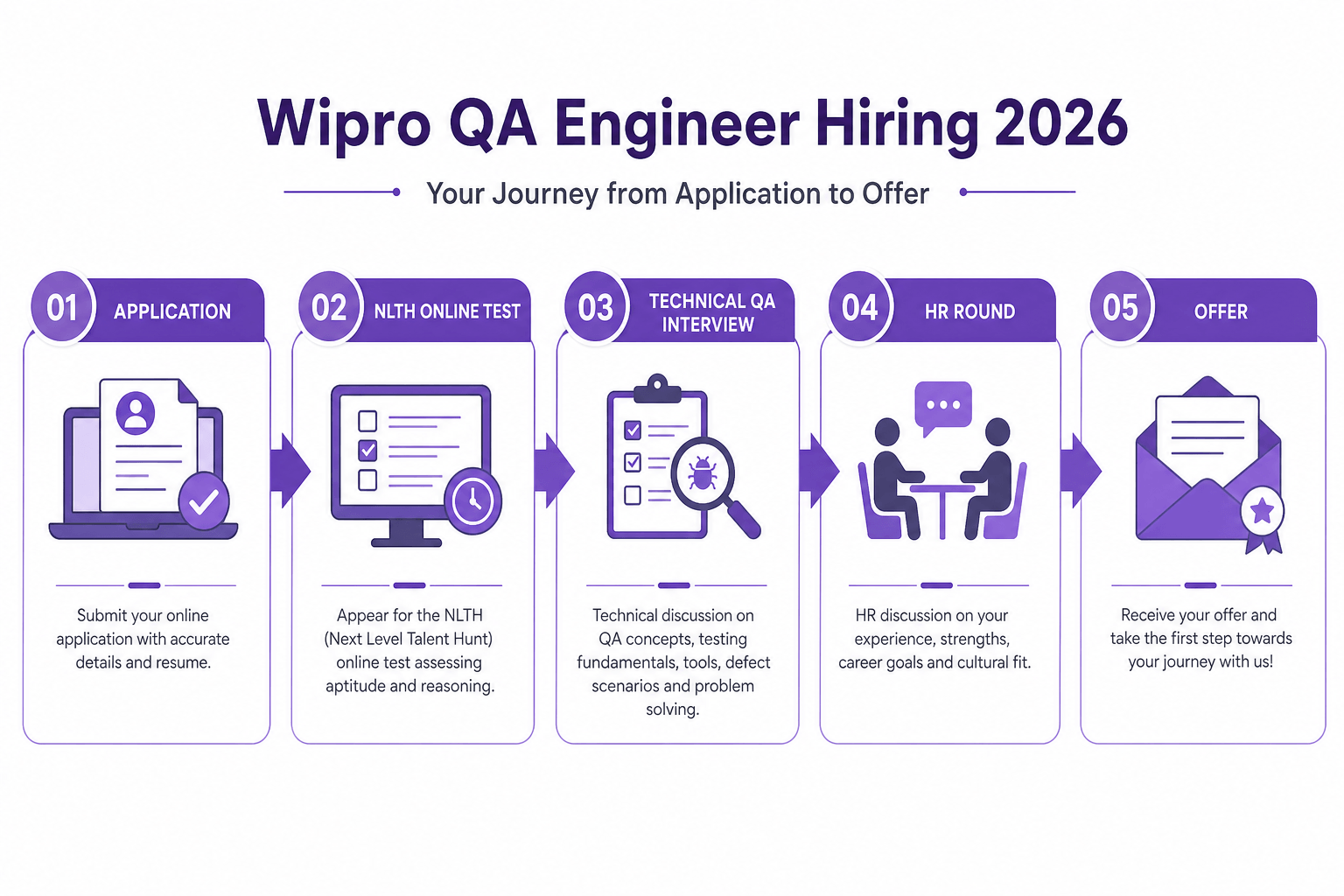
Most Wipro QA Engineer campus and off-campus drives follow NLTH online assessment, a technical QA interview covering STLC and testing fundamentals, and an HR fit round — often combined into one live session for lateral hires. Each stage filters a different signal: aptitude, testing depth, and communication.
Step 1 — Application & resume screening
Register on Wipro careers or campus portal. Recruiters scan for testing projects, internships, STLC familiarity, Selenium or API tool mentions, and CGPA. Highlight measurable QA outcomes — bugs found pre-release, test cases authored, automation coverage — not generic “good academic record” lines.
Step 2 — NLTH (National Level Talent Hunt) online test
Timed assessment covering aptitude (quant, logical, verbal) and technical MCQs (testing fundamentals, basic programming logic, SQL basics). Strong NLTH scores shortlist candidates for live QA technical panels. Treat aptitude as seriously as testing theory — weak quant eliminates strong manual testers early.
Step 3 — Technical QA interview
Live round probing STLC, manual test case design, black-box vs white-box concepts, Selenium basics, API testing approach, defect severity/priority, and testing capstone or internship project discussion. Panels expect structured answers — define, example, trade-off.
Step 4 — HR round (often combined with technical)
Communication, relocation flexibility, salary expectations, and “why Wipro QA.” Research Wipro’s global delivery model, testing COE practice, and client industries. STAR-format bug-discovery stories strengthen HR performance.
Step 5 — Offer
Selected candidates receive offer with role band and CTC (typically ₹3.5–6 LPA for fresher manual QA, higher for automation-experienced laterals), joining location, and ILP training details. Confirm fixed vs variable split before accepting.
Eligibility Criteria
Wipro QA Engineer eligibility varies by campus tier and hiring season, but the cards below reflect typical fresher and lateral expectations for QA-track shortlists in India. Strong NLTH scores and quantified project bullets can offset borderline CGPA in some drives.
Educational background
B.Tech/B.E. (CS/IT/ECE), BCA, MCA, or B.Sc. Computer Science. Wipro hires QA profiles from engineering backgrounds for campus and off-campus drives. Testing certifications (ISTQB foundation) are a plus.
CGPA cutoff
Commonly 60–65% aggregate (or 6.0+ CGPA) with no active backlogs. Strong NLTH scores or a substantive testing internship can offset borderline academics in some seasons.
Core skills
STLC phases, test case design, manual testing, basic Selenium or API testing (Postman), SQL for data validation, Git basics, and defect lifecycle. Automation depth is a plus for fresher drives but not always mandatory.
Experience level
Freshers via NLTH are the primary entry path. Lateral hires (1–3 years) face deeper automation, API, and Agile workflow questions with higher salary bands.
Freshers vs experienced
Freshers: NLTH + STLC + manual testing + one tool. Experienced: framework design, CI integration, API automation depth, and release-management scenarios. Both tracks value clear defect communication.
Interview Pattern — Round by Round
Wipro typically runs three evaluation stages for QA Engineer roles. Duration and format shift slightly between campus NLTH batches and off-campus lateral hiring, but the skill signals remain consistent.
| Round | Duration | Format | Evaluates |
|---|---|---|---|
| NLTH Online Test | 60–90 min | Aptitude + testing/technical MCQs | Speed, accuracy, testing fundamentals, and elimination before live panels. |
| Technical QA Interview | 30–45 min | STLC, test cases, Selenium/API concepts, project deep-dive | Testing theory depth, practical judgment, and whether resume claims hold under probing. |
| HR / Managerial | 15–25 min | Behavioral + fit + relocation + salary | Communication, adaptability, motivation for Wipro, and professional attitude. |
Skills Tested at Wipro
STLC and manual testing are the highest-weight skills for Wipro QA interviews, followed by defect triage and Selenium or API basics. Drill topic banks on QA Engineer interview questions and REST API interview questions alongside this guide.
STLC
HighAll phases from requirement analysis to test closure. Expect scenario questions on when each phase applies.
Manual Testing
HighTest case design, equivalence partitioning, boundary values, exploratory testing, and defect reporting.
Selenium / Automation
Medium–HighWebDriver basics, locators, explicit waits, Page Object Model awareness. Playwright mention signals modern readiness.
API Testing
MediumStatus codes, JSON schema validation, auth edge cases. Tools: Postman, REST Assured, or pytest requests.
SQL for QA
MediumData validation queries, JOINs for backend checks, and verifying DB state after test runs.
Git
Low–MediumBranching basics, pull requests, and collaborating with dev teams on test code.
Bug Triage
HighSeverity vs priority, reproducible steps, environment details, and escalation judgment.
Agile / Scrum
MediumSprint ceremonies, definition of done, and QA role in continuous delivery.
Performance basics
LowLoad vs stress testing concepts — rarely deep at fresher level but good differentiator.
Communication
HighWriting clear bug reports and explaining risk to non-technical stakeholders.
Latest 2026 Hiring Trends
Wipro QA Engineer interviews in 2026 emphasize NLTH aptitude, API-first testing, Playwright awareness, and combined technical plus HR evaluation in single sessions — more than deep performance-engineering theory.
NLTH aptitude weight increased
Campus QA shortlists still route through NLTH. Aptitude plus testing MCQ accuracy matters as much as interview charisma — prepare timed mocks weekly.
API-first testing emphasis
Wipro client projects increasingly probe REST API validation alongside UI testing. Mention Postman collections and status-code matrices in answers.
Playwright awareness rising
While Selenium remains common in legacy suites, panels appreciate candidates who know Playwright auto-waiting and modern browser automation trade-offs.
Combined technical + HR rounds
Many drives compress QA technical and HR into one session. Prepare STAR bug stories and STLC answers in the same mock — stamina matters.
Question Categories
The curated question bank below spans manual testing, STLC, Selenium, API testing, behavioral, situational, and HR categories — matching what Wipro panels probe most frequently in 2026 QA hiring.
Manual / STLC
3 questions
Functional vs non-functional, STLC phases, test case attributes
Automation
3 questions
Selenium, regression, manual vs automation ROI
API
1 question
REST validation, tools, edge cases
Testing theory
2 questions
Black-box vs white-box, TDD vs BDD
Behavioral
1 question
Critical bug STAR story
Situational
1 question
Pre-release production bug
HR
1 question
Why Wipro QA
Project
2 questions
Testing capstone, NLTH prep
Wipro Quality Engineering — Company Insights
Understanding Wipro's testing practice helps you answer HR questions credibly and frame project experience in client-delivery language. Research the Wipro interview questions hub for company-wide context beyond the QA track.
Testing practice & delivery
Wipro’s quality engineering practice spans manual, automation, and performance testing for BFSI, healthcare, retail, and telecom clients. QA engineers often work in blended onshore-offshore teams with defined SLAs.
Types of projects
Typical engagements: regression automation for enterprise apps, API test suites, UAT support, defect triage for production releases, and migration testing (cloud, ERP). Fresher projects start with supervised manual cycles.
Tech stack
Selenium/Java or Python, TestNG or pytest, Postman, Jira, SQL Server or Oracle for validation, Jenkins for CI hooks. Client stacks vary — adaptability matters more than one-tool loyalty.
Work culture
Service-delivery model with sprint deadlines, documentation standards, and client reporting. Relocation flexibility and shift readiness are frequently tested in HR.
Career progression
QA Engineer → Senior QA → Test Lead → QA Manager / Automation Architect. Upskilling in API automation and CI/CD accelerates promotion in Wipro testing COEs.
Wipro QA Engineer Salary in India (2026)
Wipro QA Engineer salaries vary by experience band, city, and client account. Use these approximate ranges as interview context — not guarantees. Fresher NLTH offers typically sit in the ₹3.5–6 LPA band; lateral hires with proven Selenium or API automation experience command higher packages.
Fresher / campus
₹3.5–6 LPA
NLTH campus offers for manual QA tracks. Automation project evidence can push toward upper band.
1–3 years
₹5–9 LPA
Independent test module ownership, Selenium/API automation, and client-facing defect communication expected.
Senior QA (3–5 years)
₹8–14 LPA
Leads test planning, mentors juniors, owns release sign-off for modules.
Lead / Automation Architect
₹12–16+ LPA
Framework design, CI integration, and cross-team quality strategy. Varies by account and city.
Wipro QA Engineer Interview Questions
Expanded expert answers · Reviewed 2026-06-23- 01
What is the difference between functional and non-functional testing?
TechnicalEasyView expert answer & prep guide
Suggested answer time: 2 min
Why interviewers ask this: Foundational QA literacy — Wipro panels use this to filter candidates who memorized tool names without understanding test types.
Expert answer: Functional testing verifies what the system does — e.g. login accepts valid credentials. Non-functional testing verifies how well — performance under 10k users, security against SQL injection, accessibility compliance. Both are mandatory in Wipro client delivery; neither replaces the other.
What interviewers evaluate: Whether you distinguish what the system does from how well it performs under load, security, or usability constraints.
Answer strategy: Define both, give one example each (login validation vs load test), note both are required in enterprise projects.
Common mistakes: Listing only functional examples, or treating non-functional as optional nice-to-have.
Follow-up questions:
- Give a non-functional test for an e-commerce checkout
- When would you run performance tests?
- 02
What is the Software Testing Life Cycle (STLC)? List and explain each phase.
TechnicalEasyView expert answer & prep guide
Suggested answer time: 3 min
Why interviewers ask this: STLC opens most Wipro QA technical rounds — panels expect phase-by-phase clarity with real examples, not a memorized bullet list.
Expert answer: STLC phases: Requirement Analysis (understand scope and testability), Test Planning (strategy, resources, schedule, entry/exit criteria), Test Case Design (scripts, data, traceability), Environment Setup, Test Execution (run cases, log defects), Test Closure (metrics, sign-off, lessons learned). QA involvement starts at requirements — defects found late cost far more to fix.
What interviewers evaluate: Testing process maturity, phase ownership, and whether you connect STLC to release risk.
Answer strategy: Walk phases in order, name QA deliverables per phase, and cite one project example for planning or closure.
Common mistakes: Skipping requirement analysis, conflating STLC with SDLC, or listing phases without deliverables.
Follow-up questions:
- What are entry and exit criteria for test execution?
- How do you handle scope creep in test planning?
- 03
What is the difference between black-box and white-box testing?
TechnicalEasyView expert answer & prep guide
Suggested answer time: 2 min
Why interviewers ask this: Tests whether you understand test design approaches used across manual and automation work at Wipro.
Expert answer: Black-box: no internal code knowledge — test against requirements (functional, UAT, exploratory). White-box: tester knows code structure — unit tests, branch coverage, path testing. Grey-box blends both (e.g. API testing with schema knowledge).
What interviewers evaluate: Knowledge vs code visibility and appropriate technique selection.
Answer strategy: Define by internal code knowledge, map to functional/UAT (black-box) and unit/coverage (white-box).
Common mistakes: Confusing black-box with “no documentation” or saying white-box is only for developers.
Follow-up questions:
- What is grey-box testing?
- Which approach for API validation?
- 04
What is regression testing and when is it run?
TechnicalEasyView expert answer & prep guide
Suggested answer time: 2 min
Why interviewers ask this: Regression discipline is daily work in Wipro maintenance projects — panels test release-readiness thinking.
Expert answer: Regression testing re-runs existing test cases after code changes to ensure previously working functionality still works. Run after every significant change, especially before releases. Automated regression suites (Selenium, CI-triggered) make this practical at Wipro client scale.
What interviewers evaluate: Understanding of re-test scope after code changes and automation fit.
Answer strategy: Define regression, state triggers (every build, pre-release), mention automated regression suites at scale.
Common mistakes: Only testing new features after a change, or unable to explain smoke vs full regression.
Follow-up questions:
- Smoke vs regression — difference?
- How do you select regression test cases?
- 05
What is Selenium WebDriver? What are its key limitations?
TechnicalMediumView expert answer & prep guide
Suggested answer time: 3 min
Why interviewers ask this: Selenium is the default automation stack in many Wipro client accounts — panels probe practical depth beyond tool name-dropping.
Expert answer: Selenium WebDriver drives browsers via the W3C WebDriver protocol — simulating real user interactions. Limitations: timing flakiness (mitigate with explicit waits, never Thread.sleep), no built-in test runner or reporting, slower than API or component tests, and maintenance overhead on dynamic UIs. Playwright improves auto-waiting and debugging but Selenium remains common in Wipro legacy suites.
What interviewers evaluate: Automation fundamentals, flakiness awareness, and tool trade-off judgment.
Answer strategy: Define WebDriver first, list 2–3 limitations with fixes, mention explicit waits and when you would choose Playwright.
Common mistakes: Claiming Selenium has no limitations, recommending Thread.sleep, or unable to name locator strategies.
Follow-up questions:
- Explicit vs implicit waits?
- How would you structure a Page Object Model?
- 06
What is the difference between TDD and BDD?
TechnicalMediumView expert answer & prep guide
Suggested answer time: 2 min
Why interviewers ask this: Agile Wipro projects often use BDD collaboration — panels check if you understand process vs coding practice.
Expert answer: TDD: developers write failing unit tests before implementation (red-green-refactor). BDD: define behaviour in Given-When-Then language (Gherkin) so business and QA share scenarios — often with Cucumber. TDD is a coding discipline; BDD is a collaboration process spanning roles.
What interviewers evaluate: Distinction between developer TDD cycle and business-readable BDD scenarios.
Answer strategy: TDD = red-green-refactor unit tests first. BDD = Given-When-Then Gherkin for cross-team alignment. Different audiences.
Common mistakes: Using TDD and BDD interchangeably, or unable to give a Gherkin example.
Follow-up questions:
- Write a Given-When-Then for login
- Does Wipro use Cucumber on your projects?
- 07
How do you test a REST API? What aspects do you check and what tools do you use?
TechnicalMediumView expert answer & prep guide
Suggested answer time: 3–4 min
Why interviewers ask this: Wipro client projects increasingly pair UI and API validation — API depth differentiates fresher QA candidates.
Expert answer: I validate status codes (200, 201, 400, 401, 403, 404, 500), response schema and required fields, boundary and negative payloads, auth headers and token expiry, idempotency for PUT/DELETE, and performance under expected load. Tools: Postman for exploration and collections, REST Assured or pytest for automated suites, and optional contract tests. I log defects with request/response snippets for reproducibility.
What interviewers evaluate: API test design, status-code literacy, negative-case thinking, and tool familiarity.
Answer strategy: Structure answer as aspects checked → tools → one concrete defect example from a Postman collection.
Common mistakes: Only checking happy-path 200 responses, ignoring auth errors, or naming tools without test scenarios.
Follow-up questions:
- How do you test pagination APIs?
- What is contract testing vs integration testing?
- 08
Tell me about the most critical bug you found. How did you find it and what was its impact?
BehavioralMediumView expert answer & prep guide
Suggested answer time: 3 min
Why interviewers ask this: Validates real testing experience and impact awareness — Wipro panels probe resume claims with STAR follow-ups.
Expert answer: Example: “During exploratory testing of a payment module, I found duplicate charge on double-click submit. I reproduced with steps, logged severity-high defect, and blocked release. Fix prevented erroneous charges for ~8,000 daily transactions.” Adapt with your real project and honest metrics.
What interviewers evaluate: Discovery method, impact quantification, and structured storytelling.
Answer strategy: STAR format: Situation, Task, Action (exploratory test, edge case), Result (users/revenue protected).
Common mistakes: Vague “found a critical bug” without steps, severity, or business impact.
Follow-up questions:
- How did you convince the team to delay release?
- What would you improve in test coverage?
- 09
You find a production-impacting bug 1 hour before a scheduled release. What do you do?
SituationalHardView expert answer & prep guide
Suggested answer time: 3 min
Why interviewers ask this: Tests release judgment under pressure — common scenario in Wipro client delivery timelines.
Expert answer: Immediately notify the release manager and test lead with clear repro steps, severity, and affected scope. Assess if a workaround exists. Do not attempt an unauthorized hotfix in one hour. The team decides: delay release, ship with known limitation, or emergency patch. Your job is evidence and risk communication.
What interviewers evaluate: Escalation discipline, documentation quality, and team-first thinking.
Answer strategy: Escalate immediately, document repro steps, assess severity/workaround, let release manager decide — do not silently fix or hide.
Common mistakes: Trying to fix alone, downplaying severity to avoid delay, or poor documentation under time pressure.
Follow-up questions:
- What if no workaround exists?
- How do you write a release blocker email?
- 10
What makes a good test case? List the essential attributes.
TechnicalEasyView expert answer & prep guide
Suggested answer time: 2 min
Why interviewers ask this: Test case quality is daily deliverable work — Wipro manual QA roles test documentation discipline.
Expert answer: Essential attributes: unique ID, clear title, preconditions, step-by-step actions, expected result, actual result field, priority/severity, traceability to requirement. A good test case is unambiguous, repeatable, atomic (one behaviour), and maintainable when requirements change.
What interviewers evaluate: Completeness, traceability, and atomicity of test design.
Answer strategy: List ID, title, preconditions, steps, expected result, priority. Add: unambiguous, repeatable, traceable, atomic.
Common mistakes: Vague expected results like “should work”, or combined multiple behaviours in one case.
Follow-up questions:
- Write a test case for password reset
- How do you trace tests to requirements?
- 11
How do you prioritise which bugs to test and report first?
TechnicalMediumView expert answer & prep guide
Suggested answer time: 2 min
Why interviewers ask this: Triage judgment matters in fast-paced Wipro sprints with limited regression windows.
Expert answer: Prioritise by severity (data corruption and crashes first) multiplied by how many users or flows are affected. Align with product manager on release-critical paths. A cosmetic bug on the homepage may outrank a rare edge case if launch is imminent — context matters alongside severity tables.
What interviewers evaluate: Severity × frequency × business risk reasoning.
Answer strategy: Severity (data loss > crash > functional > cosmetic) × user frequency. Align with PM on release goals.
Common mistakes: Reporting all bugs as high priority, or ignoring business context.
Follow-up questions:
- Severity vs priority — example?
- How do you handle duplicate bugs?
- 12
When do you choose manual testing over automation? Give two concrete examples.
HREasyView expert answer & prep guide
Suggested answer time: 2 min
Why interviewers ask this: Wipro fresher QA roles are manual-heavy initially — panels reject “automation only” mindsets.
Expert answer: Choose manual for exploratory testing (unknown defect hunting) and short-lived features where automation ROI is negative. Choose automation for regression suites, smoke tests on every build, and data-driven scenarios with stable UI. Example: usability review of a new checkout flow = manual; nightly regression of 200 login cases = automated.
What interviewers evaluate: ROI thinking and appropriate technique selection.
Answer strategy: Manual: exploratory, usability, one-off features. Automation: regression, smoke, data-driven repeats. Give two examples each.
Common mistakes: Saying manual is obsolete, or automating everything including exploratory work.
Follow-up questions:
- When is automation ROI negative?
- How do you decide what to automate first?
- 13
Walk me through your testing capstone or internship project. What was your role?
BehavioralMediumView expert answer & prep guide
Suggested answer time: 4 min
Why interviewers ask this: Wipro panels verify project ownership — tutorial-following without personal contribution fails under probing.
Expert answer: Structure: “The app was X. I owned test case design for module Y using boundary analysis, executed 45 cases, logged 12 defects (2 severity-high), and built a 20-case Selenium smoke suite. Release demo passed with zero critical open bugs.” Prepare follow-ups on your specific modules.
What interviewers evaluate: Test strategy ownership, tools used, defects found, and measurable outcomes.
Answer strategy: Scope → your specific tasks → test types used → defects found → outcome. Be honest about team vs solo work.
Common mistakes: Cannot explain test approach, or claiming full project credit for team work.
Follow-up questions:
- Which defects would you catch earlier today?
- What would you automate if you had two more weeks?
- 14
Why do you want to join Wipro as a QA Engineer?
HREasyView expert answer & prep guide
Suggested answer time: 2 min
Why interviewers ask this: HR and combined rounds test motivation, relocation fit, and company research depth.
Expert answer: Anchor on Wipro’s multi-industry testing exposure, structured ILP training, opportunity to grow from manual to automation within global delivery teams, and your fit — e.g. capstone testing experience and willingness to relocate. Tie to a specific skill you will build in year one (API automation or CI integration).
What interviewers evaluate: Genuine interest, relocation willingness, and structured communication.
Answer strategy: Wipro testing scale + training + industry exposure + personal skill growth. Avoid generic brand praise.
Common mistakes: Generic “MNC name” answers, no mention of QA practice, or sounding unprepared for relocation.
Follow-up questions:
- Are you willing to relocate?
- What are your salary expectations?
30-Day Preparation Roadmap
Follow the four-week plan below, then run full-loop mocks on InterviewEra mock interviews. Week 4 should include combined technical + HR practice — matching Wipro's 2026 combined-round trend.
Week 1
STLC + manual testing
- Revise all STLC phases with examples
- Write 10 test cases for a sample login module
- Daily NLTH aptitude drills (quant + logical)
Week 2
Testing theory + defects
- Black-box vs white-box scenarios
- Severity vs priority triage drills
- Practice 2 NLTH-style technical MCQ mocks
Week 3
Selenium + API
- Selenium locators and explicit waits
- Postman collection for a sample REST API
- SQL validation queries for test data checks
Week 4
Mocks + HR + projects
- STAR story for critical bug found
- Why Wipro QA + relocation answer
- Full Wipro-style technical + HR mock on InterviewEra
Common Mistakes Candidates Make
These twelve mistakes eliminate otherwise strong candidates in Wipro QA loops. Review each before your NLTH attempt and technical panel — especially severity/priority confusion and weak STLC answers.
- Treating QA as “easy” and skipping NLTH aptitude prep.
- Listing STLC phases without explaining QA involvement in each.
- Claiming Selenium expertise but unable to explain explicit vs implicit waits.
- Confusing severity and priority in defect triage answers.
- Saying “automation replaces manual testing” instead of discussing ROI and scope.
- Vague bug stories without reproducible steps or business impact.
- Ignoring API testing — many Wipro projects are service-heavy.
- Unable to walk through a testing capstone or internship project under follow-ups.
- Rambling HR answers without “why Wipro” research.
- Overstating automation on resume but failing basic manual test case design.
- Not knowing when to escalate a pre-release production bug.
- Copying generic QA answers without Wipro/NLTH context.
Last-Minute Checklist
Run through this checklist 24 hours before your NLTH or live panel. Every item maps to a real elimination reason observed in Wipro QA hiring drives.
- 01NLTH registration confirmed with correct academic details
- 02Resume lists STLC, test case count, tools (Selenium/Postman), and quantified bug impact
- 03STLC phases rehearsed with one example each
- 045 manual test cases written for a sample feature
- 05Selenium locator types and explicit wait example ready
- 06Postman API test with status code assertions prepared
- 07Severity vs priority answer rehearsed with scenario
- 08STAR critical-bug story with business impact metric
- 09“Why Wipro QA” answer with testing practice research
- 10Salary range researched (₹3.5–6 LPA fresher band) with flexible framing
Recommended Resources
Wipro vs TCS vs Infosys — QA Engineer
All three service giants hire QA profiles at similar difficulty for freshers — but entry assessments and HR round structure differ. Use this table when preparing for multiple employers simultaneously.
| Dimension | Wipro | TCS | Infosys |
|---|---|---|---|
| Entry assessment | NLTH (aptitude + testing MCQs) | TCS NQT (strong aptitude) | InfyTQ + aptitude |
| Manual testing depth | High — test case design expected | High | High |
| Automation expectation | Medium — Selenium basics for fresher | Medium | Medium |
| API testing | Growing emphasis in 2026 | Varies by project | Growing |
| Typical fresher package | ₹3.5–6 LPA QA band | ₹3.3–7 LPA (track dependent) | ₹3.6–4.5 LPA SE; QA similar |
| Interview difficulty | Easy to medium | Easy to medium | Easy to medium |
Frequently Asked Questions
What does Wipro ask in QA Engineer interviews?
Wipro QA interviews typically cover NLTH online assessment (aptitude + testing MCQs), STLC and manual test case design, Selenium or automation basics, API testing concepts, defect severity/priority, behavioral bug-discovery stories, and HR fit questions. Fresher drives emphasize fundamentals over advanced framework design.
Is Selenium mandatory for Wipro QA interviews?
Not always mandatory for fresher manual QA roles, but strongly expected. Panels probe WebDriver basics, locator strategies, and explicit waits. Candidates with automation project evidence stand out — prepare at least one Selenium example even if your role is manual-heavy initially.
Is automation required for Wipro QA freshers?
Freshers are primarily evaluated on manual testing, STLC, and test case design. Basic Selenium or Postman awareness is a differentiator. Full automation framework expertise is expected only for lateral automation QA hires with 1–3 years experience.
Manual vs automation — what does Wipro expect?
Wipro expects you to know when manual testing wins (exploratory, usability, short-lived features) versus when automation wins (regression, smoke, data-driven suites). Articulate ROI — not tool preference alone.
How many rounds are in Wipro QA Engineer interviews?
Typically three: NLTH online test, technical QA interview (STLC, test cases, tools, project), and HR round — sometimes combined into one live session for off-campus lateral hires.
What is tested in NLTH for QA roles?
NLTH covers aptitude (quant, logical, verbal) and technical MCQs including testing fundamentals, basic programming logic, and sometimes SQL. Weak aptitude performance eliminates candidates before live QA panels regardless of interview skills.
What is the salary for Wipro QA Engineer freshers?
Fresher campus offers typically range ₹3.5–6 LPA for manual QA tracks. With 1–3 years automation experience, expect ₹5–9 LPA. Senior and lead automation roles reach ₹8–16+ LPA depending on city and client account.
Can freshers crack Wipro QA interviews?
Yes. NLTH is designed for mass fresher hiring. Strong aptitude, STLC clarity, test case writing practice, and a quantified testing project are the primary success factors. ISTQB foundation certification strengthens your profile.
How often does Wipro ask STLC questions?
Very frequently — almost every technical round opens with STLC phase questions or scenario-based probes on test planning and closure. Know all phases with one real example each.
What API testing tools should I mention?
Postman for manual API exploration and collections, REST Assured or pytest for automated API suites. Cover status codes (200, 401, 403, 404), JSON schema validation, and edge cases like empty payloads.
Wipro vs TCS QA — which is harder?
Similar overall difficulty for fresher QA roles. Wipro routes through NLTH; TCS uses NQT with strong aptitude weight. Both test manual testing depth — compare both processes if applying to multiple employers.
Is coding required for Wipro QA interviews?
Basic programming logic may appear in NLTH MCQs. Live coding is uncommon for manual QA freshers. Automation candidates may face simple Selenium or pseudocode snippets — focus on testing judgment first.
What testing projects should I prepare?
Prepare one capstone or internship project where you authored test cases, logged defects with clear steps, and optionally automated a regression suite. Panels probe whether you built the test strategy or only executed scripts.
Does Wipro combine technical and HR rounds?
Yes, frequently. Many drives use a single combined session covering STLC questions followed by HR fit and relocation discussion. Practice sustained communication across both.
What is the difference between bug severity and priority?
Severity measures technical impact (crash = high). Priority measures business urgency for fixing (cosmetic bug on login page before launch = high priority, low severity). Wipro panels test both with release scenario examples.
Playwright vs Selenium — what should I say?
Selenium is widely used in Wipro legacy suites with broad browser support. Playwright offers auto-waiting, faster execution, and better debugging. Mention you would pick based on project stack and team skill — not personal preference alone.
How do I prepare for Wipro QA in 30 days?
Week 1: STLC + manual test cases + aptitude. Week 2: testing theory + defect triage. Week 3: Selenium + Postman API. Week 4: STAR stories, Why Wipro, and full mocks. Follow the week-by-week roadmap in this guide.
How long does the Wipro QA offer process take?
Typically 2–6 weeks from final HR round to offer letter, depending on batch scheduling and background verification. Off-campus drives may take longer during low-hiring seasons.
Practice answering, not just reading
Reading testing theory tips is not the same as performing under panel pressure. Run a Wipro-style mock covering NLTH aptitude recall, STLC and Selenium answers, and HR follow-ups — with immediate AI feedback on structure and clarity.