operations · Fresher-friendly
Business Analyst Interview Questions India 2026
Business Analyst interview questions on requirements gathering, process modelling, SQL, and stakeholder management.
On this page
What Does a Business Analyst Do?
A Business Analyst (BA) translates business outcomes into clear, testable requirements—and then stays close to delivery so the result matches what stakeholders actually needed. In India, BA roles sit on a spectrum: some are closer to product and UX discovery, others are closer to operations and reporting. The constant is the work pattern: understand the problem, define the decision the business is trying to make, align stakeholders, and reduce ambiguity for engineering and QA.
In practical terms, your week typically includes requirement workshops, data checks (often SQL), process mapping, user story grooming, and clarifying edge cases. A strong BA is not a “note taker”—they are an owner of clarity. If a requirement is vague, a BA turns it into an unambiguous acceptance criteria. If a metric is disputed, a BA traces it back to the data definition. If stakeholders disagree, a BA surfaces the trade-off and drives a decision.
If your interviews include data checks, practice the fundamentals on SQL interview questions. For delivery roles, also review Agile interview questions and how teams work in sprints.
A real-world BA workflow example (refund approvals)
Imagine a stakeholder says: “Refunds take too long. Fix it.” A BA does not jump to UI screens. They first map the current flow: request → verification → manager approval → payment gateway → customer notification. Then they quantify the pain: median turnaround time, where the queue builds up, and how many refunds are blocked by missing information.
- Clarify outcome: “Reduce refund TAT from 48 hours to 12 hours for 90% of cases.”
- Define constraints: approvals above ₹10k require a manager; every decision needs an audit trail.
- Design acceptance criteria: statuses, error states, and what “approved” means in the payment gateway.
- Validate with data: segment delays by category—verification delays vs approval delays vs gateway failures.
- Ship in slices: Phase 1 adds status + audit + SLA tracking; Phase 2 adds automation and dashboards.
This is the level of clarity interviewers want: a workflow, measurable success, constraints, and a delivery plan. If you want to strengthen your SQL confidence for these discussions, practice on the SQL interview questions topic page.
When you want to pressure-test your communication and structure under time, do not only read answers. Practice a live round: start a free mock interview on InterviewEra.
Business Analyst Roles and Responsibilities
A simple way to describe BA responsibility is: reduce rework. Rework happens when the team builds the wrong thing, builds the right thing with the wrong rules, or ships something that cannot operate in the real business environment. Your artifacts—BRDs, flows, user stories, and metric definitions—exist to prevent those failures. Roles that sit closer to IT systems design—such as a System Analyst—share overlap here, but BAs typically own business outcome clarity rather than technical architecture.
Requirement discovery and elicitation
Run stakeholder interviews and workshops. Map the current workflow, capture pain points, and convert “requests” into decisions, constraints, and acceptance criteria.
Documentation that engineering can ship
Write BRDs/SRS/user stories that are testable: definitions, edge cases, error states, and non-functional requirements (latency, audit logs, access control).
Process modelling and gap analysis
Create as-is and to-be flows (swimlanes/BPMN). Identify bottlenecks, handoffs, and policy constraints. Recommend a feasible improvement path.
Data validation and metric alignment
Use SQL and dashboards to validate claims, define KPIs, and reconcile “the number” across teams. Align on definitions before building.
The BA artifacts interviewers trust
- User story + acceptance criteria: clear, testable, and includes edge cases.
- Decision log: what was decided, why, by whom, and when it will be revisited.
- Process flow (as-is / to-be): shows handoffs, approvals, and exception paths.
- Metric definition: one source of truth for KPI formulas and filters (prevents “dashboard arguments”).
- Traceability: requirement → story → test case (critical for payments, compliance, and enterprise work).
BA Workflow (End-to-end)
Interviewers trust candidates who can explain the full delivery loop—not just “requirements.” Use this workflow to anchor your answers when asked about stakeholder management, documentation quality, UAT, and launch impact.
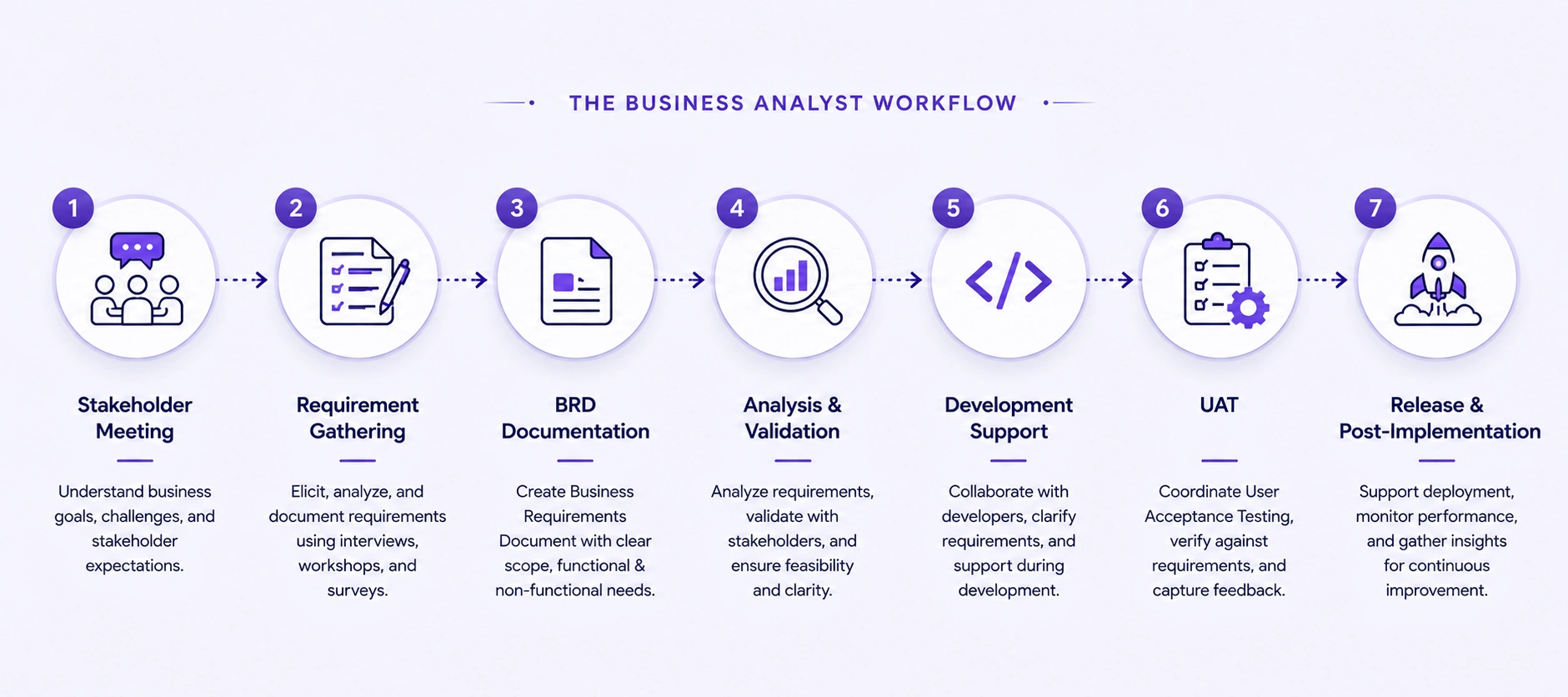
Tools commonly used across this workflow include Jira interview questions for tracking, plus Confluence/Docs for BRDs, and SQL/dashboards for validation.
Skills Required for Business Analysts in 2026
Hiring managers in 2026 are less impressed by generic “communication” claims and more impressed by a BA who can show repeatable workflows. The highest-signal skills are the ones that reduce delivery risk. Delivery-heavy teams also expect comfort with Agile interview questions around ceremonies, backlog quality, and sprint support.
Stakeholder communication (structured)
- Turn opinions into testable acceptance criteria.
- Write meeting outcomes as decisions + owners + dates.
- Handle disagreement by framing trade-offs and proposing a default.
Requirement quality (what to ship, not just what to build)
- Clear scope boundaries and non-goals.
- Edge cases: permissions, failures, retries, data validation.
- Non-functional requirements: performance, auditability, compliance.
SQL and data reasoning
- Joins, grouping, HAVING vs WHERE, window basics.
- Validate funnels and revenue drops through segmentation.
- Define metrics so dashboards don’t lie.
Process modelling and systems thinking
- Swimlanes/BPMN to expose handoffs and bottlenecks.
- As-is → to-be mapping with measurable improvement goals.
- Risk thinking: what breaks in production and how to detect it.
Business Analyst Interview Process in India
Most Indian BA interview loops are a mix of requirement reasoning, communication, and basic data skills. You might see 2–4 rounds depending on whether the role is closer to product, operations, or analytics.
One detail that differentiates strong candidates: they speak in a structured story, not a ramble. For behavioral rounds, use a clean narrative (Situation → Task → Action → Result). If you want a quick refresher with examples, read our STAR method guide.
Round 1 — Screening (HR + basics)
You will be assessed on clarity, role fit, and how you explain past work. For freshers, interviewers use your project to test requirement thinking.
Round 2 — Requirements / case study
Typical prompts: “Design a feature”, “Write user stories”, “Create acceptance criteria”, or “Map the current process and propose improvements.” You are graded on structure and edge cases.
Round 3 — Data / SQL / metrics
Expect joins and aggregation, plus reasoning about funnels, revenue drops, or operational KPIs. Even a short SQL round reveals whether you can validate assumptions independently.
Round 4 — Stakeholder and conflict scenarios
Situations like competing priorities, last-minute changes, and disagreement between business and engineering. Strong answers show alignment, written decisions, and impact analysis.
Round 1 often includes HR screening. Prepare concise, role-aligned answers with our HR interview questions guide.
What interviewers are actually grading
- Clarity: can you define the problem and success metric in one minute?
- Edge cases: permissions, failures, retries, and operational workflows.
- Trade-offs: what you would ship now vs later and why.
- Collaboration: how you align business + engineering without escalating every disagreement.
Business Analyst Tools and Software
Tools do not make someone a BA, but they reveal your delivery maturity. Interviewers like candidates who can explain why a tool was used and what artifact it produced.
A useful framing in interviews is “tool → artifact → decision.” For example: Confluence → BRD → sign-off on scope; Lucidchart → swimlane → discover the bottleneck; SQL → segmented query → prove where the drop came from. This sounds simple, but it instantly moves you from “I used Jira” to “I shipped outcomes.”
Documentation and collaboration
Confluence / Notion for specs and decisions. Google Docs for reviewable BRDs. The key is versioning: decisions should not live only in chat.
Backlog and delivery tracking
Jira / Azure DevOps for user stories, acceptance criteria, and sprint planning. A BA’s credibility improves when the backlog is clean and testable.
Process and UX modelling
Lucidchart, draw.io, Visio, or Miro for swimlanes/BPMN. Lightweight prototypes in Figma help stakeholders react to a concrete flow instead of arguing abstractly.
Analytics and SQL
SQL (Postgres/MySQL), Excel/Sheets, and dashboards like Power BI/Tableau. Know how to pull “one truth” for a metric before a review meeting.
A practical SQL habit that makes you a stronger BA
Whenever you present a metric, also know how you would validate it. Even a basic “repeat customers” query teaches the right thinking: define the entity, define the time window, filter cancelled/refunded orders, and confirm uniqueness. Interviewers trust BAs who treat numbers as definitions, not as screenshots. Drill the patterns on our SQL interview questions topic page.
Business Analyst Salary Guide India 2026
Salaries vary sharply by domain (fintech vs IT services), city, and whether the role is closer to analytics/product. Use these ranges as interviewing context, not as a guarantee.
The biggest drivers in India are (1) domain complexity, (2) decision ownership, and (3) data strength. A BA who only documents is priced lower than a BA who can influence outcomes—conversion, risk reduction, compliance, or operational throughput.
Fresher / campus
₹4–8 LPA
Common in IT services and entry roles. Strong SQL + communication can push you upward.
1–3 years
₹7–14 LPA
You are expected to own modules, lead workshops, and write high-quality acceptance criteria.
3–6 years
₹12–25+ LPA
Higher if you drive product outcomes, analytics, or domain-heavy systems (payments, risk, supply chain).
To negotiate credibly, bring evidence: impact metrics, stakeholder outcomes, and how you reduced rework. If you can quantify “what changed because of my analysis,” you negotiate from strength. Tech-adjacent BA tracks in cloud-heavy accounts may also reference Cloud Engineer interview questions when discussing platform constraints—not because you need to code, but because you need to ask the right questions about integrations and SLAs.
What to say when asked about expected salary
Anchor on role scope and market range, then connect to your strengths. For example: “For a BA role with requirement ownership, stakeholder workshops, and SQL-based validation, I’m targeting the ₹X–₹Y LPA range. I’m confident because I can independently validate metrics, write testable acceptance criteria, and reduce delivery rework.” This is stronger than quoting a number without context.
Business Analyst Career Roadmap
A good BA roadmap is not “learn everything.” It is a ladder of increasing ambiguity tolerance: from documenting known processes, to improving processes, to defining what should exist in the first place.
Stage 1 — Foundational BA (0–1 year)
Learn to write clean user stories and acceptance criteria. Practice SQL joins and aggregation. Build one project where you can show requirement artifacts (BRD + flow + user stories).
Stage 2 — Delivery owner (1–3 years)
Own a module end-to-end: discovery → requirements → sprint support → UAT → launch. Build traceability (requirements → stories → test cases). Learn to quantify impact.
Stage 3 — Domain specialist / product BA (3–6 years)
Specialize in a domain where requirements are complex (payments, risk, supply chain). You will lead stakeholder alignment and design metrics with data teams.
Stage 4 — Lead BA / Product / Program paths (6+ years)
You can move into Lead BA, Product Manager, Program Manager, or Analytics roles. Your differentiator is decision quality: can you choose trade-offs that improve outcomes?
If you want structured practice for BA interviews (including communication scoring), use the free question generator and rehearse answers out loud before interviews.
Certifications for Business Analysts
Certifications help most when they map to a real workflow you can demonstrate. Treat them as structure, not as a replacement for projects.
A good rule: if you cannot explain how the certification changed your day-to-day decisions (better requirement quality, better stakeholder alignment, better metric definitions), it will not help much in interviews. Use certifications to build a language, then prove competence through artifacts and examples.
IIBA ECBA / CCBA
Useful for formal BA foundations and terminology. Stronger when paired with a portfolio of requirement artifacts.
CBAP (experienced)
A credibility signal for senior roles. Interviewers still expect strong examples of stakeholder alignment and delivery outcomes.
Agile/Scrum certifications
Helpful if your org is Agile-heavy. More valuable when you can explain grooming, sprint support, and definition-of-done in practice.
Analytics-oriented (optional)
Power BI/Tableau or a SQL certification can strengthen analytics BA roles. Keep focus on business decision-making, not tool trivia.
If you are a fresher, prioritize a small portfolio instead: one workflow-heavy case study (process flow + user stories + acceptance criteria) and one data-heavy case study (SQL analysis + metric definition + recommendation). Those two projects often outperform certificates in interviews. For Agile-heavy teams, pair certification study with Jira interview questions so you can explain backlog hygiene in practice—not just on paper.
Business Analyst Resume Mistakes That Cause Rejection
BA resumes are rejected less for “lack of skills” and more for lack of proof. Recruiters and hiring managers look for evidence that you can clarify ambiguity, work with stakeholders, and validate decisions with data.
Generic resume summary
Weak: “Seeking a challenging role to utilize my communication and analytical skills.”
Stronger: “Business Analyst focused on requirement elicitation + SQL validation. Built a refund workflow spec that reduced turnaround time in a college project simulation.”
No measurable impact
Weak: “Improved onboarding experience.”
Stronger: “Mapped onboarding flow, identified 3 drop-off points, and proposed a change that improved completion rate from 62% → 78% in testing.”
Weak project descriptions
Weak: “Made a food delivery app.”
Stronger: “Defined user stories + acceptance criteria for coupons and refunds, wrote BRD outline, and documented UAT test cases for 12 scenarios.”
No stakeholder exposure
Weak: Only technical tasks listed, no communication artifacts.
Stronger: Mention workshops/interviews: “Conducted 6 stakeholder interviews, wrote decision log, and aligned priority with MoSCoW.”
No SQL exposure / no business metrics
Weak: “Good with Excel.”
Stronger: Include 2–3 queries or metrics: “Used SQL joins + aggregations to validate repeat users and monthly revenue; defined KPI formulas used in dashboard.”
Keyword mismatch
Weak: Resume uses generic “analysis” but not role language.
Stronger: Use role keywords: BRD, user stories, acceptance criteria, UAT, stakeholder management, SQL, Jira, Agile ceremonies.
If you’re applying to multiple tracks, tailor your language by role. Compare the expectations for Software Engineer interview questions and Cloud Engineer interview questions.
Real Business Analyst Project Example (Food Delivery Platform)
Use this case study structure in interviews when asked “describe your project” or “how do you gather requirements?” The goal is to demonstrate BA thinking: define success, capture constraints, write testable requirements, and support delivery through UAT.
Business problem
A food delivery platform saw a spike in cancellations and support tickets. Customers complained that refunds were inconsistent and slow. The business goal: reduce refund turnaround time and improve trust (measured via fewer tickets and higher reorder rate).
Stakeholder requests (what they asked for)
- Support team: refund status visibility (no more “where is my refund?” calls).
- Finance: audit trail and approval for refunds above a threshold.
- Ops: clear exception handling (address issues, partial delivery, late delivery).
- Product: faster experience with minimal extra steps for customers.
Requirements gathering (how the BA worked)
The BA ran a workshop to map the as-is flow (swimlane) and collected the top cancellation reasons. Then they validated the claim with SQL: segment cancellations by reason, region, and restaurant category to find the biggest drivers. (This is why SQL appears in BA interviews.)
BRD preparation + user stories (what got written)
- BRD scope: refund states, SLA tracking, approvals, audit logs, and customer notifications (out-of-scope: new payment provider).
- User story example: “As a customer, I can see refund status with ETA so I don’t contact support.”
- Acceptance criteria: state transitions, retry-safe updates, and clear messages for failures.
UAT + outcome (how success was measured)
The BA prepared UAT test cases for 12 scenarios (partial refund, cancellation after pickup, payment failure, approval required). After release, the team tracked refund TAT, ticket volume, and reorder rate. The result: fewer “refund status” tickets and faster resolution for high-volume cases.
You can use the same structure to answer situational questions like “revenue dropped” or “stakeholder rejects your report.” Practice articulating it clearly with a free mock interview.
Business Analyst vs Data Analyst vs Product Manager
| Dimension | Business Analyst | Data Analyst | Product Manager |
|---|---|---|---|
| Responsibilities | Requirements + delivery clarity | Insights + reporting + metrics | Strategy + prioritization + outcomes |
| Tools | Jira, Confluence, SQL, flows | SQL, Python, BI tools | Roadmaps, analytics, stakeholder docs |
| Salary (India) | ₹4–25+ LPA (by scope) | ₹5–28+ LPA (by analytics depth) | ₹10–40+ LPA (by product scope) |
| Career growth | Lead BA / PM / Program | Analytics lead / DS track | Senior PM / Group PM |
| Technical skills | SQL + systems thinking | SQL + statistics + tooling | Metrics + decision frameworks |
| Stakeholder interaction | High (requirements + alignment) | Medium (insights + recommendations) | Very high (trade-offs + leadership) |
Explore each role’s question patterns: Data Analyst, Product Manager, System Analyst.
30-60-90 Day Business Analyst Preparation Roadmap
This plan is designed for placement and early-career hiring. The goal is to build repeatable BA artifacts and the ability to explain them clearly under interview pressure.
Month 1 (0–30 days)
- Learn user stories + acceptance criteria (write 20).
- Practice core SQL: joins, group by, HAVING (daily).
- Build one process flow (as-is → to-be) for a real workflow.
- Document decisions (scope, non-goals, constraints).
Month 2 (31–60 days)
- Write a BRD outline for your project and get feedback.
- Create a UAT plan: scenarios, data, expected results.
- Rehearse 8 stakeholder scenarios (conflict, priorities, change requests).
- Use Jira concepts: epics, stories, workflow states.
Month 3 (61–90 days)
- Run mock interviews: 10 full sessions with review.
- Prepare company-specific patterns (service vs product).
- Quantify outcomes: KPIs, SLA improvements, conversion changes.
- Polish resume with artifacts + measurable impact lines.
For focused practice, use the free question generator and review related banks like Software Engineer interview questions.
Common Mistakes During BA Interviews
Answering with buzzwords instead of artifacts
Interviewers want to hear what you produced: BRD sections, user story format, acceptance criteria, traceability, and how you handled edge cases.
Skipping metric definitions
If you say “revenue dropped,” immediately explain what revenue means (gross vs net), what timeframe, and how you validated it. This is where SQL thinking shines.
Ignoring non-functional requirements
BA hires fail when they forget audit logs, permissions, latency, and operational workflows. Mention them proactively when describing requirements.
Not showing stakeholder alignment
A BA’s job is to convert disagreement into decisions. Explain how you handle conflict, document outcomes, and escalate with impact analysis.
Business Analyst Interview Process by Company
Large Indian employers follow recognizable BA interview patterns, but each company weights skills differently. Use these company-specific overviews to predict round types and prepare the right artifacts before you walk in.
TCS Business Analyst Interview ProcessEasy–Medium
Hiring overview
Tata Consultancy Services hires BAs primarily for client delivery and internal transformation projects. Campus and lateral tracks both emphasize communication clarity, domain curiosity, and whether you can translate vague business asks into structured requirements without waiting for a senior to rewrite your notes.
Typical interview rounds
Online aptitude → HR screening → technical/managerial (requirements + SQL basics) → optional client round
Difficulty level
Easy–Medium
Common business analyst questions
- Walk me through how you gathered requirements in your last project.
- Write user stories for an employee leave approval workflow.
- Explain the difference between BRD and FRD with an example.
- A stakeholder wants a report “by tomorrow”—how do you respond?
Skills frequently evaluated
- Structured communication and BRD/user story quality
- Basic SQL (joins, GROUP BY, filtering)
- Domain understanding for banking, retail, or insurance (varies by account)
- Stakeholder alignment and escalation judgment
Preparation tips
Prepare one end-to-end campus or internship story with artifacts (flow diagram, sample user stories). Practice 6–8 SQL queries and rehearse HR answers using the STAR format. Review TCS-specific process terms: change request, impact analysis, and sign-off checkpoints.
Infosys Business Analyst Interview ProcessEasy–Medium
Hiring overview
Infosys BA hiring spans digital transformation, ERP rollouts, and analytics-led engagements. Interviewers look for process discipline—can you map as-is workflows, identify gaps, and propose a to-be state that engineering can estimate? Freshers are often tested on documentation rigor more than deep SQL.
Typical interview rounds
Resume shortlist → online assessment (varies) → technical interview → HR/managerial → offer
Difficulty level
Easy–Medium
Common business analyst questions
- Draw an as-is/to-be process for invoice reconciliation.
- How do you handle conflicting requirements from two business owners?
- What goes into a change request when scope shifts mid-sprint?
- Define a KPI for customer onboarding and how you would validate it.
Skills frequently evaluated
- Process modelling (swimlanes, BPMN basics)
- Change management and impact analysis
- Requirement traceability and version control
- Analytical thinking without over-engineering solutions
Preparation tips
Build a process map for a familiar workflow (college fest registration, inventory tracking). Practice explaining change requests with scope, timeline, and risk columns. Read Infosys case patterns around ERP and digital programs so your examples feel domain-aware.
Accenture Business Analyst Interview ProcessMedium
Hiring overview
Accenture BA roles often mirror client-facing consulting: workshop facilitation, workshop outputs, and UAT ownership matter as much as writing specs. Expect scenario questions that simulate client calls—ambiguous priorities, tight deadlines, and the need to document decisions so offshore teams can execute.
Typical interview rounds
Recruiter screen → case/requirements round → functional + behavioral → senior stakeholder or client simulation → HR
Difficulty level
Medium
Common business analyst questions
- Facilitate a requirements workshop for a loyalty program redesign—what is your agenda?
- A client rejects your BRD section on reporting—how do you resolve it?
- Write acceptance criteria for a multi-step KYC verification flow.
- How do you plan UAT when the client has limited availability?
Skills frequently evaluated
- Client-style communication and workshop leadership
- Acceptance criteria depth (happy path + exceptions)
- UAT planning and defect triage coordination
- Prioritization under competing stakeholder demands
Preparation tips
Rehearse a 10-minute workshop outline: objectives, attendees, activities, outputs. Prepare a UAT checklist for a payment or onboarding feature. Practice answering “why this trade-off” with a documented decision log example—not just verbal agreement.
Cognizant Business Analyst Interview ProcessMedium
Hiring overview
Cognizant frequently blends BA work with operations and analytics—especially in BFSI, healthcare, and retail accounts. Interview loops test whether you can investigate metric anomalies, coordinate across QA and dev during delivery, and keep requirements stable when production defects surface late.
Typical interview rounds
HR phone screen → technical (requirements + SQL/metrics) → managerial → optional client/domain round
Difficulty level
Medium
Common business analyst questions
- Revenue dropped 12% last month—walk through your analysis approach.
- How do you triage a production defect that contradicts signed-off requirements?
- Segment users for a churn analysis—what dimensions would you check first?
- Describe coordinating a release when QA finds blocking issues two days before go-live.
Skills frequently evaluated
- SQL-driven investigation and metric segmentation
- Cross-team coordination (dev, QA, ops)
- Defect root-cause thinking tied back to requirements
- Operational workflow awareness (retries, SLAs, audit trails)
Preparation tips
Practice a “metric drop” case: hypothesis → SQL segments → recommendation. Prepare a change-management story where you updated requirements after a production incident. Emphasize collaboration artifacts—bug tickets linked to acceptance criteria gaps.
Capgemini Business Analyst Interview ProcessEasy–Medium
Hiring overview
Capgemini BA hiring emphasizes agile delivery fluency alongside classical requirement skills. Teams expect familiarity with backlog grooming, sprint ceremonies, and Jira workflows. Fresher-friendly panels often combine a lightweight case study with questions about how you would support developers during an active sprint.
Typical interview rounds
Application review → online/HR screen → technical + agile scenario → managerial → offer
Difficulty level
Easy–Medium
Common business analyst questions
- Convert a refund process flow into epics and user stories with acceptance criteria.
- Explain your role during sprint planning and backlog refinement.
- A developer says a story is unclear—what do you do in the next 30 minutes?
- Which non-functional requirements would you add for an admin dashboard?
Skills frequently evaluated
- Agile ceremony participation and backlog quality
- Jira/workflow literacy (states, transitions, linking)
- Requirement elicitation from single-process flows
- Collaboration with developers during active sprints
Preparation tips
Build 10–12 user stories from one end-to-end process (e.g., expense reimbursement). Review Scrum roles and definition of done. Practice explaining how you use Jira to maintain traceability from story to test case—interviewers notice delivery hygiene quickly.
For adjacent role patterns, compare System Analyst interview questions when your target role sits closer to IT systems design than pure business discovery.
Business Analyst Interview Questions (With Expert Answers)
Use these questions to practice structured answers. For extra practice on adjacent tracks, see Product Manager, Data Analyst, and Software Engineer.
Business Analysts Interview Questions
Placement-oriented · Updated 2026- 01
What is a Business Requirements Document (BRD)? What does it contain?
TechnicalEasyTip: A BRD is the business-facing definition of “what success looks like” for a change. It captures the problem, the outcome, and the boundaries—without committing to implementation details. A strong BRD includes: context and pain points (what is broken today), measurable business objectives (e.g., “reduce TAT from 48h to 12h”), in-scope and out-of-scope items, stakeholders and decision owners, functional requirements written as capabilities, non-functional requirements (latency, audit logs, access control, compliance), assumptions and constraints, dependencies, and success metrics. In interviews, show you can turn vague asks into testable acceptance: “Users should get faster approvals” becomes “95% of approvals within 12 hours, with an audit trail for every decision.”
- 02
What is the difference between functional and non-functional requirements?
TechnicalEasyTip: Functional requirements define what the system must do: user actions, business rules, workflows, and outputs (e.g., “finance user can export GST report by month”). Non-functional requirements define how well it must do it and under what constraints: performance (p95 < 2s), scalability (10k concurrent users), reliability (99.9% uptime), security (RBAC, encryption), observability (logs/alerts), and compliance. The BA failure mode is shipping “features” that break in the real operating environment. A practical example: “Generate monthly report” is functional; “export must complete in < 30 seconds for 1M rows, with a retry-safe job id and audit logs” is non-functional.
- 03
How do you elicit requirements from a stakeholder who is not sure what they want?
TechnicalMediumTip: Start with the workflow, not the feature. Ask them to walk you through the current process step-by-step (who does what, using which tool, where it breaks). Then anchor on outcomes: “What decision are we trying to make faster or safer?” Use probing questions to expose constraints: approvals, policy rules, exceptions, and handoffs. When they are unsure, use concrete artifacts: a rough prototype or a process diagram and ask for reactions (“At this step, what can go wrong?”). Use 5 Whys to separate symptom from root cause. Close by writing acceptance criteria in their language and confirming: “So success is: approvals within 12 hours, manager override allowed with reason, and every state change logged. Correct?” That confirmation is the requirement.
- 04
Write a SQL query to find all customers who placed more than 5 orders.
TechnicalMediumTip: Use aggregation to count orders per customer, then filter with HAVING (because the filter depends on an aggregate). Example: `SELECT customer_id, COUNT(*) AS order_count FROM orders GROUP BY customer_id HAVING COUNT(*) > 5;`. In interviews, add the two BA signals: (1) state assumptions (“orders has one row per order; cancelled orders excluded via status”), and (2) explain correctness (“WHERE filters rows before grouping; HAVING filters groups after aggregation”). If cancellations matter: `WHERE status != 'cancelled'` before the GROUP BY. This is exactly how you validate business claims like “repeat buyers fell this month.”
- 05
What is gap analysis? How do you apply it in a BA context?
TechnicalMediumTip: Gap analysis is the structured comparison between the current state (as-is) and the target state (to-be), followed by an actionable plan to close the gaps. In BA work: document the current workflow (swimlanes, pain points, cycle time), define the target outcome and constraints (speed, accuracy, compliance), identify the gaps (missing data, manual handoffs, unclear ownership, tooling limits), then prioritize fixes based on impact and feasibility. Example: if onboarding takes 5 days because KYC is manual, the gap may be “no automated document validation + no SLA tracking.” Your deliverable is not the diagram—it is a recommended initiative list with owners, dependencies, and success metrics.
- 06
What is a use case diagram? When do you use it over a user story?
TechnicalMediumTip: A use case diagram is a high-level UML view of system scope: actors (user types or external systems), the system boundary, and the major use cases (capabilities). Use it when you need to align stakeholders on scope and roles early—especially when multiple actors interact with the same system (customer, agent, manager, audit team). User stories are the delivery unit: small, sprint-ready, and tied to acceptance criteria. In interviews, say it plainly: “Use case diagrams reduce scope confusion; user stories reduce build ambiguity.” Often you start with a use case diagram, then break it into stories for delivery.
- 07
Tell me about a project where requirements changed significantly mid-development. How did you manage it?
BehavioralMediumTip: Show that you can handle change without chaos. First, capture the change as a clear statement (“Add approval step for refunds above ₹10k with audit trail”). Then run an impact analysis: scope (new screens/states), timeline (extra sprint?), cost, dependencies, and risks (data migration, permissions). Present options: ship current scope first vs include now; explain trade-offs. Get stakeholder sign-off in writing, update the BRD/user stories/acceptance criteria, and align QA on new test cases. A strong BA answer includes the “why”: “We changed because compliance required it; we preserved delivery by slicing an MVP and deferring reporting to Phase 2.”
- 08
How do you identify the root cause of a 30% drop in monthly revenue?
SituationalHardTip: Start with decomposition, not guesses. Break revenue into drivers: traffic/volume × conversion × price × retention (or ARPU). Segment quickly: which product line, geography, customer cohort, or channel is responsible for most of the drop? Then validate with data (SQL or dashboards): did orders fall, did AOV fall, or did refunds rise? Correlate with internal events (release, pricing change, payment gateway issue) and external events (seasonality, competitor discount). A BA-quality answer ends with an action: “We isolated the drop to Android checkout conversion after release X; error rate spiked on UPI. Roll back + add monitoring + write a postmortem.”
- 09
A key stakeholder rejects your analysis report two days before a project deadline. What do you do?
SituationalMediumTip: Do not defend—diagnose. Ask for the specific rejection reason: data accuracy, methodology, missing context, or an uncomfortable implication. If it is data: re-check definitions, joins, filters, and time windows; share a reproducible query or source. If it is methodology: explain assumptions and show sensitivity (“If we exclude refunds, the trend changes by X”). If it is interpretation: separate facts from recommendations and propose a decision path. Time-box the fix: “I can resolve the accuracy issue in 2 hours; otherwise we ship with the earlier baseline and document the risk.” Escalate with options, not drama.
- 10
What is a process flow diagram and how do you create one?
TechnicalEasyTip: A process flow diagram visualizes the sequence of steps, decision points, and ownership in a workflow. Swimlanes make responsibility explicit (Customer vs Ops vs System). Create one by: defining the start and end event, listing the steps in order, adding decision diamonds for branches (“KYC passed?”), annotating inputs/outputs, and marking handoffs (where delays and errors often occur). In BA interviews, mention how you use it: you map as-is to find bottlenecks, propose a to-be, and then derive user stories and acceptance criteria from each step and exception.
- 11
How do you manage competing priorities from multiple stakeholders?
BehavioralMediumTip: Make priorities explicit, comparable, and documented. First, clarify each stakeholder’s goal and metric (cost, speed, compliance, growth). Then translate requests into impact: user value, risk, effort, and dependency. Use a simple prioritization model (impact vs effort, or MoSCoW) and validate in a joint meeting so trade-offs are visible to all, not negotiated privately. If conflict remains, escalate with a recommendation and rationale (“Compliance requirement blocks release; we must ship audit logs first”). Close the loop by writing the decision, owner, and review date—this prevents priority drift.
- 12
What tools do you use for requirements documentation and process modelling?
HREasyTip: Name tools in context of artifacts. For documentation: Confluence/Notion/Google Docs for BRDs, decision logs, and meeting outcomes (with version history). For backlog: Jira/Azure DevOps for stories, acceptance criteria, and sprint support. For modelling: Lucidchart/draw.io/Visio/Miro for swimlanes and BPMN. For traceability: Excel/Sheets for a requirement-to-test-case matrix when stakes are high (compliance, payments). For analytics: SQL + dashboards (Power BI/Tableau) to validate assumptions. Interviewers are listening for your workflow: “I capture decisions, I turn them into stories, I model the process, and I validate metrics.”
Frequently Asked Questions
How many interview questions should a Business Analyst prepare?
Aim for 40–60 core questions across requirements, process modelling, SQL, stakeholder management, and product thinking. What matters is not memorizing—practice explaining your approach and trade-offs using one real project end-to-end.
Do Business Analyst interviews in India require SQL?
For analytics-heavy BA roles, yes. You are usually tested on joins, grouping, filtering, and basic window functions. Even when SQL is not the primary skill, it signals you can validate metrics and investigate issues without waiting for an analyst.
What is the fastest way to improve requirement gathering skills?
Stop asking for “features” and start eliciting decisions: user goal, success metric, constraints, and edge cases. Use a structured script: context → current workflow → pain points → desired outcome → acceptance criteria → non-functional requirements.
How do I answer “Tell me about yourself” as a BA fresher?
Use a BA-specific narrative: your domain interest, one project where you gathered requirements or analyzed data, the impact (even if small), and the BA tools you used. Close by mapping your strengths to the role’s day-to-day responsibilities.