Wipro · data
Wipro Data Analyst Interview Questions and Answers (2026)
Complete Wipro Data Analyst preparation for India 2026 — NLTH online test, SQL and Python technical depth, statistics, visualization, case studies, salary ranges, 30-day roadmap, and expert sample answers for campus and lateral hiring.
On this page
What Wipro Asks Data Analyst Candidates in 2026
Wipro Data Analyst interviews test NLTH aptitude first, then live SQL, Python/pandas basics, statistics, Excel reporting, visualization judgment, and structured case communication. Fresher drives emphasize fundamentals and project ownership — not competitive-programming difficulty. Most successful candidates clear NLTH, narrate query logic aloud, and quantify project impact in STAR format.
Compare with TCS Data Analyst questions, Infosys DA questions, and the Data Analyst interview questions hub before you lock your study plan.
Wipro Data Analyst Hiring Process
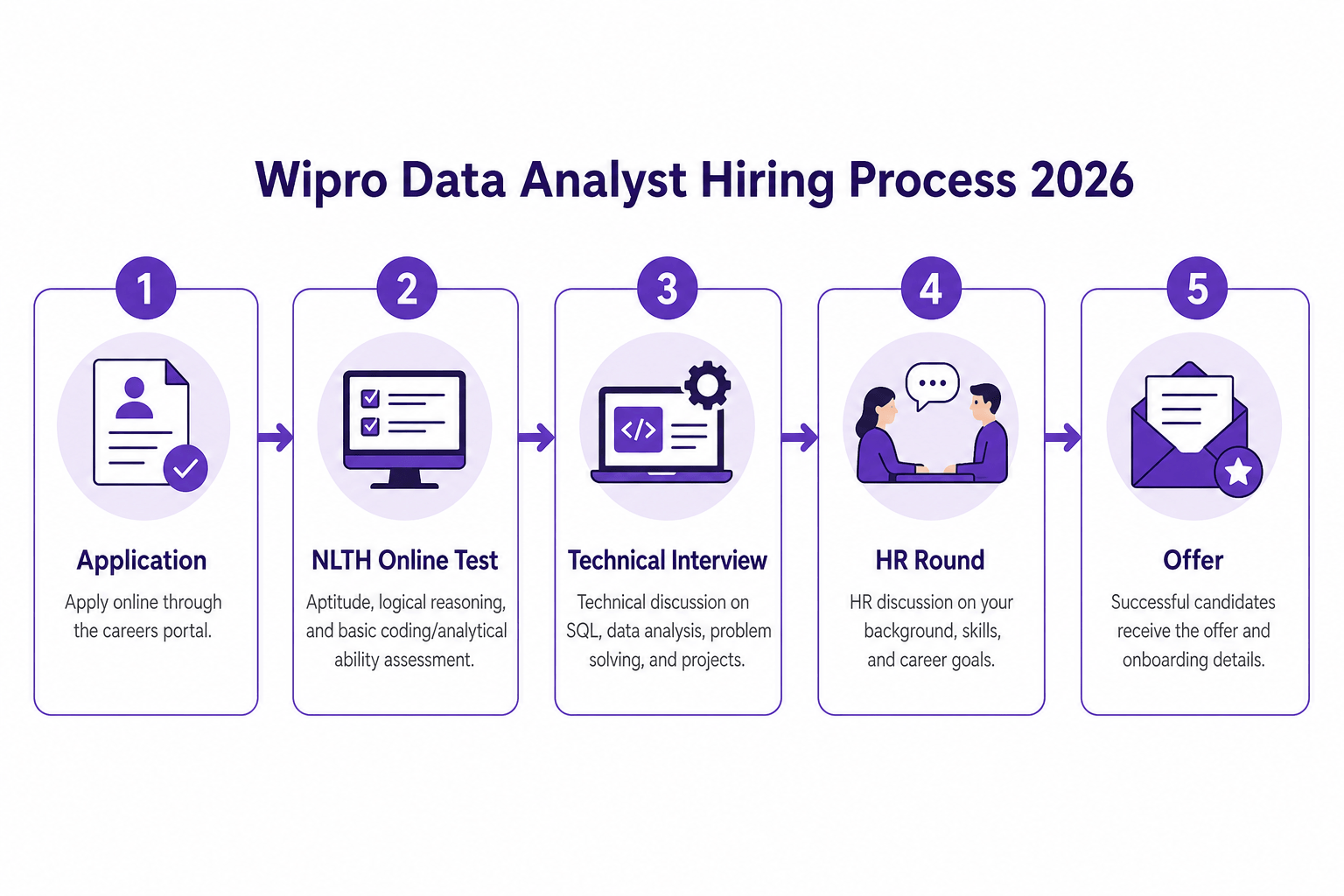
Most Wipro Data Analyst campus and off-campus drives follow NLTH online assessment, a technical interview covering SQL and analytics fundamentals, and an HR fit round — often combined into one live session for lateral hires. Each stage filters a different signal: speed, hands-on skills, and communication.
Step 1 — Application & resume screening
Register on Wipro careers or campus portal with accurate academic details. Recruiters scan for analytics-relevant projects, SQL/Python mentions, internships, and CGPA. Highlight measurable outcomes — dashboards built, data cleaned, or insights delivered — not generic “good academic record” lines.
Step 2 — NLTH (National Level Talent Hunt) online test
Timed online assessment covering aptitude (quant, logical, verbal), technical MCQs (SQL basics, programming logic, statistics fundamentals), and sometimes a short coding or pseudocode section. Strong NLTH scores shortlist candidates for live technical panels.
Step 3 — Technical interview
One combined or split technical round probing SQL query writing, Python/pandas data manipulation, statistics concepts, Excel reporting, visualization tool familiarity, and project discussion. Panels expect narrated problem-solving — explain your approach before writing queries or code.
Step 4 — HR round (often combined with technical)
Communication, relocation flexibility, salary expectations, and “why Wipro.” Research Wipro’s analytics practice, Topcoder community, and sustainability initiatives for credible company-specific answers. STAR-format behavioral stories strengthen HR performance.
Step 5 — Offer
Selected candidates receive offer with role band, CTC breakdown (typically ₹3.5–6 LPA for fresher analytics tracks, higher for lateral hires with experience), joining location, and training period details. Confirm fixed vs variable split before accepting.
Eligibility Criteria
Wipro Data Analyst eligibility varies by campus tier and hiring season, but the cards below reflect typical fresher and lateral expectations for analytics-track shortlists in India. Strong NLTH scores and quantified project bullets can offset borderline CGPA in some drives.
Educational background
B.Tech/B.E., BCA, MCA, B.Sc. (CS/Statistics/Mathematics), or MBA with analytics electives. Wipro hires DA profiles from engineering and quantitative backgrounds for campus and off-campus drives.
CGPA cutoff
Commonly 60–65% aggregate (or 6.0+ CGPA on 10-point scale) with no active backlogs at most campuses. Strong NLTH scores or internship experience can offset borderline academics in some seasons.
Core skills
SQL (joins, aggregations, subqueries), basic Python/pandas, statistics fundamentals, Excel pivot tables, and one visualization tool (Power BI or Tableau). Machine learning basics are a plus, not mandatory for fresher DA roles.
Experience level
Freshers via NLTH campus drives are the primary entry path. Lateral hires (1–3 years) face deeper SQL, case study, and domain-specific analytics questions with higher salary bands.
Freshers vs experienced
Freshers: NLTH + fundamentals + project discussion. Experienced: end-to-end case walkthroughs, stakeholder communication scenarios, and tool-depth probes. Both tracks value clear communication over memorized definitions.
Interview Pattern — Round by Round
Wipro typically runs three evaluation stages for Data Analyst roles. Duration and format shift slightly between campus NLTH batches and off-campus lateral hiring, but the skill signals remain consistent.
| Round | Duration | Format | Evaluates |
|---|---|---|---|
| NLTH Online Test | 60–90 min | Aptitude + technical MCQs + optional coding | Speed, accuracy, SQL/statistics fundamentals, and elimination filter before live panels. |
| Technical Interview | 30–45 min | Live SQL queries, Python/pandas snippets, stats Q&A, project deep-dive | Hands-on data skills, problem narration, and whether resume project claims hold under probing. |
| HR / Managerial | 15–25 min | Behavioral + fit + relocation + salary discussion | Communication clarity, adaptability, motivation for Wipro, and professional attitude. |
Skills Tested at Wipro
SQL is the highest-weight skill for Wipro Data Analyst interviews, followed by communication and Python data manipulation. Drill topic banks on SQL interview questions and Python interview questions alongside this guide.
SQL
HighJOINs, GROUP BY, subqueries, window functions, and query optimization basics. Expect live query writing on whiteboard or shared editor.
Python
Medium–Highpandas groupby, missing value handling, basic data cleaning scripts. Full ML pipelines are rare at fresher level.
Statistics
MediumMean/median/mode, distributions, hypothesis testing, p-values, and correlation vs causation.
Probability
Low–MediumBasic probability rules, conditional probability, and expected value — often via aptitude or conceptual MCQs.
Data Cleaning
MediumNULL handling, outlier treatment, deduplication, and imputation strategies with business justification.
Excel
MediumPivot tables, VLOOKUP/INDEX-MATCH, conditional formatting, and quick ad-hoc analysis for reporting roles.
Visualization
MediumPower BI or Tableau chart selection, dashboard design principles, and explaining visuals to non-technical stakeholders.
Business Cases
MediumStructured case walkthroughs — define problem, gather data, analyze, recommend action with measurable KPIs.
Communication
HighTranslating analysis into business recommendations. Panels reject candidates who cannot explain “so what” behind numbers.
Machine Learning basics
LowSupervised vs unsupervised, overfitting awareness, and one project example. Deep ML theory is uncommon for entry DA.
Latest 2026 Hiring Trends
Wipro Data Analyst interviews in 2026 emphasize NLTH fundamentals, structured case communication, and Power BI–ready visualization skills more than deep machine learning theory. Panels increasingly combine technical and HR evaluation in single sessions.
NLTH remains the primary fresher gate
Campus and mass-hiring drives still route through NLTH online assessment. Aptitude plus technical MCQ weight has increased — weak fundamentals eliminate candidates before SQL live rounds.
Case study depth is rising
Panels increasingly ask “walk me through a business problem you would solve with data” instead of isolated trivia. Structure answers: problem → data → analysis → recommendation → impact.
Power BI emphasis in visualization rounds
Wipro client projects frequently use Microsoft stack. Mentioning Power BI dashboards, DAX basics, or Excel-to-Power BI workflows signals practical readiness.
Combined technical + HR rounds
Many drives compress technical and HR into one session. Prepare STAR stories and SQL answers in the same mock — stamina and communication matter as much as syntax.
Question Categories
The curated question bank below spans SQL, Python, statistics, Excel, visualization, case studies, behavioral, and HR categories — matching what Wipro panels probe most frequently in 2026 analytics hiring.
SQL
3 questions
Live query writing, JOINs, aggregations, ranking
Python
2 questions
pandas manipulation, missing values, groupby
Statistics
2 questions
Hypothesis testing, p-values, distributions
Excel
1 question
Lookup functions, pivot tables, reporting
Visualization
1 question
Chart selection, Power BI/Tableau
Case Study
1 question
Business problem structuring
Behavioral
1 question
STAR project stories with impact
HR
1 question
Why Wipro, relocation, salary
Wipro Analytics — Company Insights
Understanding Wipro's analytics practice helps you answer HR questions credibly and frame project experience in client-delivery language. Research the Wipro interview questions hub for company-wide context beyond the DA track.
Analytics teams & practice
Wipro’s data and analytics practice serves BFSI, retail, healthcare, and manufacturing clients. Data Analysts often work on reporting automation, dashboard delivery, and ad-hoc analysis within larger delivery teams.
Types of projects
Typical engagements: KPI dashboard builds, ETL support, customer churn analysis, operations reporting, and migration from Excel to Power BI. Fresher projects start with supervised reporting before independent module ownership.
Tech stack
SQL Server, Oracle, or PostgreSQL for querying; Python/pandas for scripting; Power BI and Tableau for visualization; Excel for rapid prototyping. Cloud exposure (Azure) grows with project assignment.
Work culture
Service-delivery model with client timelines and structured training (ILP). Expect rotational learning, documentation standards, and collaboration with onshore teams. Relocation flexibility is frequently tested in HR.
Career progression
Data Analyst → Senior DA → Lead Analyst / Analytics Consultant → Practice lead. Upskilling in cloud, advanced SQL, and domain expertise (BFSI, supply chain) accelerates promotion cycles.
Wipro Data Analyst Salary in India (2026)
Wipro Data Analyst salaries vary by experience band, city, and client account. Use these approximate ranges as interview context — not guarantees. Fresher NLTH offers typically sit in the ₹3.5–6 LPA band; lateral hires with proven SQL and dashboard delivery command higher packages.
Fresher / campus
₹3.5–6 LPA
NLTH campus offers for analytics and data roles. Strong NLTH percentile and internship experience can push toward upper band.
1–3 years
₹5–9 LPA
Independent module ownership, client-facing reporting, and SQL/Python depth expected. Domain specialization adds premium.
Senior DA (3–5 years)
₹8–14 LPA
Leads small analytics workstreams, mentors juniors, and owns stakeholder communication for deliverables.
Lead DA / Analytics Lead
₹12–18+ LPA
Practice-level ownership, pre-sales support, and cross-functional leadership. Varies sharply by account and city.
Wipro Data Analyst Interview Questions
Expanded expert answers · Reviewed 2026-06-23- 01
Write a SQL query to find the second-highest salary from an Employee table.
TechnicalEasyView expert answer & prep guide
Suggested answer time: 2–3 min
Why interviewers ask this: Ranking queries are the most common live SQL task in Wipro DA panels — they test subquery thinking, dialect awareness, and edge-case discussion under time pressure.
Expert answer: Approach 1 (subquery): SELECT MAX(salary) AS second_highest FROM Employee WHERE salary < (SELECT MAX(salary) FROM Employee). Approach 2 (window): SELECT salary FROM (SELECT salary, DENSE_RANK() OVER (ORDER BY salary DESC) AS rnk FROM Employee) t WHERE rnk = 2. Mention tie-handling: DENSE_RANK returns all rows tied at second place; LIMIT 1 alone may drop valid ties.
What interviewers evaluate: Subquery vs window-function fluency, duplicate-salary handling, and whether you narrate logic before typing.
Answer strategy: State two valid approaches, write one cleanly, then discuss ties and NULL salaries before the panel asks.
Common mistakes: Using LIMIT/OFFSET without naming SQL dialect, forgetting NULLs, or unable to explain why the subquery works.
Follow-up questions:
- Find the Nth highest salary
- What if all salaries are identical?
- 02
What is the difference between INNER JOIN and LEFT JOIN?
TechnicalEasyView expert answer & prep guide
Suggested answer time: 1–2 min
Why interviewers ask this: SQL JOIN fluency is a top filter in Wipro SWE panels — service-company projects are database-heavy and weak SQL eliminates strong coders.
Expert answer: INNER JOIN returns only rows where the join condition matches in both tables. LEFT JOIN returns all rows from the left table; non-matching right columns are NULL. Example: all customers LEFT JOIN orders shows customers with zero orders as NULL order fields — useful for gap analysis.
What interviewers evaluate: Relational query understanding, NULL semantics, and when to preserve non-matching rows.
Answer strategy: Define both, draw mental Venn diagram, give one business example (customers without orders).
Common mistakes: Confusing LEFT with RIGHT JOIN, or unable to explain NULL behavior for non-matches.
Follow-up questions:
- RIGHT JOIN vs LEFT JOIN?
- INNER JOIN with WHERE vs ON clause?
- 03
Use a window function to rank employees by salary within each department.
TechnicalMediumView expert answer & prep guide
Suggested answer time: 3–4 min
Why interviewers ask this: Window functions separate candidates who only know basic GROUP BY from those ready for ranking and running-total reports on client dashboards.
Expert answer: SELECT employee_id, department, salary, DENSE_RANK() OVER (PARTITION BY department ORDER BY salary DESC) AS dept_salary_rank FROM Employee ORDER BY department, dept_salary_rank. Filter top 3 per department with QUALIFY (BigQuery/Snowflake) or a CTE: WHERE dept_salary_rank <= 3.
What interviewers evaluate: PARTITION BY correctness, function choice (RANK vs DENSE_RANK vs ROW_NUMBER), and ability to filter ranked results.
Answer strategy: Explain PARTITION BY department first, pick DENSE_RANK for tie-friendly ranking, show optional top-N filter.
Common mistakes: Using GROUP BY instead of window functions, or picking RANK without explaining gap behavior after ties.
Follow-up questions:
- RANK vs ROW_NUMBER for unique ranks?
- Running total by department with SUM() OVER?
- 04
How do you handle missing values in a pandas DataFrame? Give at least three strategies.
TechnicalMediumView expert answer & prep guide
Suggested answer time: 2–3 min
Why interviewers ask this: Real client datasets are messy — Wipro panels want practical cleaning judgment, not textbook definitions alone.
Expert answer: Drop rows/columns if missingness is below ~5% and random. Impute with median (skewed numeric) or mode (categorical). Forward-fill for time series. Flag imputed values in production pipelines so stakeholders know data quality limits.
What interviewers evaluate: When to drop vs impute vs model-fill, and whether you justify choices with data context.
Answer strategy: List three strategies with when-to-use: drop (low missing %), mean/median impute (numeric), forward-fill (time series), model-based (high stakes).
Common mistakes: Always dropping NULLs without checking bias, or imputing means on skewed distributions without mentioning median alternative.
Follow-up questions:
- How do you detect if missingness is random?
- Would you impute before or after train/test split?
- 05
How would you group sales data by region and compute monthly totals in pandas?
TechnicalMediumView expert answer & prep guide
Suggested answer time: 2–3 min
Why interviewers ask this: groupby operations mirror daily reporting tasks — panels check if you can translate business questions into pandas code.
Expert answer: df["month"] = pd.to_datetime(df["date"]).dt.to_period("M"); result = df.groupby(["region", "month"])["sales"].sum().reset_index(). Sort by region and month for readable output. Mention handling missing regions or null sales explicitly.
What interviewers evaluate: groupby syntax, aggregation choice, and date handling for monthly rollups.
Answer strategy: Mention parsing dates, creating a month column, then groupby region + month with sum on sales column.
Common mistakes: Forgetting to reset_index for flat output, or aggregating before filtering invalid dates.
Follow-up questions:
- How would you pivot this result for a dashboard?
- How do you handle duplicate transactions?
- 06
What does a p-value of 0.03 mean in a hypothesis test?
TechnicalHardView expert answer & prep guide
Suggested answer time: 2 min
Why interviewers ask this: Misinterpreting p-values is a common analyst failure mode — Wipro panels use this to test statistical literacy.
Expert answer: A p-value of 0.03 means: if the null hypothesis were true, there is a 3% probability of observing a result this extreme or more. It does NOT mean a 97% chance the alternative hypothesis is true. Compare against your chosen significance level (often 0.05) before rejecting the null.
What interviewers evaluate: Correct frequentist interpretation and awareness of common wrong phrasing.
Answer strategy: Define p-value under null hypothesis, give the 0.03 reading, explicitly state what it does NOT mean.
Common mistakes: Saying “97% probability the result is correct” or confusing p-value with effect size.
Follow-up questions:
- What is Type I error?
- How is p-value different from confidence interval?
- 07
Explain the difference between supervised and unsupervised learning with one example each.
TechnicalMediumView expert answer & prep guide
Suggested answer time: 2 min
Why interviewers ask this: Basic ML literacy is increasingly tested even for DA roles that are not ML-heavy — panels check conceptual clarity.
Expert answer: Supervised learning uses labeled data to learn a mapping — e.g. predicting churn (yes/no) from customer features. Unsupervised finds patterns without labels — e.g. customer segmentation via clustering. Most Wipro DA reporting work is supervised or descriptive statistics, not deep unsupervised pipelines.
What interviewers evaluate: Label vs no-label understanding and ability to cite practical business examples.
Answer strategy: Define both, give one example each (classification/regression vs clustering), note when DA work stays supervised.
Common mistakes: Listing algorithms without explaining labels, or claiming all analytics is machine learning.
Follow-up questions:
- What is overfitting?
- When would you use clustering in a business context?
- 08
When would you use VLOOKUP vs INDEX-MATCH in Excel?
TechnicalEasyView expert answer & prep guide
Suggested answer time: 1–2 min
Why interviewers ask this: Excel remains ubiquitous in Wipro client reporting — panels test practical spreadsheet skills alongside SQL.
Expert answer: VLOOKUP searches the leftmost column and returns a value from a fixed column index — simple but breaks if lookup column is not leftmost. INDEX-MATCH pairs INDEX and MATCH for flexible lookups in any direction and is more robust when columns move. Use XLOOKUP on newer Excel if available.
What interviewers evaluate: Lookup mechanics, column position limitations, and performance awareness on large tables.
Answer strategy: Explain VLOOKUP left-column lookup limit, INDEX-MATCH flexibility for any column, mention approximate vs exact match.
Common mistakes: Not mentioning VLOOKUP column-index rigidity, or unable to explain #N/A error causes.
Follow-up questions:
- What is the difference between exact and approximate match?
- How would you handle duplicate keys?
- 09
How do you decide which chart type to use for a stakeholder dashboard?
TechnicalEasyView expert answer & prep guide
Suggested answer time: 2 min
Why interviewers ask this: Visualization judgment reflects client-facing readiness — Wipro DAs present insights to non-technical managers.
Expert answer: Match chart to the decision: bar charts for category comparison, line charts for time trends, histograms for distributions, scatter for correlation. Avoid pie charts with many slices. Always label axes, cite data source, and lead with the “so what” recommendation before showing the chart.
What interviewers evaluate: Chart-intent mapping and ability to avoid misleading visuals.
Answer strategy: Map analytical intent to chart: comparison → bar, trend → line, distribution → histogram, part-to-whole → stacked bar (not pie unless few categories).
Common mistakes: Defaulting to pie charts, using dual axes misleadingly, or showing charts without a narrative recommendation.
Follow-up questions:
- When is a stacked bar better than a grouped bar?
- How do you handle seasonality in trend charts?
- 10
Walk me through how you would analyze customer churn for a subscription business.
SituationalHardView expert answer & prep guide
Suggested answer time: 4–5 min
Why interviewers ask this: Case studies test structured thinking — Wipro panels want problem framing, not jump-to-model answers.
Expert answer: Define churn rate (cancelled / active at period start). Pull subscription, usage, and support ticket data. Segment churn by tenure and plan. Compare behavioral features of churned vs retained users. Recommend targeted retention (onboarding fixes, usage alerts). Measure impact with a cohort A/B test or pre/post intervention tracking.
What interviewers evaluate: Problem definition, metric choice, data needs, analysis approach, and actionable recommendations.
Answer strategy: Define churn metric → identify data sources → exploratory analysis → root causes → recommend interventions → mention how you would measure success.
Common mistakes: Jumping to ML without defining churn, ignoring data quality, or skipping actionable recommendations.
Follow-up questions:
- What features would you engineer?
- How would you validate the analysis?
- 11
Tell me about a data analysis project you worked on. What was the business impact?
BehavioralMediumView expert answer & prep guide
Suggested answer time: 3 min
Why interviewers ask this: Resume verification — Wipro panels probe whether project claims are real and whether you can quantify outcomes.
Expert answer: Example: “For my capstone, sales data had 12% duplicate orders. I used SQL to dedupe and Python to flag anomalies, built a Power BI dashboard for weekly KPIs, and our demo showed a 15% reduction in manual reconciliation time for the operations team.” Adapt with your real project and honest metrics.
What interviewers evaluate: STAR structure, ownership clarity, tool fluency, and quantified business impact.
Answer strategy: Situation → Task → Action (tools: SQL/Python/viz) → Result with a number (%, ₹ saved, time reduced).
Common mistakes: Vague “we analyzed data” without your role, no metrics, or unable to answer follow-ups on methodology.
Follow-up questions:
- What would you improve if you rebuilt it?
- Which part did you personally implement?
- 12
Why do you want to join Wipro as a Data Analyst?
HREasyView expert answer & prep guide
Suggested answer time: 2 min
Why interviewers ask this: HR and combined rounds test motivation, relocation fit, and whether you researched Wipro beyond the job posting.
Expert answer: Anchor on Wipro’s multi-industry analytics exposure, structured ILP training, and opportunity to grow from reporting to client-facing insights. Mention relocation flexibility and a specific skill you will build (e.g. Power BI + SQL depth) in the first year. Tie to your project experience authentically.
What interviewers evaluate: Company research depth, genuine motivation, relocation flexibility, and communication clarity.
Answer strategy: Combine Wipro analytics scale, training structure, industry exposure, and personal learning goals — avoid generic praise.
Common mistakes: Generic “brand name” answers, no mention of analytics practice, or sounding unprepared for relocation questions.
Follow-up questions:
- Are you willing to relocate?
- What are your salary expectations?
30-Day Preparation Roadmap
Follow the four-week plan below, then run full-loop mocks on InterviewEra mock interviews. Week 4 should include combined technical + HR practice — matching Wipro's 2026 combined-round trend.
Week 1
SQL foundations
- Master SELECT, JOINs, GROUP BY, HAVING, and subqueries
- Practice 15 live query problems (ranking, dedup, aggregations)
- Review NLTH aptitude quant and logical sections daily
Week 2
Python + data cleaning
- pandas groupby, merge, fillna, and value_counts drills
- Clean a messy CSV end-to-end with documented steps
- Complete 2 NLTH-style technical MCQ mock tests
Week 3
Statistics + visualization
- Revise p-values, hypothesis tests, correlation vs causation
- Build one Power BI or Tableau dashboard with 3 chart types
- Practice explaining a chart to a non-technical audience
Week 4
Cases + mocks + HR
- Walk through 3 structured business case scenarios aloud
- Prepare 2 STAR project stories with quantified impact
- Full Wipro-style technical + HR mock on InterviewEra
Common Mistakes Candidates Make
These twelve mistakes eliminate otherwise strong candidates in Wipro DA loops. Review each before your NLTH attempt and technical panel — especially p-value misinterpretation and silent query writing.
- Memorizing SQL syntax without explaining query logic aloud during live rounds.
- Claiming ML expertise on resume but failing basic supervised vs unsupervised questions.
- Ignoring NLTH aptitude — strong SQL alone cannot save a failed online assessment.
- Answering p-value questions incorrectly by saying “97% chance the hypothesis is true.”
- Using pie charts for everything instead of matching chart type to analytical intent.
- Rambling project answers without STAR structure or measurable business impact.
- Saying “I don’t know” without offering a structured guess or follow-up plan.
- Skipping Excel prep because the role is “data” — Wipro clients still use spreadsheets daily.
- Not researching Wipro-specific context for “why this company” HR answers.
- Overstating salary expectations without tying to role scope and market range.
- Silent coding/query writing — panels expect narrated approach before typing.
- Copying generic DA answers from other company pages without Wipro/NLTH context.
Last-Minute Checklist
Run through this checklist 24 hours before your NLTH or live panel. Every item maps to a real elimination reason observed in Wipro analytics hiring drives.
- 01NLTH registration confirmed with correct academic details
- 02Resume updated with SQL, Python, and one visualization tool — quantified project bullets
- 0310 SQL queries practiced live (JOINs, subqueries, ranking)
- 04pandas groupby and missing-value handling script ready to explain
- 05p-value and hypothesis testing answer rehearsed without common misinterpretations
- 06One Power BI or Tableau dashboard demo prepared
- 07Two STAR behavioral stories with business impact metrics
- 08“Why Wipro” answer with analytics practice and relocation willingness
- 09Salary range researched (₹3.5–6 LPA fresher band) with flexible framing
- 10Laptop, stable internet, and quiet space confirmed for online rounds
Recommended Resources
Wipro vs TCS vs Infosys — Data Analyst
All three service giants hire analytics profiles at similar difficulty for freshers — but entry assessments and HR round structure differ. Use this table when preparing for multiple employers simultaneously.
| Dimension | Wipro | TCS | Infosys |
|---|---|---|---|
| Entry assessment | NLTH online test (aptitude + technical MCQs) | TCS NQT (strong aptitude weight) | InfyTQ certification + aptitude |
| SQL depth | Medium — live queries expected | Medium — MCQ + panel queries | Medium — similar for analytics tracks |
| Python expectation | pandas basics for DA roles | Varies by project assignment | Growing for data-heavy SE/DA paths |
| Typical fresher package | ₹3.5–6 LPA analytics band | ₹3.3–7 LPA (Ninja/Digital tracks) | ₹3.6–4.5 LPA SE; DA similar |
| HR style | Often combined with technical | Separate MR/HR common | Dedicated HR round typical |
| Interview difficulty | Easy to medium for fresher DA | Easy to medium | Easy to medium |
Frequently Asked Questions
What does Wipro ask in Data Analyst interviews?
Wipro Data Analyst interviews typically cover NLTH online assessment (aptitude + technical MCQs), live SQL queries, Python/pandas basics, statistics concepts, Excel reporting, visualization tool familiarity, project discussion, and HR/behavioral questions. Fresher drives emphasize fundamentals over advanced machine learning.
Is SQL mandatory for Wipro Data Analyst interviews?
Yes. SQL is the highest-weight skill for Wipro DA roles. Expect live query writing — JOINs, GROUP BY, subqueries, and ranking problems. Candidates who cannot write basic queries are eliminated in technical rounds regardless of Python or ML knowledge.
Is Python compulsory for Wipro Data Analyst roles?
Python is strongly expected but not always tested as heavily as SQL. Panels probe pandas data manipulation, missing value handling, and groupby operations. You should be able to read and explain short Python scripts even if live coding is optional.
How difficult is the Wipro Data Analyst interview?
Easy to medium for fresher campus hires. NLTH filters aptitude first; technical rounds focus on foundational SQL, statistics, and communication — not competitive-programming difficulty. Lateral hires with 1–3 years face deeper case studies and domain questions.
How many rounds are in Wipro Data Analyst interviews?
Typically three stages: NLTH online test, technical interview (SQL/Python/stats/project), and HR round — sometimes combined into one live session. Off-campus drives may add a resume screening step before NLTH.
What is the salary for Wipro Data Analyst in India?
Fresher campus offers typically range ₹3.5–6 LPA. With 1–3 years experience, expect ₹5–9 LPA. Senior and lead analytics roles reach ₹8–18+ LPA depending on domain, city, and client account. Confirm fixed vs variable CTC split before accepting.
Can freshers crack Wipro Data Analyst interviews?
Yes. NLTH is designed for mass fresher hiring. Strong aptitude, SQL fundamentals, a quantified capstone project, and clear communication are the primary success factors. Internship or analytics coursework strengthens your profile significantly.
What is NLTH and is it mandatory for Wipro hiring?
NLTH (National Level Talent Hunt) is Wipro’s online assessment for campus and off-campus fresher drives. It includes aptitude, technical MCQs, and sometimes coding. Most analytics campus shortlists treat NLTH as mandatory — prepare as if you cannot skip it.
Does Wipro ask machine learning questions to Data Analysts?
Basic ML concepts — supervised vs unsupervised, overfitting awareness — may appear. Deep algorithm theory and model tuning are uncommon for entry-level DA. Focus on SQL, statistics, and business case communication first.
What CGPA cutoff does Wipro use for Data Analyst roles?
Commonly 60–65% aggregate or 6.0+ CGPA with no active backlogs. Cutoffs vary by college tier and hiring season. Strong NLTH scores or relevant internships can offset borderline academics in some drives.
Wipro vs TCS Data Analyst — which is harder?
Similar overall difficulty for fresher DA roles. Wipro routes through NLTH; TCS uses NQT with strong aptitude weight. Both test SQL and fundamentals. Compare both processes and prepare company-specific mocks in your final week.
What visualization tools should I mention for Wipro DA?
Power BI is the strongest mention for Wipro client work. Tableau, Excel charts, and Python matplotlib/seaborn are also valued. Explain chart selection logic — bar for comparison, line for trends, histogram for distributions.
How should I answer “Why Wipro” in the HR round?
Combine Wipro’s global analytics practice scale, structured training (ILP), client exposure across industries, and personal fit — relocation willingness and learning goals. Avoid generic brand-name answers without specific research.
How long does the Wipro Data Analyst offer process take?
Typically 2–6 weeks from final HR round to offer letter, depending on batch scheduling, background verification, and joining date alignment. Off-campus drives may take longer during low-hiring seasons.
What projects should I prepare for Wipro DA technical rounds?
Prepare one analytics capstone or internship project with clear problem statement, data sources, SQL/Python tools used, visualizations built, and quantified business impact. Panels probe whether you built the analysis or only followed a tutorial.
Does Wipro combine technical and HR rounds?
Yes, frequently. Many drives use a single combined session covering SQL/stats questions followed by HR fit and relocation discussion. Practice sustained communication — do not treat HR as an afterthought.
What statistics topics matter most for Wipro DA?
Mean/median/mode, distributions, correlation, hypothesis testing, p-value interpretation, and A/B test basics. The most common trap is misinterpreting p-values — study correct and incorrect phrasing before your panel.
How do I prepare for Wipro DA interviews in 30 days?
Week 1: SQL drills + NLTH aptitude. Week 2: Python/pandas + data cleaning. Week 3: statistics + Power BI dashboard. Week 4: case studies, STAR stories, and full mock interviews. Follow the week-by-week roadmap in this guide.
Practice answering, not just reading
Reading SQL tips is not the same as performing under panel pressure. Run a Wipro-style mock covering NLTH aptitude recall, live SQL narration, and HR follow-ups — with immediate AI feedback on structure and clarity.