Wipro · engineering
Wipro Software Engineer Interview Questions and Answers (2026)
Complete Wipro Software Engineer preparation for India 2026 — NLTH online test, DSA coding, OOP, DBMS, OS, CN, project discussion, salary ranges, 30-day roadmap, and expert sample answers for campus and lateral hiring.
On this page
What Wipro Asks Software Engineer Candidates in 2026
Wipro Software Engineer interviews test NLTH aptitude first, then easy-to-medium DSA, OOP, DBMS/SQL, OS and CN fundamentals, capstone project depth, and structured behavioral stories. Fresher drives emphasize fundamentals and narrated problem-solving — not competitive-programming extremes. Most successful candidates clear NLTH, explain code aloud with complexity, and quantify project impact in STAR format.
Compare with Wipro Java Developer questions, Wipro QA Engineer questions, and the Software Engineer interview questions hub before you lock your study plan.
Wipro Software Engineer Hiring Process
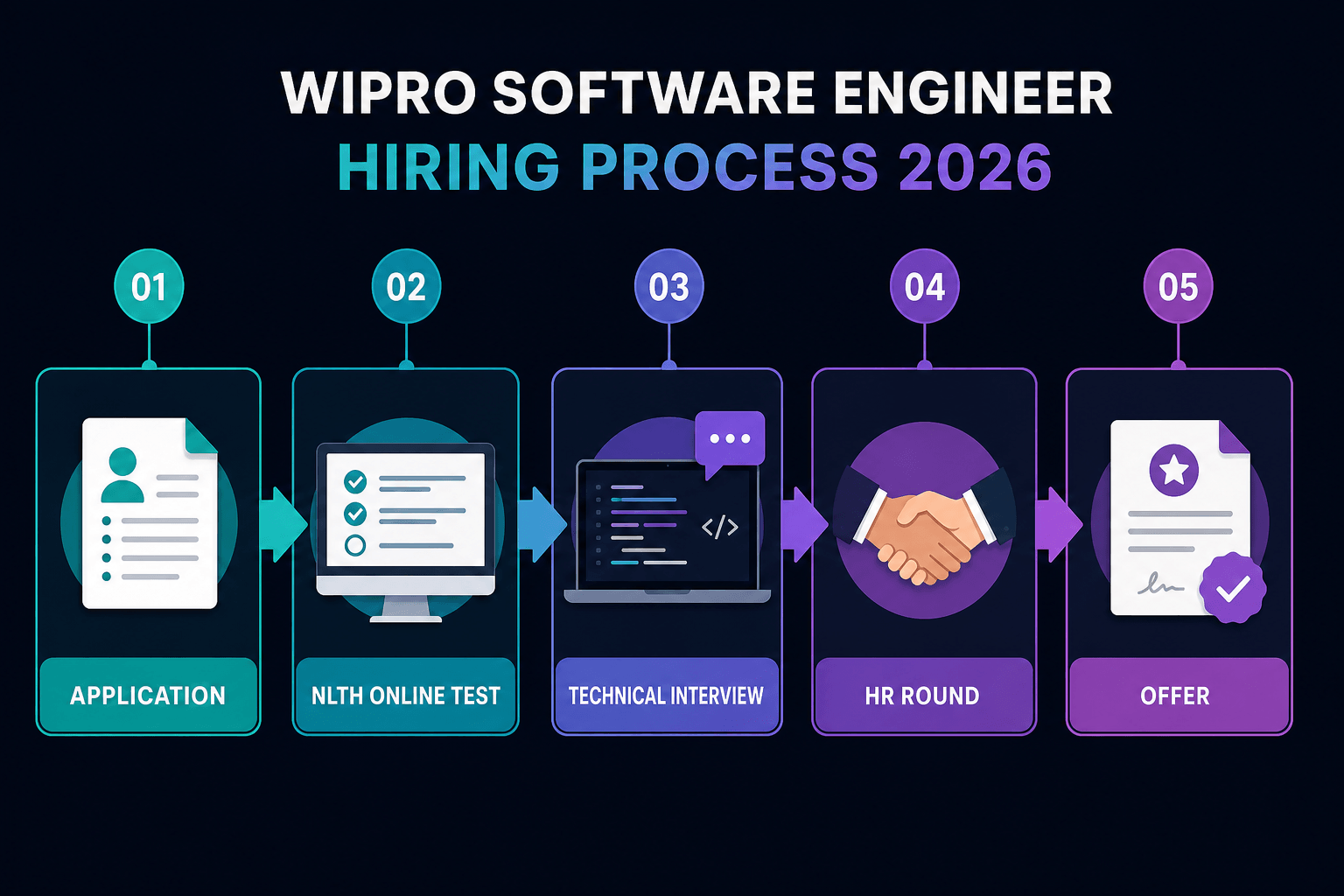
Most Wipro Software Engineer campus and off-campus drives follow NLTH online assessment, a technical interview covering DSA and Core CS fundamentals, and an HR fit round — often combined into one live session for lateral hires. Each stage filters a different signal: aptitude, engineering depth, and communication.
Step 1 — Application & resume screening
Register on Wipro careers or campus portal. Recruiters scan for DSA practice evidence, capstone or internship projects, CGPA, and hackathon participation. Highlight measurable engineering outcomes — features shipped, bugs fixed, performance gains — not generic “good academic record” lines.
Step 2 — NLTH (National Level Talent Hunt) online test
Timed assessment covering aptitude (quant, logical, verbal) and technical MCQs (programming logic, OOP, DBMS, CN basics). Many drives include one or two easy coding problems. Strong NLTH scores shortlist candidates for live technical panels — weak aptitude eliminates strong coders early.
Step 3 — Technical interview
Live round probing DSA (easy to medium), OOP, DBMS/SQL, OS, CN, and deep project discussion. Panels expect narrated problem-solving — approach before code, edge cases, and complexity. Fresher difficulty is fundamentals-heavy, not competitive-programming extremes.
Step 4 — HR round (often combined with technical)
Communication, relocation flexibility, salary expectations, and “why Wipro.” Research Wipro’s digital engineering practice, Topcoder partnership, and client industries. STAR-format project stories strengthen HR performance.
Step 5 — Offer
Selected candidates receive offer with role band and CTC (typically ₹3.5–7 LPA for fresher SWE tracks depending on college tier and NLTH percentile), joining location, and ILP training details. Confirm fixed vs variable split before accepting.
Eligibility Criteria
Wipro Software Engineer eligibility varies by campus tier and hiring season, but the cards below reflect typical fresher and lateral expectations for SWE-track shortlists in India. Strong NLTH scores and quantified project bullets can offset borderline CGPA in some drives.
Educational background
B.Tech/B.E. (CS/IT/ECE/EEE), MCA, or B.Sc. Computer Science. Wipro hires SWE profiles from engineering backgrounds for campus and off-campus drives. Relevant internships and GitHub projects strengthen shortlists.
CGPA cutoff
Commonly 60–65% aggregate (or 6.0+ CGPA) with no active backlogs. Strong NLTH scores or a substantive capstone project can offset borderline academics in some seasons.
Core skills
DSA (arrays, strings, linked lists, trees basics), OOP, DBMS/SQL, OS and CN fundamentals, Java or Python fluency, Git basics, and Agile awareness. System design depth is rare at fresher level.
Experience level
Freshers via NLTH are the primary entry path. Lateral hires (1–3 years) face deeper coding, framework, and client-delivery questions with higher salary bands.
Freshers vs experienced
Freshers: NLTH + fundamentals + project walkthrough. Experienced: module ownership, debugging production issues, and framework depth. Both tracks value clear communication over memorized definitions.
Interview Pattern — Round by Round
Wipro typically runs three evaluation stages for Software Engineer roles. Duration and format shift slightly between campus NLTH batches and off-campus lateral hiring, but the skill signals remain consistent.
| Round | Duration | Format | Evaluates |
|---|---|---|---|
| NLTH Online Test | 60–90 min | Aptitude + technical MCQs + optional coding | Speed, accuracy, programming logic, and elimination before live panels. |
| Technical Interview | 45–60 min | DSA, Core CS, SQL, project deep-dive | Problem-solving narration, fundamentals depth, and resume authenticity. |
| HR / Managerial | 15–25 min | Behavioral + fit + relocation + salary | Communication, adaptability, motivation for Wipro, and professional attitude. |
Skills Tested at Wipro
DSA and OOP are the highest-weight skills for Wipro SWE interviews, followed by DBMS/SQL and project depth. Drill topic banks on Software Engineer interview questions and DSA interview questions alongside this guide.
DSA / Coding
HighArrays, strings, two-pointer, sliding window, linked lists, trees basics. Easy-medium difficulty with narrated approach.
OOP
HighEncapsulation, inheritance, polymorphism, abstraction with Java or C++ examples. Design trade-offs over textbook definitions.
DBMS / SQL
HighNormalization, JOINs, indexing basics, ACID properties. Expect one live or verbal SQL query.
Operating Systems
MediumProcess vs thread, deadlock, scheduling, memory management basics.
Computer Networks
MediumTCP vs UDP, HTTP methods, REST basics, DNS and IP layer awareness.
Java / Python
Medium–HighLanguage syntax, collections, exception handling, and project stack alignment.
Git
Low–MediumBranching, pull requests, merge conflict resolution on team projects.
Agile / Scrum
MediumSprint ceremonies, definition of done, and developer role in client delivery.
System design basics
LowHigh-level API and DB schema discussion on capstone — not distributed systems at fresher level.
Communication
HighExplaining code aloud, summarizing projects in two minutes, and structured HR answers.
Latest 2026 Hiring Trends
Wipro Software Engineer interviews in 2026 emphasize NLTH aptitude, project ownership depth, combined technical plus HR evaluation in single sessions, and cloud/API awareness from capstone work — more than deep distributed system design at fresher level.
NLTH remains the primary fresher gate
Campus and mass-hiring drives still route through NLTH. Aptitude plus technical MCQ accuracy has increased — weak fundamentals eliminate candidates before live coding rounds.
Project depth over LeetCode grind
Wipro panels increasingly probe capstone architecture, your specific contributions, and trade-offs — not only isolated algorithm puzzles.
Combined technical + HR rounds
Many drives compress technical and HR into one session. Prepare DSA answers and “why Wipro” in the same mock — stamina matters.
Cloud and API awareness
Mention REST APIs, basic AWS/Azure exposure, or CI/CD hooks from projects. Full cloud architecture depth is not expected for freshers.
Question Categories
The curated question bank below spans DSA, Core CS, SQL, behavioral, situational, HR, and project categories — matching what Wipro panels probe most frequently in 2026 SWE hiring.
DSA / Algorithms
3 questions
Stack/queue, binary search, two-sum pattern
Core CS
4 questions
OOP, deadlock, TCP/UDP, process vs thread
DBMS / SQL
1 question
INNER vs LEFT JOIN
Behavioral
2 questions
Deadline STAR, learning agility
Situational
1 question
Pre-release production bug
HR
2 questions
Why Wipro, company research
Project
1 question
Capstone walkthrough
Wipro Digital Engineering — Company Insights
Understanding Wipro's engineering practice helps you answer HR questions credibly and frame project experience in client-delivery language. Research the Wipro interview questions hub for company-wide context beyond the SWE track.
Engineering practice & delivery
Wipro’s digital engineering practice spans application development, cloud migration, and maintenance for BFSI, healthcare, retail, and telecom clients. SWEs often work in blended onshore-offshore Agile teams with sprint deadlines.
Types of projects
Typical engagements: enterprise web apps, API modernization, ERP integrations, test automation support, and cloud lift-and-shift. Fresher projects start with supervised feature development and bug fixes under senior mentorship.
Tech stack
Java/Spring, .NET, Python, Angular/React on client projects, SQL Server or Oracle, Jenkins/GitLab CI, and Jira for sprint tracking. Stack varies by account — adaptability matters more than one-language loyalty.
Work culture
Service-delivery model with client reporting, documentation standards, and relocation flexibility. ILP (Initial Learning Program) trains freshers before project allocation.
Career progression
Project Engineer → Senior Engineer → Team Lead → Project Manager / Architect. Certifications (cloud, architecture) and consistent delivery accelerate promotion in Wipro engineering tracks.
Wipro Software Engineer Salary in India (2026)
Wipro Software Engineer salaries vary by experience band, city, and client account. Use these approximate ranges as interview context — not guarantees. Fresher NLTH offers typically sit in the ₹3.5–7 LPA band; lateral hires with proven module ownership command higher packages.
Fresher / campus
₹3.5–7 LPA
NLTH campus offers vary by college tier and role band. Strong NLTH percentile and internship experience push toward upper band.
1–3 years
₹6–11 LPA
Independent module ownership, client-facing demos, and framework fluency expected.
Senior SWE (3–5 years)
₹10–16 LPA
Leads technical decisions for modules, mentors juniors, owns release quality.
Lead / Architect
₹14–22+ LPA
Solution design, cross-team coordination, and account-level technical ownership. Varies by city and client.
Wipro Software Engineer Interview Questions
Expanded expert answers · Reviewed 2026-06-23- 01
What is the difference between a stack and a queue? Where would you use each?
TechnicalEasyView expert answer & prep guide
Suggested answer time: 2 min
Why interviewers ask this: Foundational data-structure question in almost every Wipro SWE technical round — tests CS basics before harder DSA.
Expert answer: A stack follows LIFO, so the last item pushed is the first removed. A queue follows FIFO, so the first item added is the first removed. I use stacks for undo/redo, recursion, and browser back navigation. I use queues for job scheduling, print spooling, and request buffering in APIs. In interviews, I also mention operation costs: push/pop are O(1) for stack, and enqueue/dequeue are O(1) for queue implementations using linked lists or circular arrays.
What interviewers evaluate: Core data-structure fundamentals and your ability to map theory to practical engineering use cases.
Answer strategy: Define LIFO vs FIFO first, then attach one real production scenario for each structure and mention O(1) operations.
Common mistakes: Mixing up ordering semantics, giving only textbook definitions, or skipping where each structure is actually used.
Follow-up questions:
- How would you implement both using arrays?
- When would you choose deque over queue?
- 02
What is the time complexity of binary search and what is its prerequisite?
TechnicalEasyView expert answer & prep guide
Suggested answer time: 2 min
Why interviewers ask this: Binary search probes algorithmic thinking and complexity clarity — common warm-up before live coding at Wipro.
Expert answer: Binary search runs in O(log n) time because every comparison removes half of the search space. The mandatory prerequisite is that data must be sorted in the same order you search against. Space is O(1) for iterative implementation and O(log n) for recursive due to call stack. In campus interviews, I also clarify edge cases: duplicate values, not-found result handling, and overflow-safe midpoint calculation using left + (right - left) / 2.
What interviewers evaluate: Algorithmic complexity clarity and whether you understand binary search preconditions and implementation details.
Answer strategy: State O(log n) immediately, mention sorted input requirement, then explain halve-the-range logic with one example.
Common mistakes: Forgetting sorted prerequisite, wrong midpoint arithmetic, or not discussing boundary conditions for duplicates.
Follow-up questions:
- How do you find first occurrence in duplicates?
- What changes for rotated sorted arrays?
- 03
Explain the four pillars of Object-Oriented Programming with one example each.
TechnicalEasyView expert answer & prep guide
Suggested answer time: 3 min
Why interviewers ask this: OOP is core to Wipro Java/.NET client projects — panels reject definition-only answers.
Expert answer: The four pillars are encapsulation, inheritance, polymorphism, and abstraction. Encapsulation means keeping data private and exposing controlled methods, like a BankAccount class with deposit/withdraw methods. Inheritance lets a SavingsAccount reuse BankAccount behavior. Polymorphism means calling the same method on different classes, like processPayment() for UPI and Card. Abstraction hides complexity behind interfaces, like a PaymentGateway interface exposing pay() while each provider handles its own implementation details.
What interviewers evaluate: Foundational OOP understanding and your ability to connect concepts with concrete coding examples.
Answer strategy: Name each pillar in order and provide one short production-style class example rather than abstract analogies only.
Common mistakes: Confusing abstraction with encapsulation, or listing pillars without explaining why each matters in design.
Follow-up questions:
- Can you show method overriding vs overloading?
- When is composition better than inheritance?
- 04
What is a deadlock? State the four conditions required for it to occur.
TechnicalMediumView expert answer & prep guide
Suggested answer time: 2–3 min
Why interviewers ask this: Concurrency fundamentals appear in OS rounds and multi-threaded project follow-ups at Wipro.
Expert answer: A deadlock is a state where two or more threads wait forever because each holds a resource the other needs. The four Coffman conditions are mutual exclusion, hold and wait, no preemption, and circular wait. If all four exist together, deadlock is possible. In production Java services, I reduce risk by enforcing lock ordering, minimizing nested locks, and using timed lock acquisition so stuck threads fail fast and trigger alerts instead of hanging indefinitely.
What interviewers evaluate: Concurrency fundamentals and whether you can reason about deadlock causes and practical prevention.
Answer strategy: Define deadlock first, list all four conditions correctly, then add one prevention tactic like lock ordering.
Common mistakes: Missing one Coffman condition, treating deadlock as slowdown only, or giving no prevention approach.
Follow-up questions:
- How do you detect deadlocks in Java?
- What is livelock and how is it different?
- 05
What is the difference between TCP and UDP? When would you choose each?
TechnicalMediumView expert answer & prep guide
Suggested answer time: 2–3 min
Why interviewers ask this: Networking trade-offs matter for API-heavy Wipro client projects — tests practical judgment.
Expert answer: TCP is connection-oriented, reliable, and ordered: packets are acknowledged, retransmitted if needed, and delivered in sequence. UDP is connectionless, lower-overhead, and does not guarantee delivery or order. I choose TCP for APIs, payments, and file transfer where correctness matters. I choose UDP for real-time use cases like live voice, gaming updates, or telemetry where occasional packet loss is acceptable but low latency is critical. In interviews, I also mention handshake overhead and congestion control differences.
What interviewers evaluate: Networking trade-off judgment between reliability, ordering, and latency for real systems.
Answer strategy: Compare reliability and ordering first, then map each protocol to one latency-sensitive and one correctness-sensitive scenario.
Common mistakes: Saying UDP is always faster without caveats, or failing to justify protocol choice by workload needs.
Follow-up questions:
- Why does HTTP/3 use QUIC over UDP?
- What is TCP three-way handshake?
- 06
Describe the difference between process and thread. What are the pros and cons of multithreading?
TechnicalMediumView expert answer & prep guide
Suggested answer time: 3 min
Why interviewers ask this: OS fundamentals and concurrency trade-offs — common in Core CS blocks at Wipro.
Expert answer: A process is an isolated execution unit with its own memory space, while threads are lighter units inside a process that share the same memory. Multithreading improves responsiveness and throughput for I/O-heavy workloads because tasks can run concurrently with lower context-switch overhead than processes. The trade-offs are race conditions, deadlocks, and harder debugging due to shared state. In backend services, I combine thread pools, immutable data where possible, and synchronization primitives to keep concurrency safe and predictable.
What interviewers evaluate: OS and concurrency fundamentals plus awareness of practical engineering trade-offs in multithreaded code.
Answer strategy: Start with memory model difference, then present one benefit and one risk of multithreading with mitigation.
Common mistakes: Claiming threads are always better, or ignoring synchronization and shared-state failure modes.
Follow-up questions:
- When do you prefer multiprocessing?
- How does context switching differ for process vs thread?
- 07
What is the difference between INNER JOIN and LEFT JOIN?
TechnicalEasyView expert answer & prep guide
Suggested answer time: 2 min
Why interviewers ask this: SQL JOIN fluency is a top filter in Wipro SWE panels — service-company projects are database-heavy and weak SQL eliminates strong coders.
Expert answer: INNER JOIN returns only rows where the join condition matches in both tables. LEFT JOIN returns all rows from the left table; non-matching right columns are NULL. Example: all customers LEFT JOIN orders shows customers with zero orders as NULL order fields — useful for gap analysis.
What interviewers evaluate: Relational query understanding, NULL semantics, and when to preserve non-matching rows.
Answer strategy: Define both, draw mental Venn diagram, give one business example (customers without orders).
Common mistakes: Confusing LEFT with RIGHT JOIN, or unable to explain NULL behavior for non-matches.
Follow-up questions:
- RIGHT JOIN vs LEFT JOIN?
- INNER JOIN with WHERE vs ON clause?
- 08
Given an array of integers, how would you find two numbers that sum to a target?
TechnicalMediumView expert answer & prep guide
Suggested answer time: 4–5 min
Why interviewers ask this: Two-sum is the most common live coding pattern in Wipro NLTH and technical rounds — tests hash map thinking under time pressure.
Expert answer: Optimal: one pass with a hash map storing value → index. For each x, check if (target - x) exists; if yes return indices. O(n) time, O(n) space. For sorted arrays, two-pointer approach also works in O(n). Always state approach and complexity before coding.
What interviewers evaluate: Algorithm optimization, edge-case handling, and narrated problem-solving.
Answer strategy: Start with brute force O(n²), optimize to hash map O(n), mention duplicate and negative number handling.
Common mistakes: Silent coding, wrong index on duplicates, or no complexity analysis.
Follow-up questions:
- Three-sum extension?
- What if array is sorted?
- 09
Tell me about a time you had to meet a tight deadline. How did you prioritise?
BehavioralMediumView expert answer & prep guide
Suggested answer time: 3 min
Why interviewers ask this: Client delivery deadlines are daily reality at Wipro — STAR format tests execution under pressure.
Expert answer: In my final-year placement project, we had three days to demo a recruiter dashboard after API scope changed late. I split features into must-have versus nice-to-have, aligned with the mentor on a thin vertical slice, and assigned owners for API, UI, and testing. We shipped login, candidate list, and status updates first, and deferred analytics charts. I sent progress updates every few hours and flagged blockers early. We demoed on time with zero critical bugs and added deferred items in the next sprint.
What interviewers evaluate: Execution discipline, prioritization under pressure, and communication maturity during constrained delivery.
Answer strategy: Use STAR with clear constraints, your prioritization framework, stakeholder communication, and measurable result.
Common mistakes: Giving vague team stories, skipping trade-offs, or not showing what you intentionally deprioritized.
Follow-up questions:
- What did you cut first and why?
- What would you improve in that execution plan today?
- 10
Describe a situation where you had to learn a new technology quickly.
BehavioralEasyView expert answer & prep guide
Suggested answer time: 2–3 min
Why interviewers ask this: Wipro ILP and client projects require rapid stack switching — learning agility is a hiring signal.
Expert answer: During internship onboarding, I had to deliver a feature in Next.js even though I had mostly used plain React. I spent the first day reading official docs and building a small sandbox for App Router patterns, then paired with a senior for code-review feedback. By day three, I shipped a production-ready page with server-side data fetching and form validation. I documented what I learned for the next intern. The key was structured learning, fast experimentation, and immediate application to a real task.
What interviewers evaluate: Learning agility, self-directed execution, and ability to convert learning into deliverable output quickly.
Answer strategy: Share your learning loop: docs, proof-of-concept, mentorship feedback, then production implementation with timeline.
Common mistakes: Saying you are a fast learner without concrete actions, outcomes, or evidence of applied understanding.
Follow-up questions:
- How did you validate your understanding quickly?
- What would you do if no mentor was available?
- 11
If you discovered a critical bug in production right before a major release, what would you do?
SituationalHardView expert answer & prep guide
Suggested answer time: 3 min
Why interviewers ask this: Release judgment under pressure — mirrors Wipro client sprint deadlines and production support scenarios.
Expert answer: I would first assess severity and user impact, then immediately notify the release owner and relevant stakeholders. If the bug risks data integrity, payment flow, or security, I would block release and trigger rollback or a controlled hotfix path. I would assign owners for triage, fix, verification, and communication, while keeping an incident log. After stabilization, I would run root-cause analysis and add safeguards like regression tests, monitoring alerts, and release checklist updates so the same class of failure is less likely to recur.
What interviewers evaluate: Incident judgment, communication under pressure, and production-risk management maturity.
Answer strategy: Walk through sequence: impact assessment, escalation, release decision, mitigation, validation, and post-incident prevention.
Common mistakes: Acting alone without communication, prioritizing launch date over user risk, or skipping postmortem actions.
Follow-up questions:
- When do you choose rollback over hotfix?
- What would your postmortem include?
- 12
Walk me through your capstone or internship project. What was your role?
BehavioralMediumView expert answer & prep guide
Suggested answer time: 4 min
Why interviewers ask this: Wipro panels verify project ownership — tutorial clones fail under architecture and contribution follow-ups.
Expert answer: Structure: “Built X for Y users. I owned authentication API and PostgreSQL schema — chose JWT over sessions for stateless scaling. Reduced login latency 40% via indexing. If rebuilt, I would add integration tests earlier.” Prepare module-level follow-ups.
What interviewers evaluate: Technical depth, ownership clarity, and trade-off reasoning.
Answer strategy: Problem → your modules → tech stack → challenges → measurable outcome. Be honest about team scope.
Common mistakes: Cannot explain architecture, or claiming full team credit.
Follow-up questions:
- Why that database choice?
- What would you improve?
- 13
Why do you want to join Wipro as a Software Engineer?
HREasyView expert answer & prep guide
Suggested answer time: 2 min
Why interviewers ask this: HR and combined rounds test motivation, relocation fit, and company research depth.
Expert answer: Anchor on Wipro’s multi-industry project exposure, structured ILP training, opportunity to grow from fundamentals to client-facing delivery, and alignment with my capstone stack. Tie to year-one goal — e.g. deepening Spring or cloud skills on enterprise accounts. Confirm relocation flexibility.
What interviewers evaluate: Genuine interest, relocation willingness, and structured communication.
Answer strategy: Wipro digital engineering scale + ILP + industry exposure + your stack fit. Avoid generic brand praise.
Common mistakes: Generic MNC answer, no Wipro-specific research, or sounding uncommitted.
Follow-up questions:
- Willing to relocate?
- Salary expectations?
- 14
Why do you want to work at Wipro? What do you know about us?
HREasyView expert answer & prep guide
Suggested answer time: 2 min
Why interviewers ask this: Tests company research — generic answers are penalized in Wipro HR and combined rounds.
Expert answer: Wipro is a global IT services leader with strong digital engineering and cloud practices across BFSI, healthcare, and retail. I know about the Initial Learning Program for structured fresher onboarding and Topcoder for competitive engineering culture. I want Wipro because it offers enterprise project exposure early in my career while I build depth in Java and cloud — matching my capstone and long-term architect goal.
What interviewers evaluate: Preparation quality and credible motivation.
Answer strategy: Name Wipro digital engineering, Topcoder partnership, client industries, and connect to your career plan.
Common mistakes: Only citing brand name, wrong facts, or no personal career link.
Follow-up questions:
- Which Wipro practice interests you?
- Recent Wipro news you followed?
30-Day Preparation Roadmap
Follow the four-week plan below, then run full-loop mocks on InterviewEra mock interviews. Week 4 should include combined technical + HR practice — matching Wipro's 2026 combined-round trend.
Week 1
DSA + aptitude
- Arrays, strings, two-pointer daily
- Stack, queue, binary search revision
- Daily NLTH aptitude drills (quant + logical)
Week 2
Core CS + SQL
- OOP, OS, CN concept cards
- INNER/LEFT JOIN and one ranking SQL query
- Practice 2 NLTH-style technical MCQ mocks
Week 3
Projects + coding
- Capstone architecture one-pager
- 5 easy-medium coding problems timed
- STAR stories for deadline and learning agility
Week 4
Mocks + HR
- Why Wipro SWE + relocation answer
- Full project walkthrough rehearsal
- Combined technical + HR mock on InterviewEra
Common Mistakes Candidates Make
These twelve mistakes eliminate otherwise strong candidates in Wipro SWE loops. Review each before your NLTH attempt and technical panel — especially silent coding and weak project walkthroughs.
- Ignoring NLTH aptitude — strong DSA alone cannot save a failed online assessment.
- Silent coding without narrating approach, complexity, and edge cases.
- Listing OOP pillars without concrete class examples.
- Unable to explain your capstone architecture under follow-up probing.
- Claiming full project credit for team work without stating your specific modules.
- Weak SQL — JOIN confusion is a common elimination reason.
- Rambling HR answers without Wipro-specific research.
- Overstating LeetCode count but failing easy warm-up problems.
- No plan for production bug scenario — heroics without communication.
- Memorizing TCP definitions without mapping to real protocol choices.
- Skipping Git basics when resume lists team projects.
- Copying generic SWE answers without Wipro/NLTH context.
Last-Minute Checklist
Run through this checklist 24 hours before your NLTH or live panel. Every item maps to a real elimination reason observed in Wipro SWE hiring drives.
- 01NLTH registration confirmed with correct academic details
- 02Resume lists tech stack, project modules owned, and quantified outcomes
- 035 DSA problems rehearsed with complexity stated aloud
- 04OOP four pillars with one example each ready
- 05One SQL JOIN query and one ranking query practiced
- 06Capstone walkthrough under 3 minutes with follow-up prep
- 07STAR deadline story with measurable delivery outcome
- 08“Why Wipro SWE” answer with digital engineering research
- 09TCP vs UDP and process vs thread answers crisp
- 10Salary range researched (₹3.5–7 LPA fresher band) with flexible framing
Recommended Resources
Wipro vs TCS vs Infosys — Software Engineer
All three service giants hire SWE profiles at similar difficulty for freshers — but entry assessments and HR round structure differ. Use this table when preparing for multiple employers simultaneously.
| Dimension | Wipro | TCS | Infosys |
|---|---|---|---|
| Entry assessment | NLTH (aptitude + technical MCQs + coding) | TCS NQT (strong aptitude) | InfyTQ + HackWithInfy |
| Coding difficulty | Easy to medium | Easy to medium | Easy to medium |
| Core CS weight | High — OOP, DBMS, OS, CN | High | High |
| Project discussion | Deep — ownership probed | Moderate to deep | Deep |
| Typical fresher package | ₹3.5–7 LPA SWE band | ₹3.3–7 LPA (track dependent) | ₹3.6–9 LPA (track dependent) |
| Interview difficulty | Easy to medium | Easy to medium | Easy to medium |
Frequently Asked Questions
What does Wipro ask in Software Engineer interviews?
Wipro SWE interviews typically cover NLTH online assessment (aptitude + technical MCQs + optional coding), live DSA and Core CS questions (OOP, DBMS, OS, CN), SQL probes, capstone project discussion, and HR fit questions. Fresher drives emphasize fundamentals over advanced system design.
Is coding mandatory for Wipro SWE freshers?
Yes. NLTH often includes coding or pseudocode, and technical rounds probe easy-to-medium DSA with narrated problem-solving. You do not need competitive-programming mastery — clean fundamentals and communication matter more.
What is NLTH and is it mandatory for Wipro SWE?
NLTH (National Level Talent Hunt) is Wipro’s online assessment for campus and off-campus fresher drives. It includes aptitude, technical MCQs, and sometimes coding. Most SWE campus shortlists treat NLTH as mandatory.
How many rounds are in Wipro Software Engineer interviews?
Typically three: NLTH online test, technical interview (DSA + Core CS + project), and HR round — sometimes combined into one live session for off-campus hires.
What is the salary for Wipro Software Engineer freshers?
Fresher campus offers typically range ₹3.5–7 LPA depending on college tier and NLTH performance. With 1–3 years experience, expect ₹6–11 LPA. Senior and lead roles reach ₹10–22+ LPA depending on city and client account.
Can freshers crack Wipro SWE interviews?
Yes. NLTH is designed for mass fresher hiring. Strong aptitude, DSA fundamentals, a quantified capstone project, and clear communication are the primary success factors.
Wipro vs TCS SWE — which is harder?
Similar overall difficulty for fresher SWE roles. Wipro routes through NLTH; TCS uses NQT with strong aptitude weight. Both test DSA and Core CS fundamentals — compare both processes if applying to multiple employers.
Is system design asked at Wipro for freshers?
Rarely in depth. Fresher panels may ask high-level capstone architecture — API layers, database schema, deployment basics. Full distributed system design is expected only for senior lateral hires.
Which language should I prepare — Java or Python?
Match your resume and capstone stack. Wipro client projects use Java, .NET, and Python widely. Consistency matters — do not claim Java expertise if your projects are all Python without justification.
What projects should I prepare?
Prepare one capstone or internship where you owned specific modules, can draw architecture, explain trade-offs, and quantify outcomes (users, latency, bugs fixed). Panels probe ownership, not tutorial clones.
Does Wipro combine technical and HR rounds?
Yes, frequently. Many drives use a single combined session covering DSA questions followed by HR fit and relocation discussion. Practice sustained communication across both.
How important is SQL for Wipro SWE?
Very important. Expect JOIN questions, basic normalization, and sometimes a live query. SQL weakness eliminates otherwise strong coders in service-company panels.
What DSA topics matter most?
Arrays, strings, two-pointer, sliding window, linked lists, stacks/queues, binary search, and basic trees. Focus on easy-medium with clean narration and complexity analysis.
How do I prepare for Wipro SWE in 30 days?
Week 1: DSA + aptitude. Week 2: Core CS + SQL. Week 3: projects + timed coding. Week 4: STAR stories, Why Wipro, and full mocks. Follow the week-by-week roadmap in this guide.
What is Wipro ILP?
Initial Learning Program — structured training for freshers before project allocation. Covers technology fundamentals, soft skills, and client-readiness. Mention ILP positively in “why Wipro” answers.
How long until offer after final round?
Typically 2–6 weeks from final HR round to offer letter, depending on batch scheduling and background verification. Off-campus drives may take longer during low-hiring seasons.
Are CGPA cutoffs strict at Wipro?
Commonly 60–65% aggregate or 6.0+ CGPA with no active backlogs. Cutoffs vary by college tier. Strong NLTH scores or internships can offset borderline academics in some drives.
What should I say for “Why Wipro”?
Anchor on multi-industry project exposure, ILP training structure, digital engineering practice, and your fit — e.g. capstone stack alignment and willingness to relocate. Avoid generic MNC praise without specifics.
Practice answering, not just reading
Reading DSA tips is not the same as performing under panel pressure. Run a Wipro-style mock covering NLTH aptitude recall, DSA and Core CS answers, project discussion, and HR follow-ups — with immediate AI feedback on structure and clarity.