Microsoft · engineering
Microsoft Software Engineer Top 10 Interview Questions 2026
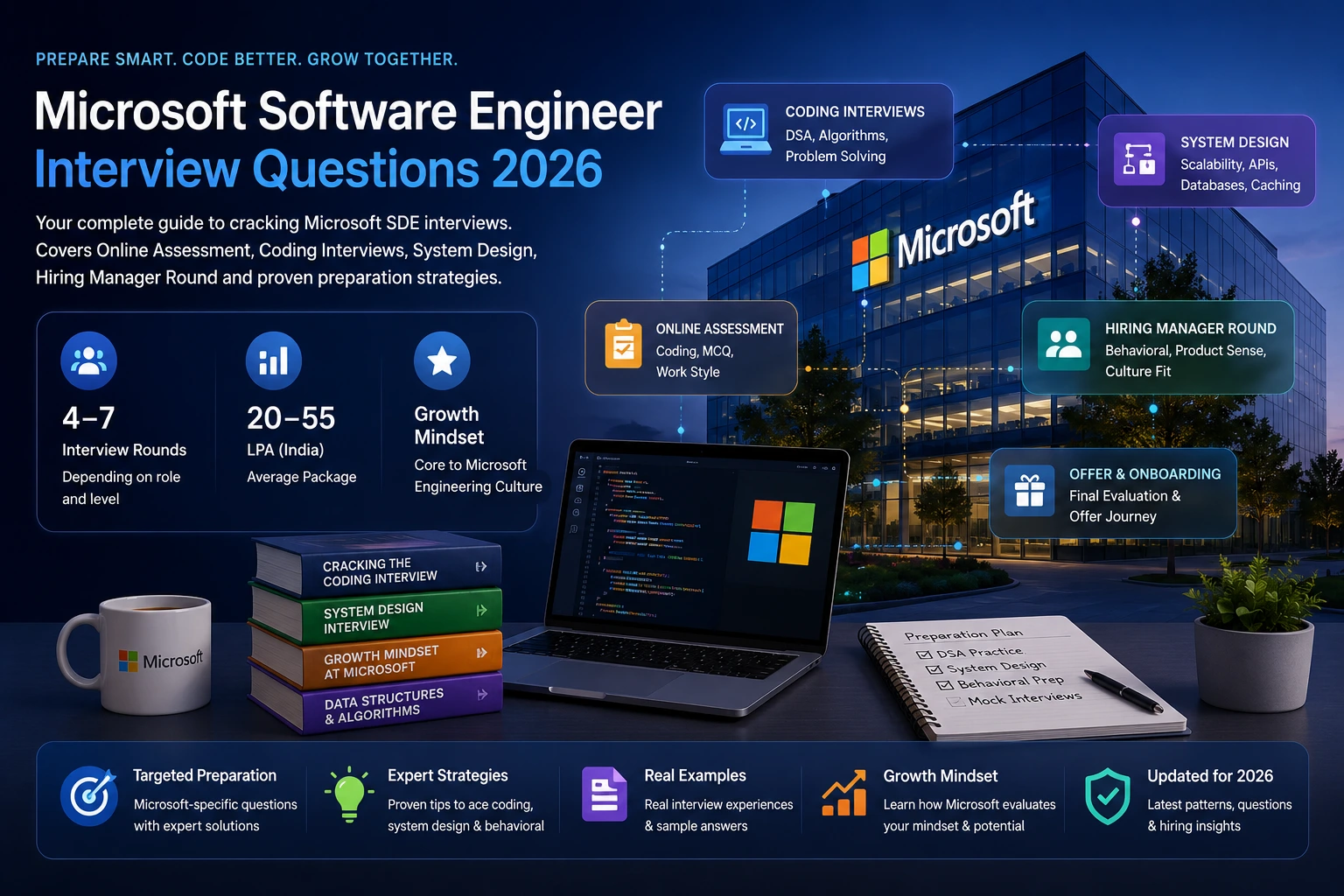
A complete preparation guide with top 10 curated interview questions covering Microsoft's Online Assessment, coding interviews, system design, hiring manager round, and growth mindset culture for software engineer roles in India.
On this page
Why Microsoft Interviews Are Different
Microsoft does not optimize interviews solely for algorithm speed. Panels balance coding rigour with growth mindset, collaboration signals, and whether you can thrive on large-scale platform teams — Azure, Office, Windows, and enterprise services.
Strong LeetCode scores help, but hiring managers also grade how you learn from mistakes, partner across roles, and reason about reliability at scale. This guide includes top 10 curated questions with expanded expert answers. Compare expectations with Amazon SDE interviews and Google SDE interviews before you commit to a study plan.
Microsoft Hiring Philosophy
Microsoft hiring under Satya Nadella emphasizes learn-it-all culture, inclusive collaboration, and customer-backward engineering. Interview feedback is compared across rounds for consistent level calibration.
Growth Mindset
Microsoft shifted from “know-it-all” to “learn-it-all” under Satya Nadella. Interviewers reward curiosity, feedback-seeking, and honest reflection — not defensive expertise.
Collaboration
Engineering at Microsoft is team-first. Panels look for how you partner across disciplines, give and receive feedback, and unblock others without ego.
Customer Focus
Products serve billions of users and enterprises. Strong candidates tie technical decisions to customer outcomes, trust, and long-term value — not internal metrics alone.
Engineering Excellence
Clean code, testability, operational rigor, and thoughtful trade-offs matter. Microsoft expects you to ship reliably at scale, not just solve puzzles in isolation.
Innovation
From Azure to Copilot, Microsoft invests in platform bets. Show pragmatic invention — simplifying systems, exploring new tools, and learning from experiments.
Microsoft Engineering Culture
Microsoft engineering culture shows up in every round — not only the hiring manager panel. These five signals help interviewers judge long-term fit on platform teams at scale.
Growth Mindset
What it means: Treat skills as developable — seek feedback, learn from failure, and adapt when evidence changes your view.
Why Microsoft values it: Cultural north star under Satya Nadella; interviewers probe learning agility over defensive expertise.
Sample interview signal: Failure story with honest root cause, behaviour change, and measurable improvement afterward.
Collaboration
What it means: Partner across PM, design, and ops to ship outcomes — give candid feedback and elevate team output.
Why Microsoft values it: Large orgs ship through cross-functional alignment; siloed heroes rarely scale at Microsoft.
Sample interview signal: Conflict resolved respectfully with data or prototypes, shared credit, and a team-level outcome.
Customer Focus
What it means: Prioritize user and customer impact when making engineering trade-offs — not internal convenience alone.
Why Microsoft values it: Enterprise and consumer products compete on trust; customer-backward reasoning differentiates strong loops.
Sample interview signal: Decision that accepted short-term cost for measurable customer outcome, with segment and metric named.
Learn It All vs Know It All
What it means: Prefer continuous learning over defending existing knowledge — admit gaps and show how you close them.
Why Microsoft values it: Directly reflects Microsoft's cultural shift; bluffing expertise is a red flag in HM rounds.
Sample interview signal: “I don't know yet, but here is how I would investigate” followed by a real example of doing that.
Cross-team Impact
What it means: Influence beyond your immediate squad — unblock dependencies, align standards, and raise bar org-wide.
Why Microsoft values it: Platform teams (Azure, Office, Windows) require engineers who improve systems others depend on.
Sample interview signal: Initiative that helped multiple teams — API standard, shared library, or incident process with adoption proof.
Microsoft Interview Process
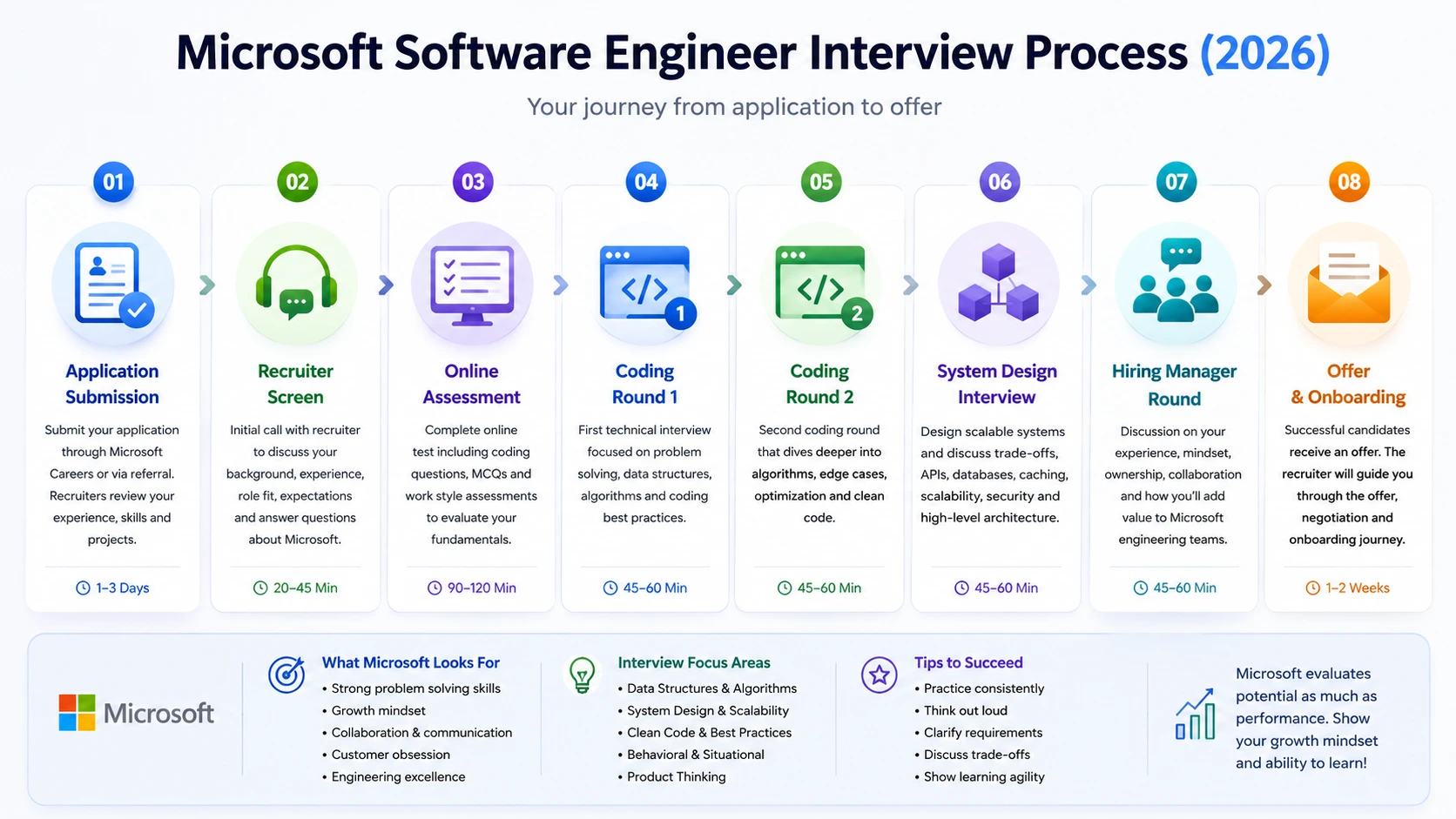
Timelines vary by team and level, but most Microsoft software engineer loops in India follow the sequence below. Each stage tests a different signal — not a repeat of the previous round.
Step 1 — Resume screening
Recruiters scan for relevant impact, project depth, and level alignment. Highlight Azure, distributed systems, or platform experience where applicable.
Step 2 — Recruiter discussion
30–45 minutes on background, role fit, location, and timeline. Prepare a crisp “why Microsoft / why this org” answer and clarify level expectations early.
Step 3 — Online Assessment
Timed coding logic, MCQs, and sometimes work-style scenarios. Practice under clock pressure — OA eliminates many candidates before live panels.
Step 4 — Coding interviews
Usually two rounds: DSA on a shared editor plus CS fundamentals. Explain approach before coding; state complexity; discuss edge cases aloud.
Step 5 — System design round
Common for SDE-2+. Cover APIs, storage, caching, queues, and failure modes. Draw diagrams and justify trade-offs clearly.
Step 6 — Hiring manager round
Growth mindset and collaboration questions plus team fit. Expect deep follow-ups on projects, conflict, and what you learned from failure.
Step 7 — Offer
Compensation includes base, RSUs, and bonus. Level confirmation happens before the written offer — negotiate the full package.
Before OA, align your resume with Software Engineer interview questions and the Microsoft company interview hub.
Microsoft Resume Examples
Microsoft recruiters screen for measurable impact, engineering ownership, scalability proof, and performance improvements. Weak bullets describe tasks; strong bullets prove decisions recruiters can discuss in hiring manager rounds.
Measurable impact
Weak resume bullet: “Improved API performance for the team.”
Strong resume bullet: “Reduced order-service p99 latency from 380ms to 145ms (62% drop) by adding Redis caching and batching DB reads — cut checkout timeouts 19%.”
Engineering ownership
Weak resume bullet: “Worked on microservices with the backend team.”
Strong resume bullet: “Owned notification pipeline reliability — designed retry queues, on-call runbooks, and post-incident fixes across 4 Azure services.”
Scalability
Weak resume bullet: “Built a scalable backend system.”
Strong resume bullet: “Designed event-driven inventory sync on Azure Service Bus handling 12k events/min with idempotent consumers and partition-aware workers.”
Performance improvements
Weak resume bullet: “Optimized code for better speed.”
Strong resume bullet: “Profiled hot paths in C# API, replaced N+1 queries with batched reads, and cut CPU usage 34% while sustaining 2× peak traffic.”
Coding Interviews
Microsoft coding rounds test structured problem-solving under time pressure. Interviewers want narrated reasoning, clean implementation, and correct complexity analysis — not silent coding.
Arrays
Difficulty: Medium–High
Preparation strategy: Master two pointers, prefix sums, and binary search variants. Narrate approach before coding.
Common mistakes: Off-by-one errors, ignoring edge cases (empty, single element), skipping complexity analysis.
Strings
Difficulty: Medium
Preparation strategy: Practice sliding window, character frequency maps, and palindrome/substring patterns under time pressure.
Common mistakes: Mutating strings inefficiently, missing Unicode/edge cases in OA, not clarifying constraints.
Linked Lists
Difficulty: Medium
Preparation strategy: Fluent pointer manipulation — dummy head, fast/slow pointers, cycle detection, merge patterns.
Common mistakes: Losing references during reversal, infinite loops, forgetting null tail handling.
Trees
Difficulty: Medium–High
Preparation strategy: DFS/BFS templates, BST properties, recursion with return values, and iterative stack approaches.
Common mistakes: Confusing traversal orders, missing null base cases, suboptimal space on deep trees.
Graphs
Difficulty: High
Preparation strategy: BFS/DFS, topological sort, union-find, and shortest-path basics. State graph representation choice aloud.
Common mistakes: Visiting nodes twice without tracking, wrong adjacency structure, ignoring disconnected components.
Dynamic Programming
Difficulty: High
Preparation strategy: Identify overlapping subproblems — start with recursion + memo, then tabulation. Practice classic 1D/2D DP.
Common mistakes: Jumping to code without state definition, wrong base cases, not optimizing space when possible.
Drill patterns with DSA interview questions and algorithms topic questions.
System Design Interviews
System design rounds evaluate whether you can architect reliable services at scale — not just draw boxes. Microsoft interviewers probe trade-offs, failure modes, and operational awareness.
Scalability
Horizontal scaling, load balancing, partitioning, and bottleneck identification under growth.
Availability
SLAs, redundancy, failover, graceful degradation, and incident-aware architecture.
Databases
SQL vs NoSQL trade-offs, indexing, replication, consistency models, and query patterns.
Caching
CDN, application cache, cache invalidation, TTL strategy, and stampede prevention.
APIs
REST/gRPC design, versioning, rate limiting, idempotency, and backward compatibility.
Distributed Systems
Queues, event-driven flows, CAP trade-offs, and observability across services.
What Microsoft interviewers evaluate
- Clear requirements clarification and scope boundaries for the target level.
- Justified technology choices with explicit trade-offs (consistency, cost, latency).
- Failure handling, monitoring, and how you would iterate after launch.
- Communication — diagram narration and responding to “what if scale 10×?” follow-ups.
Pair design prep with system design interview questions and cloud architecture questions.
Product Thinking at Microsoft
Microsoft SDE loops — especially hiring manager and senior design rounds — often probe product sense. You do not need PM experience, but you should reason about user pain, prioritization, and success metrics on familiar Microsoft surfaces.
Improving Microsoft Teams
Discuss latency, notification reliability, meeting quality, and enterprise compliance — not feature lists alone. Strong answers tie UX pain to measurable engagement or support-ticket reduction.
Improving Outlook
Cover search relevance, sync reliability, calendar conflicts, and mobile offline behaviour. Show you understand email as a mission-critical workflow for enterprises.
Improving Xbox
Address matchmaking latency, download pipelines, social features, and live-service uptime. Product sense here includes gamer trust and session retention — not only backend scale.
Product prioritization
Frame decisions with user impact, engineering cost, risk, and learning value. Use a simple rubric: customer pain × reach × confidence ÷ effort — then defend your top pick with trade-offs.
What interviewers evaluate
- Whether you start from user pain — not technology for its own sake.
- How you prioritize under constraints (time, headcount, legacy debt).
- Clarity on success metrics and how you would validate after launch.
- Awareness of Microsoft product context (enterprise vs consumer, platform vs app).
Pair product prep with Software Engineer interview questions and STAR method guide for structured behavioural answers.
Growth Mindset
Growth mindset is Microsoft's signature behavioural signal. Build at least one story per theme below — with honest reflection, metrics, and what you changed afterward. Structure answers using our STAR method guide.
Learn It All vs Know It All
Meaning: Prefer continuous learning over defending what you already know. Admit gaps, seek feedback, and show how you improved after failure.
Why Microsoft values it: Satya Nadella made this cultural north star — interviewers probe whether you grow from setbacks or rationalize them.
Sample interview question: Tell me about a time you were wrong about a technical decision. What did you change?
Strong answer indicators: Names the mistake, explains what you learned, and describes a concrete behaviour change afterward.
Collaboration
Meaning: Work effectively across roles — PM, design, ops — and elevate team output without hoarding credit.
Why Microsoft values it: Large orgs ship through cross-functional alignment; siloed heroes rarely scale at Microsoft.
Sample interview question: Describe a time you resolved a disagreement with a teammate on a technical approach.
Strong answer indicators: Respectful disagreement, data or prototype used to decide, and shared outcome with credit distributed fairly.
Continuous Learning
Meaning: Stay current with tools, patterns, and domain knowledge — and apply learning to real delivery.
Why Microsoft values it: Cloud, AI, and platform stacks evolve fast; stagnation is a hiring risk at senior levels.
Sample interview question: What have you learned in the last six months and how did you apply it?
Strong answer indicators: Specific resource or experiment, applied on a real project, with measurable or observable outcome.
Innovation
Meaning: Find simpler, better ways to solve problems — challenge legacy complexity without reckless risk.
Why Microsoft values it: Azure and product teams reward engineers who simplify operations and unlock new capabilities pragmatically.
Sample interview question: Tell me about a time you improved a process or system others accepted as fixed.
Strong answer indicators: Before/after comparison, trade-offs considered, and adoption or maintenance impact quantified.
Ownership
Meaning: Own outcomes end-to-end — including monitoring, incident response, and follow-through after handoff.
Why Microsoft values it: Services at scale need engineers who stay accountable beyond the initial merge.
Sample interview question: Describe a problem you owned outside your formal scope.
Strong answer indicators: Clear personal actions, sustained ownership, and measurable reliability or customer outcome.
Customer Obsession
Meaning: Start from user and customer impact when prioritizing engineering work.
Why Microsoft values it: Enterprise and consumer products compete on trust; customer-backward reasoning differentiates strong loops.
Sample interview question: Tell me about a time you prioritized user impact over internal convenience.
Strong answer indicators: Customer segment named, trade-off accepted, and impact metric or qualitative proof provided.
Hiring Manager Round
The hiring manager round is often the final filter before offer. It confirms level fit, team alignment, and whether your growth mindset stories survive deep follow-ups.
Purpose
The hiring manager round confirms level fit, team alignment, growth mindset signals, and long-term potential — not just coding scores from prior rounds.
Common Questions
Past project depth, conflict and collaboration stories, why Microsoft/why this team, career goals, and “as-appropriate” behavioural probes tied to Microsoft values.
What Gets Candidates Rejected
Shallow project stories, defensive answers to failure questions, misaligned level expectations, or strong coding with no evidence of collaboration or customer thinking.
Preparation Strategy
Prepare 6–8 growth-mindset stories with metrics, research the team’s product area, practise concise “why Microsoft” answers, and rehearse level-appropriate scope examples.
Practise concise behavioural delivery with behavioural interview preparation tips and HR interview questions.
Microsoft Interview Preparation Resources
Use these guides alongside this Microsoft SDE hub and its top 10 curated questions. Each resource targets a different signal Microsoft evaluates — coding depth, design thinking, behavioural structure, or cross-company calibration.
Microsoft vs Amazon vs Google Interviews
Big Tech loops share DSA expectations but weight behavioural and design signals differently. Use this table to prioritize prep time before you commit to a Microsoft-first study plan. Drill company-specific patterns on Amazon SWE questions and Google SWE questions.
| Dimension | Microsoft | Amazon | |
|---|---|---|---|
| Coding Difficulty | High — 2 coding rounds + OA | High — 2 coding rounds + OA | Very High — multiple onsite coding rounds |
| System Design Weight | Dedicated round at SDE-2+ | Common at SDE-2+; lighter at entry | Dedicated onsite design round |
| Behavioral Weight | Medium — growth mindset narratives | Very High — 16 Leadership Principles | Medium — Googleyness + collaboration |
| Hiring Philosophy | Learn-it-all growth mindset | Customer-backward + bar-raising LPs | Googleyness + intellectual humility |
| Offer Timeline | 3–6 weeks in India | 4–8 weeks in India | 4–8 weeks in India |
| Interview Style | OA → coding ×2 → design → HM | OA → tech ×2 → LP → Bar Raiser | Recruiter → phone → onsite (4–5) |
Microsoft Preparation Roadmap
Week 1
Coding Fundamentals
- Refresh arrays, strings, linked lists
- Practice 15 easy–medium problems timed
- Review Big-O and clean code habits
Week 2
DSA Practice
- 40 medium problems (trees, graphs, DP)
- 2 full OA-style simulations
- Narrate approach before every solution
Week 3
System Design
- URL shortener + notification system drills
- Caching, DB, and API trade-off revision
- Draw diagrams aloud in 35 minutes
Week 4
Mock Interviews + Behavioral
- Full-loop mocks (coding + HM-style)
- Growth mindset story bank (6–8 stories)
- Team research + “why Microsoft” pitch
Review the top 10 curated questions below, then run full-loop mocks on InterviewEra mock interviews or drill prompts with the free question generator.
Top 10 Microsoft Software Engineer Interview Questions
Top 10 curated questions · Updated 2026- 01
What is the Microsoft interview process and how is the hiring manager loop structured?
HREasyView expert answer & prep guide
Expert answer: Microsoft loops usually start with an online assessment, followed by multiple coding rounds, and end with a hiring manager or as-appropriate round. The final round is not a formality; it tests judgment, collaboration style, and growth mindset in addition to technical clarity. I prepare round-wise: timed DSA practice for OA, whiteboard narration for coding rounds, and structured impact stories for manager conversations. In India hiring, clear communication and learning mindset often differentiate similar coding performances.
What interviewers evaluate: Process literacy and whether you prepare for growth-mindset behavioural depth — not only coding.
Answer strategy: Map each round to its signal (OA = speed + accuracy, coding = DSA narration, HM = collaboration + learning).
Common mistakes: Treating hiring manager as a formality after strong technical rounds.
Follow-up questions:
- What is the as-appropriate round?
- How many coding rounds for SDE-2 at Microsoft India?
- 02
Implement a LRU (Least Recently Used) cache with O(1) get and put operations.
TechnicalHardView expert answer & prep guide
Expert answer: I implement LRU using a HashMap and a doubly linked list. The map gives O(1) node lookup by key, while the list maintains recency order with most recent at head and least recent at tail. On get, I move the node to head. On put, I update and move existing nodes, or insert a new node and evict tail if capacity exceeds limit. I keep helper methods for add/remove/move to avoid pointer bugs and then verify O(1) complexity.
What interviewers evaluate: Data structure design fluency, pointer discipline, and complexity analysis under time pressure.
Answer strategy: Explain HashMap + DLL design first, implement get/put/move-to-head/evict-tail, then state O(1) amortized.
Common mistakes: Broken pointer links, forgetting to update map on node moves, or O(n) eviction scan.
Follow-up questions:
- How would you make this thread-safe?
- What if cache size is unbounded?
- 03
What is Microsoft's growth mindset culture and why does it matter in interviews?
HREasyView expert answer & prep guide
Expert answer: Microsoft's growth mindset emphasizes learning over ego: acknowledge gaps, reason transparently, and adapt from feedback. In interviews, this shows up in how you handle unknowns, not just correct answers. If stuck, I state assumptions, explore alternatives, and course-correct based on hints. I also use examples where I improved after failure or mentorship. For product teams in India, this matters because long-term collaboration and learning velocity are critical in evolving stacks, customer requirements, and cross-team execution.
What interviewers evaluate: Self-awareness, learning agility, and honest reflection — not defensive expertise.
Answer strategy: Give one failure story with what you changed; contrast know-it-all vs learn-it-all behaviour explicitly.
Common mistakes: Buzzword answers with no personal example, or claiming you never fail.
Follow-up questions:
- Tell me about a time feedback changed your approach.
- How do you stay current with new technology?
- 04
Given a string, find the longest substring without repeating characters.
TechnicalMediumView expert answer & prep guide
Expert answer: I use a sliding window with a map of last seen indices. As I expand the right pointer, if the current character already exists inside the active window, I move left pointer to max(left, lastIndex + 1). I update maximum length each step. This gives O(n) time and O(min(n, charset)) space. I validate edge cases such as empty string, all same characters, and Unicode handling assumptions. Narrating window invariants helps avoid off-by-one errors.
What interviewers evaluate: Sliding window pattern recognition, clean implementation, and edge-case handling.
Answer strategy: Clarify charset constraints, narrate window expand/shrink logic, track last-seen index in a map.
Common mistakes: Off-by-one window bounds, not resetting map on shrink, or skipping empty string edge case.
Follow-up questions:
- Solve for at most k distinct characters.
- What changes for Unicode input?
- 05
Explain the SOLID principles of object-oriented design.
TechnicalMediumView expert answer & prep guide
Expert answer: SOLID includes Single Responsibility, Open/Closed, Liskov Substitution, Interface Segregation, and Dependency Inversion. I explain each with one practical refactor: splitting overloaded service classes, extending behavior via strategies, ensuring subclass contract compatibility, avoiding fat interfaces, and injecting abstractions for better testability. In Microsoft-style design discussions, I avoid pure theory by mapping principles to maintainability outcomes like easier unit tests, safer feature extensions, and fewer regression risks in large codebases.
What interviewers evaluate: OOP design maturity and whether you can cite real refactoring examples — not textbook recitation.
Answer strategy: One sentence per principle plus a micro code example showing violation vs fix.
Common mistakes: Mixing up Liskov and Interface Segregation, or no concrete example from your projects.
Follow-up questions:
- Which principle did you violate recently and how did you fix it?
- How does DI help testability?
- 06
How does Azure Kubernetes Service (AKS) differ from running Kubernetes manually?
TechnicalMediumView expert answer & prep guide
Expert answer: AKS is managed Kubernetes where Azure operates the control plane and handles much of the operational overhead, including upgrades and integrations like identity and monitoring. In self-managed Kubernetes, teams own full control plane setup, HA, patching, and recovery, which requires deeper SRE capacity. I choose AKS when delivery speed and reliability are priorities for product teams. I consider self-managed only when strict customization, regulatory constraints, or platform-specific requirements justify the additional operational cost.
What interviewers evaluate: Cloud platform understanding and trade-off reasoning for managed vs self-hosted infrastructure.
Answer strategy: Compare control plane ownership, upgrade burden, observability integration, and cost/complexity trade-offs.
Common mistakes: Treating AKS as “just hosted VMs” without explaining managed control plane benefits.
Follow-up questions:
- When would you choose self-managed K8s?
- How do you handle secrets in AKS?
- 07
Write code to merge two sorted linked lists into one sorted list.
TechnicalEasyView expert answer & prep guide
Expert answer: I prefer an iterative solution with a dummy head and a tail pointer. At each step, I compare current nodes from both lists, append the smaller one to tail, and move that list forward. After one list finishes, I attach the remaining nodes from the other list. This runs in O(m+n) time and O(1) extra space. I mention recursive variant too, but iterative is usually safer for long lists because recursion can hit stack limits.
What interviewers evaluate: Linked list pointer fluency and ability to implement iteratively or recursively cleanly.
Answer strategy: Use dummy head for iterative solution; state base case clearly for recursive variant.
Common mistakes: Losing tail reference, returning wrong head, or stack overflow on deep recursive chains.
Follow-up questions:
- Merge k sorted lists.
- Do it in-place without extra nodes?
- 08
What is the difference between Azure Blob Storage, Azure Files, and Azure Disk Storage?
TechnicalMediumView expert answer & prep guide
Expert answer: Blob Storage is object storage for unstructured data accessed via REST, ideal for media, logs, and backups. Azure Files provides managed SMB/NFS file shares mountable across VMs or containers, useful for shared file-system semantics. Azure Disk is block storage attached to VMs for OS and database workloads requiring low-latency persistent volumes. In interviews, I map service choice to access pattern and workload behavior instead of memorizing product descriptions.
What interviewers evaluate: Storage service selection judgment for real workloads — not memorized definitions alone.
Answer strategy: Match each service to access pattern (REST object, file share mount, block disk) with one use case each.
Common mistakes: Using Blob for POSIX file share needs, or Disk Storage for static asset delivery.
Follow-up questions:
- When would you pick Azure Files over Blob?
- How does redundancy differ across tiers?
- 09
Describe a complex technical problem you solved and walk through your debugging process.
BehavioralMediumView expert answer & prep guide
Expert answer: I debugged an intermittent checkout failure where logs were noisy and non-deterministic. I first built a reproducible test harness, added correlation IDs, and narrowed failure scope by isolating external dependency calls. After eliminating UI and network layers, traces showed timeout and retry collisions in payment idempotency handling. I fixed retry sequencing, added circuit-breaker thresholds, and wrote regression tests for failure modes. Error rate dropped significantly, and we kept new dashboards to catch similar patterns earlier.
What interviewers evaluate: Methodical problem-solving, hypothesis-driven debugging, and prevention mindset.
Answer strategy: STAR format with reproduction test, bisection/isolation steps, fix validation, and guardrail added.
Common mistakes: Lucky guess fixes, no reproduction steps, or skipping post-incident prevention.
Follow-up questions:
- What hypothesis failed first?
- How did you prevent recurrence?
- 10
Given a 2D matrix, write code to search for a target value where rows and columns are sorted.
TechnicalMediumView expert answer & prep guide
Expert answer: I start from top-right (or bottom-left). If current value is larger than target, move left; if smaller, move down. Each move eliminates one row or column, giving O(m+n) time and O(1) space. I explain why this dominates row-wise binary search in many interview constraints. I also cover edge cases: empty matrix, single row/column, and duplicate values. The main scoring point is proving elimination logic clearly before writing code.
What interviewers evaluate: Pattern recognition on sorted structures and ability to optimize beyond brute force.
Answer strategy: Explain why top-right corner works, walk through one example, then code the two-pointer move logic.
Common mistakes: Starting from wrong corner, infinite loops, or defaulting to row-by-row binary search without justification.
Follow-up questions:
- What if only rows are sorted?
- How would you handle duplicate values?
Frequently Asked Questions
What is Microsoft's growth mindset culture?
Growth mindset is Microsoft's cultural shift from defending existing knowledge (“know-it-all”) to continuous learning (“learn-it-all”). Interviewers expect honest reflection on failures, feedback-seeking behaviour, and evidence that you adapt — not bluffing expertise.
How many rounds are in Microsoft SDE interviews in India?
Most loops include recruiter screen, Online Assessment, 2–3 technical coding rounds, system design (often for SDE-2+), and a hiring manager or “as-appropriate” round. Exact count depends on level and org (Azure, Office, Windows, etc.).
How difficult is the Microsoft Online Assessment?
OA typically includes timed coding logic, MCQs, and sometimes work-style scenarios. Difficulty is moderate-to-high for product roles — it filters for structured problem-solving under pressure, not memorized puzzle volume alone.
Is system design required for Microsoft SDE interviews?
For entry-level SDE roles, focus on strong DSA and clean coding. For SDE-2 and above, expect a dedicated system design round covering scalability, APIs, databases, caching, and failure modes.
What is the “as-appropriate” round at Microsoft?
The as-appropriate round is a senior interviewer (often director-level or partner) who assesses overall fit, growth mindset, and level calibration. It can influence final hire/no-hire even when technical rounds were strong.
How long does the Microsoft interview process take?
Typically 3–6 weeks from application to offer in India, depending on team, level, and scheduling. Panel coordination and the as-appropriate round often add calendar time between active interview days.
What DSA topics matter most for Microsoft technical rounds?
Arrays, strings, linked lists, trees, graphs, heaps, binary search, sliding window, and DP fundamentals. Microsoft also values clear communication, correct complexity analysis, and test-case discussion.
How should I prepare for the Microsoft hiring manager round?
Build growth-mindset stories with metrics, research the team's product, prepare concise “why Microsoft / why this team” answers, and practise behavioural follow-ups on conflict, failure, and collaboration.
Does Microsoft hire freshers for software engineer roles in India?
Microsoft hires early-career engineers through campus and off-campus pipelines, but volume varies by year. The bar still includes OA, DSA depth, and growth-mindset behavioural evaluation.
How does Microsoft evaluate collaboration in interviews?
Through behavioural questions on conflict resolution, cross-team work, mentoring, and feedback. Strong answers show respectful disagreement, shared outcomes, and learning — not solo heroics.
When should I negotiate Microsoft compensation?
After verbal offer and level confirmation. Microsoft packages include base, stock (RSUs), and bonus components — negotiate the full package using competing offers and role scope as anchors.
How much does an employee referral help at Microsoft?
Referrals improve recruiter visibility and response speed but do not bypass the interview bar. You still complete OA, technical loops, and hiring manager evaluation.