Interview Experiences
Amazon SDE I Intern Interview Experience 2026 (University Hiring)
Read a complete Amazon SDE I Intern Interview Experience for 2026 University Hiring. Learn the Online Assessment pattern, interview rounds, coding questions, Leadership Principles, preparation roadmap, tips, mistakes to avoid, and resources.
- Amazon
- Medium-Hard
- University Hiring
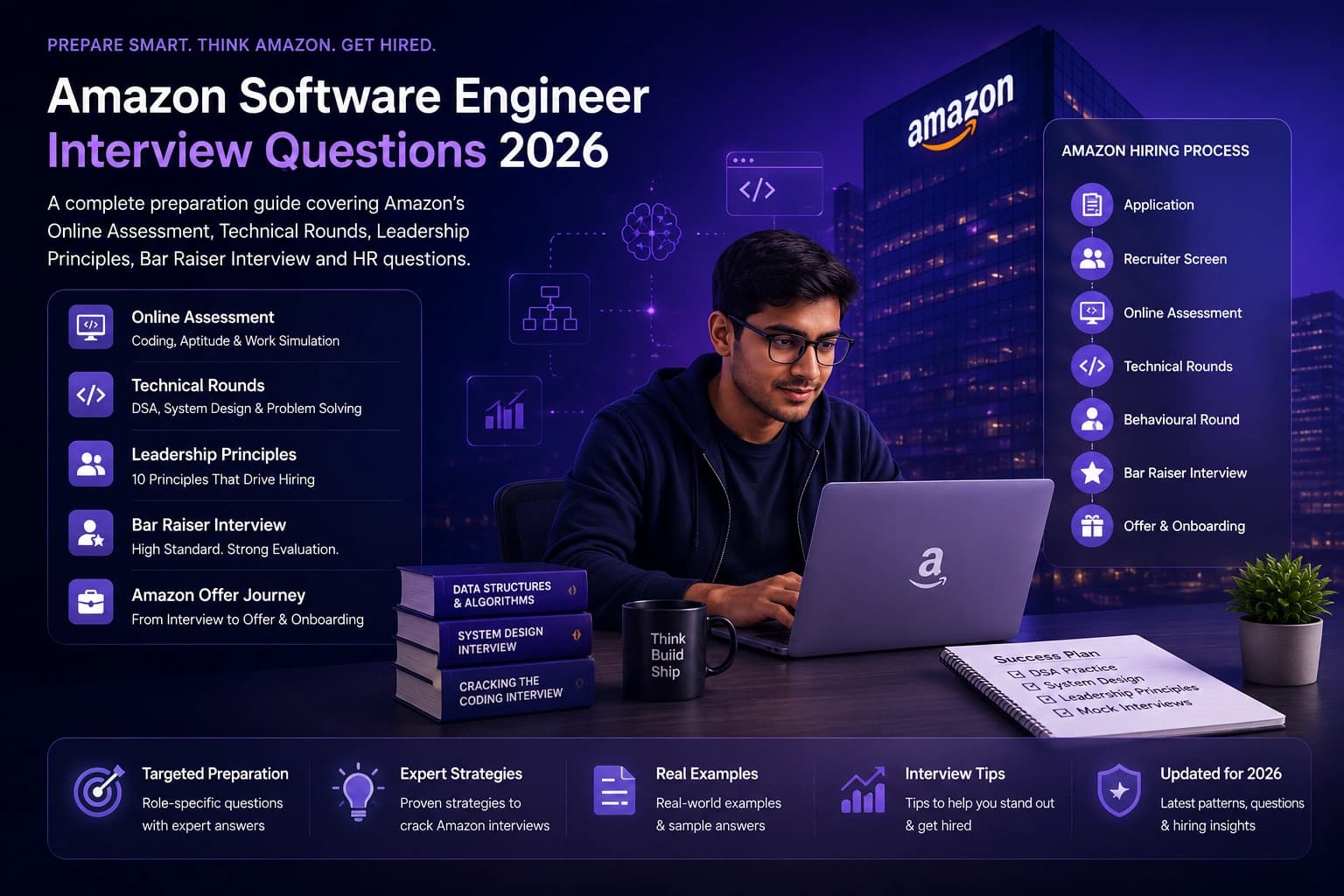
Community synthesis + editorial guide covering Amazon SDE Intern OA (~90 min official baseline), interview patterns, Leadership Principles, and a 30-day preparation roadmap.
[Official] · [Community] · [InterviewEra Insight] · [Observation] labels mark evidence sources throughout.
If you are preparing for Amazon SDE Intern university hiring in 2026, you need more than “do DSA and Leadership Principles.”
You need a clear map of the official OA baseline, what candidates commonly report next, and how to practice without wasting weeks.
Trust your recruiter email and official posting over social media screenshots.
Quick background
Role focus: Software Development Engineer Intern (often listed as SDE Intern / SDE I Intern).
Audience: final-year students, pre-final students (if eligible), freshers targeting early-career pipelines.
Core skills tested: coding under time pressure + behavioral alignment with Leadership Principles.
[Observation] Amazon-style intern interviews usually fail candidates who prepare only coding or only behavioral answers. Both matter.
Company overview
Amazon evaluates student and graduate SDE candidates for technical problem-solving and behavioral skills aligned with its mission to be Earth's most customer-centric company.
[Official] Amazon publishes university SDE OA and interview preparation guidance on amazon.jobs, including a dedicated Online Assessment page for student/graduate SDE roles.
You do not need Amazon product trivia to clear OA. You do need clear coding fundamentals and consistent workplace judgment.
Internship details
Exact stipend, duration, and location depend on the official posting for your cycle. Do not invent numbers from unofficial lists.
| Detail | Status |
|---|---|
| Role title | Confirm on posting (SDE Intern / SDE I Intern naming varies) |
| Duration | Posting-dependent |
| Location / work mode | Posting-dependent |
| Tech stack | Team-dependent |
[Community] Candidates in India university / early-career cycles commonly discuss internship windows in the multi-month range and major tech city locations. Treat those as reports, not guarantees.
[InterviewEra Insight]Never copy last year's campus drive assumptions into this year's application. Read the current posting line by line.
Why this guide matters
Most students prepare randomly:
- 200 LeetCode problems with no pattern revision
- zero Leadership Principle stories
- one silent mock the night before OA
[InterviewEra Insight] Amazon conversion usually comes from timed pattern practice + spoken explanation + STAR stories with metrics.
What you will learn
- Official internship OA structure baseline
- Community-reported interview round patterns
- How to prepare DSA, CS fundamentals, projects, and LPs
- Representative coding/behavioral examples (not claimed leaked questions)
- A 30-day roadmap and checklist
- Mistakes that quietly reduce offer chances
Amazon SDE Internship 2026 overview
| Field | Summary | Evidence |
|---|---|---|
| Company | Amazon | Official naming |
| Role | SDE Intern / SDE I Intern | Confirm posting |
| Hiring | University / early-career | Varies by program |
| Duration | Posting-dependent | Do not invent |
| OA | Coding + Workstyles + Feedback (~90 min internship OA) | [Official] |
| Interview rounds | Often 1–2 technical interviews after OA | [Community] |
| Difficulty | Medium–Hard overall | [Community] + [Observation] |
| Result | Offer / reject / hold; timelines vary | [Community] |
Amazon SDE Intern job description themes
Do not invent eligibility, salary, or required coursework. Use your official job description. Themes below are common for university SDE Intern postings and should be verified against your listing.
Responsibilities (typical themes)
- Build and test software with mentor guidance
- Write maintainable code and participate in reviews
- Debug issues with increasing independence
- Collaborate with engineers and stakeholders
- Communicate progress clearly
Technologies & preferred skills
Stack is team-dependent. Candidates often work with Java / C++ / Python, Git, testing, APIs, and data stores. Preferred signals: DSA fundamentals, clear communication, project ownership, and fast learning under feedback.
Eligibility / locations / expected knowledge: confirm on the posting. Do not rely on unofficial Telegram lists for CGPA cutoffs, branch rules, or location guarantees.
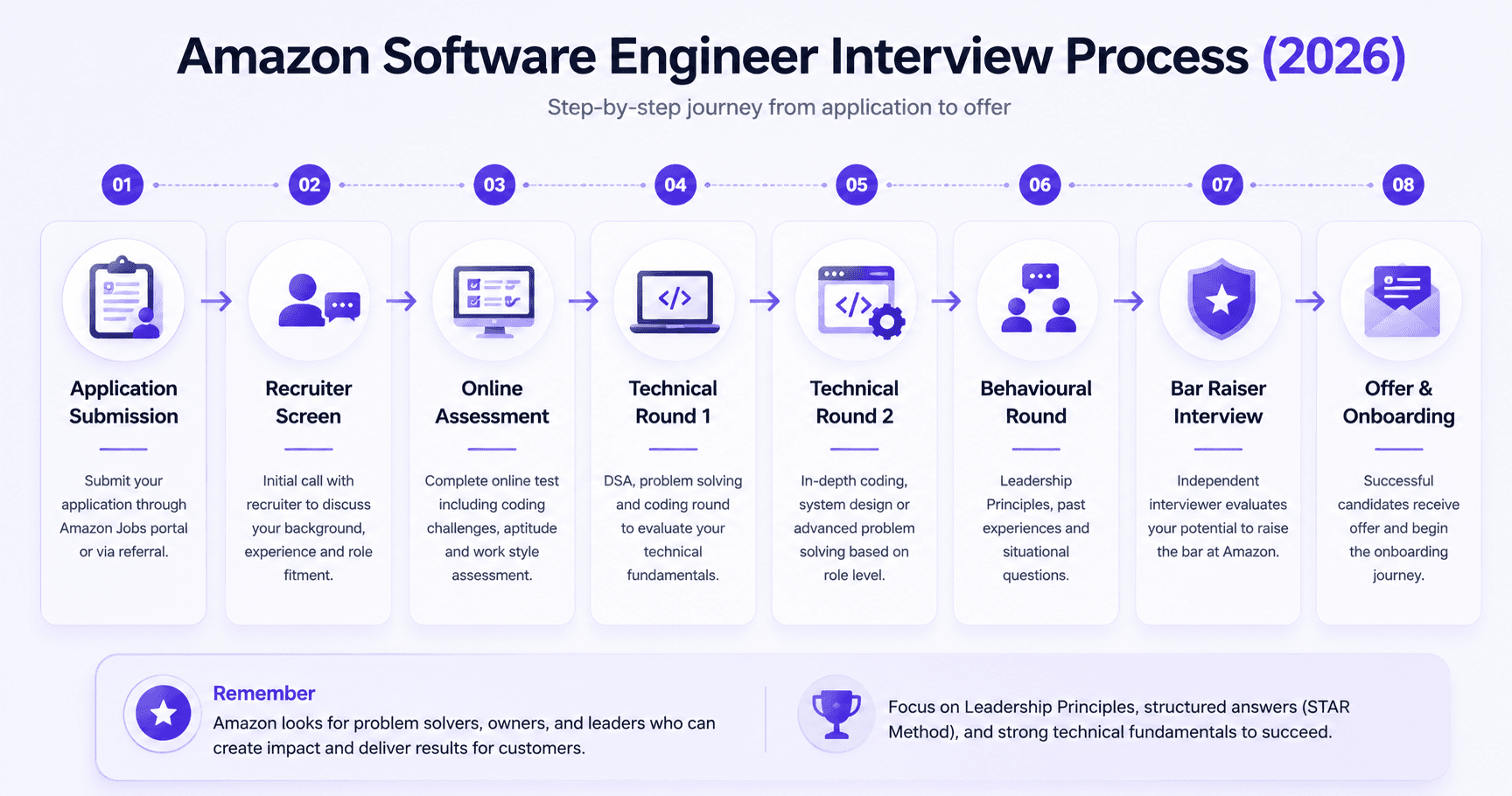
Hiring timeline
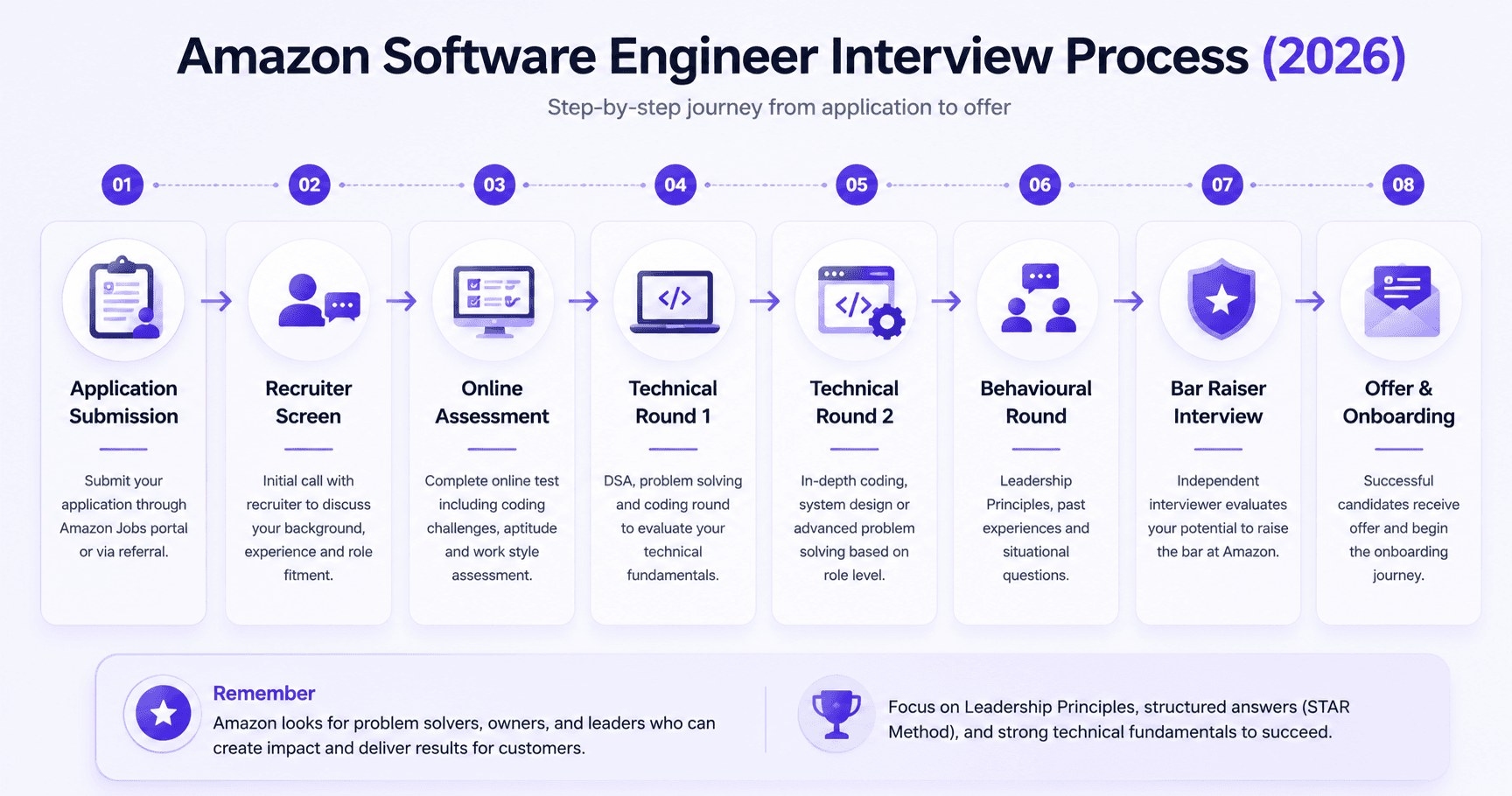
Application
Campus portal / Amazon university careers / recruiter shortlist
OA invitation
Deadline + setup instructions
Online Assessment
Coding + workstyles + feedback survey
Interview invite
If shortlisted for that window
Round 1
Coding + project/LP discussion (community pattern)
Round 2
Deeper coding and/or stronger LP probing (community pattern)
Recruiter communication
Update / additional loop / decision
Offer
If selected; details in offer documents
[Community] Some campuses compress rounds. Some candidates wait longer between OA and interviews. Plan for variance.
Preparation strategy
DSA
| Topic | Why it matters | Practice focus |
|---|---|---|
| Arrays | Base for OA and live coding | Two pointers, prefix sums |
| Strings | Frequent warm-up / OA pattern | Windows, parsing, hashing |
| Trees | Common live interview topic | DFS/BFS, recursion control |
| Graphs | Separates strong solvers | Modeling + traversal |
| Binary Search | Clean reasoning signal | Search-space design |
| Sliding Window | High OA frequency in community reports | Fixed + variable windows |
| HashMap | Lookup / frequency problems | Complexity + edge cases |
| DP | Appears in harder prompts | State definition first |
| Greedy | Fast correctness checks | Counterexamples |
| Heaps | Top-K / scheduling style | Trade-off clarity |
CS fundamentals
| Area | Interview-ready depth |
|---|---|
| OOP | Classes, composition vs inheritance, practical design |
| OS | Threads vs processes, deadlock basics, memory awareness |
| DBMS | Keys, joins, indexing, transactions |
| CN | HTTP, TCP vs UDP, DNS high-level |
Projects, resume, Leadership Principles
Prepare 1–2 projects you can defend for 10 minutes: problem, your contribution, architecture choice, biggest bug, metric/outcome, and what you would rebuild.
Write ownership clearly on your resume (action + system + metric). Before applying, review formatting with InterviewEra's ATS Resume Checker.
Prepare 8–12 STAR stories. Rehearse follow-ups: What did you do? What metric changed? What would you do differently?
Online Assessment experience
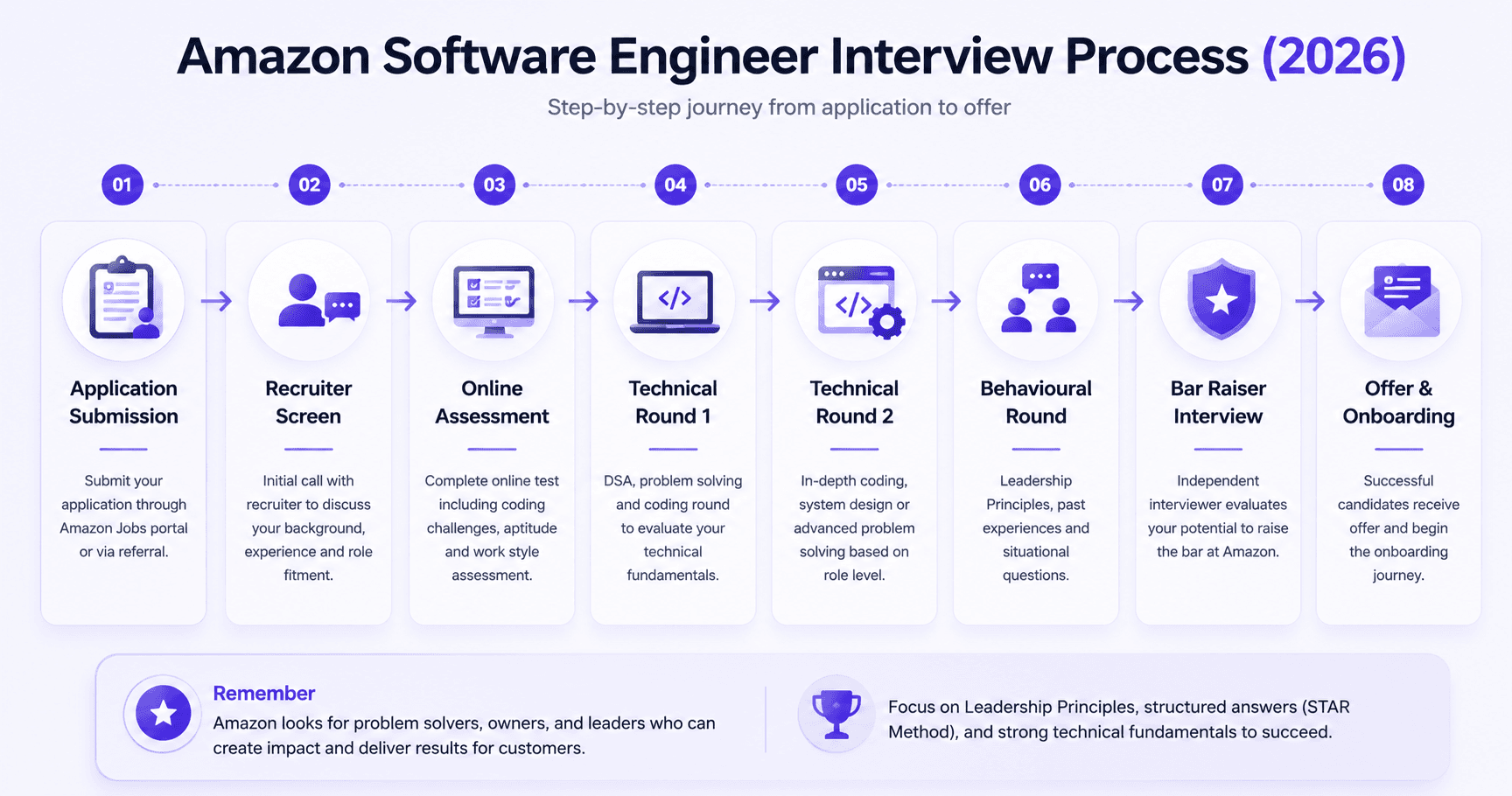
This OA section combines [Official] structure with [Community] difficulty reports and [InterviewEra Insight] tactics. It is not a claim that every campus receives identical prompts.
Structure
[Official]For SDE internships, Amazon's university OA guidance states the OA takes about 90 minutes and includes:
- Coding Assessment — average ~70 minutes
- Workstyles Assessment — average ~15 minutes
- Feedback Survey — average ~5 minutes
Source: amazon.jobs — Online assessment prep for SDE roles. Amazon also notes OA details can differ by country/role. Follow your invitation email.
Coding & Workstyles
- [Official]Practice using Amazon's Online Assessment Practice Test when available
- [Official] Publicly accessible online resources may be allowed during coding, with restrictions
- [Official] Avoid prohibited actions such as print-screen behavior that can terminate the session
- [Official] Complete the feedback survey — failure to complete it can delay results/next steps
- [Community] Candidates commonly report two DSA-style coding problems
- [InterviewEra Insight] Answer Workstyles as one consistent person
Representative coding themes
Theme 1: Sliding window / frequency constraints (practice theme — not a claimed leaked item). Restate constraints → confirm brute force → window + HashMap → validate edge cases. Typical complexity O(n) time, O(k) space.
Theme 2: Trees / graphs / heap-based selection. Model the structure, explain BFS/DFS/heap choice, handle empty/disconnected inputs, ship correct slower solution then optimize.
Interview Round 1 (representative walkthrough)
[Community]After OA, many university-hiring candidates report at least one technical interview mixing coding with project and Leadership Principle discussion. This is a representative walkthrough, not one person's private transcript.
- 60–90 second intro: who you are, what you study, one project, why SDE internship
- Project probes: hardest bug, stack choice, success metric, what you would change
- Often one medium DSA problem with follow-ups ([Community])
- LP examples candidates commonly report: ownership beyond assigned work; handling disagreement
Common mistakes: coding before clarifying constraints, silent coding, “we did everything,” ignoring behavioral questions in a “technical” round.
Interview Round 2 (representative walkthrough)
[Community] A second round, when scheduled, is often deeper on coding rigor and Leadership Principle follow-ups.
- Sharper project probes: bottlenecks, failure modes, rejected trade-offs
- Medium–hard themes commonly discussed: DP state design, constrained graph traversal, hashing + sorting
- Deeper LP prompts: tight deadline delivery, failure + learning, dive-deep root cause
[InterviewEra Insight] Candidates who convert often need a hint — and use it well — then finish with working code plus a strong STAR story.
Leadership Principles
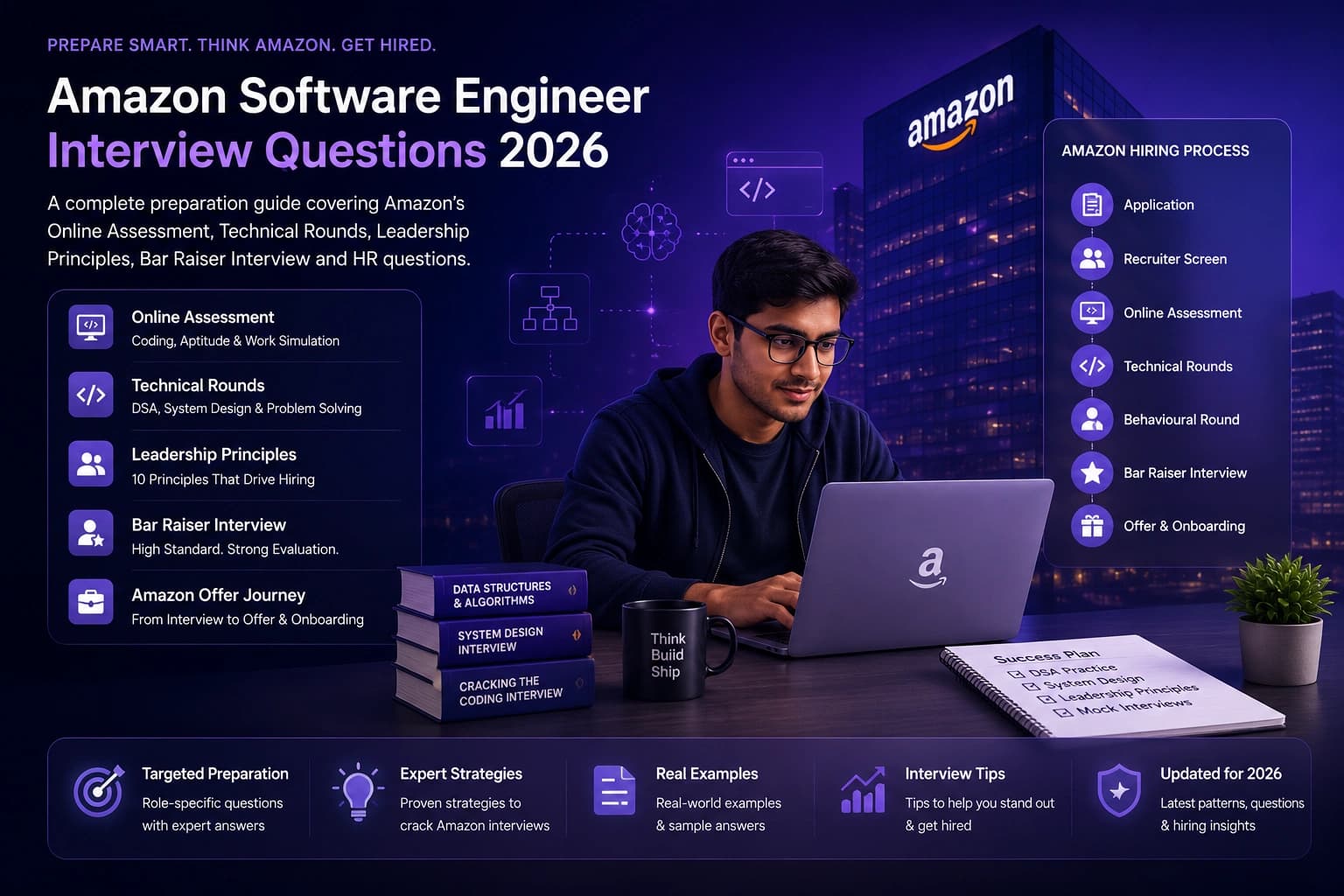
[Official] Amazon publicly documents its Leadership Principles and uses them in hiring conversations. Official reference: Amazon Leadership Principles.
| Leadership Principle | What strong answers show | Student-friendly example angle |
|---|---|---|
| Ownership | You fixed issues beyond a narrow task list | Unblocked a broken module without waiting to be assigned |
| Customer Obsession | You optimized for end-user outcome | Changed a feature after tester/user feedback |
| Learn & Be Curious | You taught yourself under pressure | Learned a library mid-project to ship |
| Bias for Action | You decided with incomplete data, responsibly | Shipped MVP with rollback plan |
| Deliver Results | You finished despite obstacles | Hit a demo after a mid-project failure |
| Dive Deep | You inspected evidence, not guesses | Used logs/metrics to find root cause |
| Invent & Simplify | You reduced complexity | Replaced a messy flow with a simpler design |
Technical questions
Practice DSA themes (sliding window, trees, graphs, binary search, heaps, DP), plus OOP, DBMS, OS, and CN probes at interview depth — not textbook memorization. Language fluency matters less than correct code under pressure and clear complexity reasoning.
Behavioral questions
Use STAR every time: Situation (2–3 lines), Task, Action (longest, personal), Result (metric + learning). High-frequency prompts candidates and coaches rehearse: conflict, failure, too many tasks, feedback that changed a plan, learning quickly, incomplete information.
For deeper STAR practice, see STAR method with examples.
Coding questions summary
| Topic | Difficulty | Pattern |
|---|---|---|
| Substring/subarray constraint | Medium | Sliding window + HashMap |
| Merge intervals | Medium | Sort + sweep |
| Path sum / LCA-style | Medium | Tree DFS |
| Dependency ordering | Medium | Graph + topo sort |
| Top K frequent | Medium | Heap / HashMap |
| Sequence DP | Medium–Hard | DP states |
| Grid DFS/BFS | Medium | Flood fill / search |
| Rotated search | Medium | Binary search |
Practice under a timer, then explain out loud. Use InterviewEra's Interview Question Generator and software engineer interview guide for drills.
30-day preparation roadmap
- Week 1 — Foundations: arrays, strings, hashing, two pointers; 2 timed sets; draft 6 STAR stories; clean resume
- Week 2 — OA simulation: sliding window, binary search, trees; 3 timed OA-style mocks; Workstyles consistency; project deep dives
- Week 3 — Depth + live skills: graphs, heaps, intro DP; speak-while-coding; LP follow-ups; 2 mock interviews
- Week 4 — Conversion polish: weak-pattern revision; 2 harder mocks; finalize 10–12 STAR stories; sleep + setup checklist
Resources
- amazon.jobs SDE OA page — official OA expectations
- Amazon Leadership Principles — exact LP language
- LeetCode, InterviewBit, TakeUForward / Striver Sheet, NeetCode — practice patterns
- InterviewEra AI Mock Interview — live coding + behavioral rehearsal
- Career / placement roadmaps
Common mistakes
- DSA-only prep with zero LP stories
- Memorizing solutions without patterns
- Silent mocks, then freezing in real interviews
- Project stories with no metrics
- Inconsistent Workstyles answers
- Skipping OA edge cases
- Overusing “we” instead of personal ownership
- Panic-switching approaches every few minutes
- Missing recruiter deadlines
- Chasing Hard problems before Medium patterns are solid
Pro tips
- Clarify constraints before coding
- Correct first, optimize second
- Keep a failure story ready
- Quantify results
- Practice 45–60 minute interviews, not only 20-minute puzzles
- Rehearse your intro until it sounds natural
- Sleep before OA day
- After every mock, fix one weakness next session
What usually helps candidates convert
[Community] + [InterviewEra Insight]
- Timed OA mocks until two mediums feel routine
- STAR stories with metrics
- Narrated coding in every practice session
- One strong project explained end-to-end
- Consistent Workstyles answers
- Calm recovery after hints
What most candidates would do differently: start LP prep in Week 1, record mocks, build an edge-case checklist earlier, stop chasing random Hard problems too early, keep a decision log for projects.
Preparation checklists
Resume Checklist
0/6 · 0%
Projects Checklist
0/6 · 0%
Leadership Principles Checklist
0/6 · 0%
Interview Day Checklist
0/7 · 0%
Who should apply?
Apply if you match the official eligibility window, can write code in at least one mainstream language, will prepare both DSA and behavioral storytelling, and can explain projects without reading a README aloud.
[Observation] You do not need a mythical perfect profile. You need clear signal: problem-solving, ownership, and communication.
Latest 2026 hiring trends
[Community] Recent candidates commonly report coding + Leadership Principle evaluation across the process.
[Official]Internship OA baseline remains coding + workstyles + feedback survey (~90 minutes) per Amazon's university OA page.
Exact OA and interview process may vary by university, region, hiring team, recruiter, and year / hiring window. When sources conflict, prioritize recruiter email + amazon.jobs over unofficial forwards.
Key takeaways
- This article is a Community Synthesis + Editorial Guide, not a fabricated offer diary.
- [Official] Internship OA ≈ 90 minutes: coding + workstyles + survey.
- [Community] Interviews often mix DSA with Leadership Principles; round count varies.
- Prepare patterns, not PDF dumps.
- Build 8–12 STAR stories with metrics.
- Communication under pressure is part of the evaluation.
- A 30-day plan with weekly mocks beats last-week panic grinding.
Frequently AskedQuestions
Process Overview
What is the Amazon SDE Intern interview process for university hiring?
Most university pipelines follow application → OA → interviews → recruiter update → decision. Exact steps vary by campus, region, and hiring team. Use your recruiter email as the source of truth for your loop.
How hard are Amazon SDE Intern interviews?
Overall difficulty is commonly described as medium to hard. The real challenge is combined: timed coding quality, behavioral depth, and clear communication.
How many interview rounds are there after OA?
Many candidates report around one to two technical interviews after OA. Some loops add or compress rounds depending on team and campus process.
How long does the Amazon SDE Intern hiring process take?
Timelines vary widely by campus, region, and hiring window. Some candidates move from OA to interviews within days; others wait weeks. Track recruiter emails and spam folders rather than assuming a fixed calendar.
Is Amazon SDE Intern hiring the same for every college?
No. University, region, recruiter, hiring team, and year can change OA timing, interview count, and communication style. Treat campus drive stories as patterns, not guarantees for your batch.
Do I need a referral for Amazon university hiring?
Referrals can improve visibility in some pipelines, but they do not replace OA or interviews. You still need strong coding and Leadership Principle stories. Follow the official application path listed for your cycle.
InterviewEra
Practice what Amazon actually tests
Coding under time pressure plus Leadership Principle stories. Educate first, then practice with feedback.