AI-assisted interviews
Agentic AI Interview Round (2026):The Ultimate Guide to Cracking AI-Assisted Technical Interviews
Part 1 — Understand the shift
Part 2 — How you are evaluated
Part 3 — Train like the rubric
Part 4 — India & what comes next
A few years ago, interviewers wanted to know whether you could write code without Google. Today, some of the world's fastest-growing AI companies hand you Cursor, Claude, or ChatGPT on day one — and judge how effectively you collaborate with AI instead.
That shift produced the agentic AI interview round: not a trick question about algorithms memorized at 2 a.m., but a realistic slice of modern engineering where you clarify requirements, plan, delegate, verify, test, and own the outcome. This guide is InterviewEra's flagship hub for candidates, recruiters, engineering managers, and students preparing for that new bar — from first principles through rubrics, India-specific trends, and daily prep roadmaps.
Part I — Foundations
Understand the shift
Learn what agentic AI interview rounds are, why companies adopt them, how interviews evolved, and what “agentic” really means before you touch an IDE.
What is an Agentic AI Interview Round?
An agentic AI interview round is a technical assessment where candidates use AI coding assistants (Cursor, Claude, ChatGPT, Copilot) as collaborators while interviewers evaluate engineering judgment, requirement clarification, planning, verification, and ownership — not memorized syntax or typing speed.
Traditional coding interviews optimized for a world where IDEs were offline and Stack Overflow was taboo. Agentic AI rounds optimize for 2026: engineers ship features with AI agents in the loop, and companies need to know you will not ship hallucinated garbage to production.
The round is still a technical interview. You may build an API, fix a bug, or extend a frontend — but permitted AI tools are part of the environment. Interviewers watch how you work, not whether you can outperform a language model on raw typing speed.
AI-assisted coding is using autocomplete or a single suggestion. AI dependency is accepting output you cannot explain or test. Agentic collaboration sits between: you orchestrate multi-step work, iterate on prompts, review diffs, and remain accountable.
| Dimension | Traditional | Agentic AI |
|---|---|---|
| Goal | Recall algorithms & syntax under pressure | Engineering judgment with AI as a tool |
| Tools | Whiteboard or bare IDE, no internet | AI assistants permitted (company-specific) |
| Evaluated | Correctness, complexity analysis | Clarification, planning, verification, ownership |
| Risk signal | Cannot solve without hints | Cannot verify or explain AI-generated code |
| Mirrors work? | Partially (legacy loops) | Yes — modern product engineering |
| Senior signal | Optimal algorithm quickly | Delegates well, reviews ruthlessly, ships safely |
Why Companies Are Introducing Agentic AI Rounds
Companies introduce agentic AI rounds because modern engineers ship with AI tools daily; the interview must measure how candidates delegate, verify, and own outcomes in real workflows — skills that separate senior judgment from blind copy-paste.
Three forces converged. First, tool adoption: Copilot, Cursor, and Claude Code are line items on engineering budgets. Second, productivity: teams that collaborate well with AI ship faster. Third, hiring signal: coding speed alone no longer separates strong seniors from weak hires — judgment does.
- Real workflows: Pairing with AI mirrors daily delivery more than isolated LeetCode.
- Senior vs junior thinking: Juniors prompt; seniors direct, review, and cut scope.
- Engineering judgment: Trade-offs, security, and operability remain human-owned.
Evolution of Technical Interviews
Technical interviews evolved from whiteboard memorization through take-homes and online judges to pair programming, LLM-assisted coding, and now agentic AI rounds that test human-AI collaboration before future autonomous engineering assessments.
Understanding the timeline explains why your seniors trained differently — and why your cohort needs agentic skills now, not after offer letter.
Technical interview evolution (illustrative)
- 1
Whiteboard Era~1990s–2010s
Algorithms on whiteboard, no IDE
- 2
Take-home Assignments~2010s
Multi-hour projects at home
- 3
Online Coding Platforms~2015–2020
HackerRank, Codility OAs
- 4
Pair Programming~2018–present
Live collaboration with interviewer
- 5
LLM-Assisted Coding~2023–2024
Early Copilot experiments in interviews
- 6
Agentic AI Interviews~2024–2026
Full AI collaboration assessment
- 7
Autonomous EngineeringProjected 2027+
AI agents with human oversight loops
What Does "Agentic" Actually Mean?
"Agentic" means the AI can plan multi-step work, propose implementations, and iterate with tool use — while the human retains accountability for requirements, architecture, code review, testing, and final decisions.
An AI agent can plan subtasks, call tools, read files, and propose multi-file changes. That is qualitatively different from tab-completion. Human oversight means you validate each step against requirements and risk appetite. Decision ownership never transfers.
Myth: Agentic interviews mean AI does the work for you.
Reality: You are evaluated on how you direct, verify, and own the output — not on AI throughput.
Myth: DSA knowledge no longer matters.
Reality: Fundamentals enable you to catch AI errors, choose algorithms, and explain complexity.
Myth: More AI usage always scores higher.
Reality: Disciplined, purposeful AI use beats chaotic prompting and unreviewed paste.
Myth: Any AI tool is allowed.
Reality: Companies specify permitted tools; always confirm at the start of the round.
Poor prompt
Build a task APIGood prompt
Stack: Node + Express + TypeScript.
Add POST /tasks: { title: string (1-120), dueDate?: ISO8601 }.
Return 201 { id, title, dueDate? }. 400 on validation errors.
Files: src/routes/tasks.ts only. No new dependencies.
Improved prompt
Context: existing app in src/app.ts, in-memory store pattern in src/store.ts.
Task: POST /tasks — validate title 1-120 chars, optional ISO8601 dueDate.
Errors: 400 { error: string }. Success: 201 { id: uuid, title, dueDate? }.
Also generate vitest tests: happy path, empty title, invalid date.
Do not add packages beyond what is in package.json.
Adds file context, test expectations, and dependency guardrails.
Part II — The Interview Process
How you are evaluated
Walk through the live loop — skills scored, senior mindset, formats, a minute-by-minute workflow, and a side-by-side simulation of weak vs strong candidates.
How an Agentic AI Interview Works
A typical agentic AI interview flows from problem statement through clarification, planning, AI-assisted implementation, testing, code review, and a discussion of trade-offs — mirroring how senior engineers work on production tasks.
Loops vary by company, but the macro flow is stable. You are evaluated continuously — not only on the final diff.
End-to-end agentic interview process
Skills Being Evaluated
Interviewers score clarification, communication, system thinking, prompting quality, planning, architecture, trade-offs, debugging, testing, risk analysis, ownership, decision-making, code review, and engineering judgment.
Interviewers use a multi-dimensional rubric (see Section 12). Below: what each skill means, strong vs weak signals, and what they write on the scorecard.
| Skill | Why it matters | Good signal | Bad signal |
|---|---|---|---|
| Requirement clarification | Ambiguous specs cause wrong solutions; seniors ask before coding. | Asks about auth model, rate limits, and error format before writing endpoints. | Assumes REST when the interviewer wanted GraphQL; builds the wrong API. |
| Communication | Interviewers must follow your reasoning in real time. | Narrates plan: "I will add validation layer first, then handler, then tests." | Silent for 20 minutes, then surprises interviewer with unfinished code. |
| System thinking | Features touch data, APIs, and failure modes — not isolated functions. | Considers idempotency, retries, and observability for a webhook handler. | Implements happy path only; no logging or error boundaries. |
| AI prompting | Vague prompts produce vague code; precision saves review time. | Prompt includes stack, constraints, file structure, and test expectations. | "Build the API" with no context — receives generic, wrong-framework code. |
| Planning | Plan prevents rework and shows you can decompose problems. | Sketches modules, data flow, and test order on paper or comments first. | Prompts AI repeatedly without structure; ends with conflicting files. |
| Architecture | Structure must scale and remain readable for the team. | Separates routes, services, and repositories with clear interfaces. | Single 400-line file mixing HTTP, SQL, and business logic. |
| Trade-off analysis | Every choice has cost; seniors articulate alternatives. | Chooses in-memory cache for interview scope; notes Redis for production. | Adds Kubernetes because AI suggested it for a CLI tool. |
| Debugging | AI introduces subtle bugs; you must trace and fix them. | Reads stack trace, reproduces failure, fixes root cause in validation layer. | Re-prompts AI randomly until something compiles. |
| Testing | Tests prove the solution works and catch AI hallucinations. | Writes unit tests for edge cases AI missed; runs them before claiming done. | Manual click-test only; misses null input and boundary failures. |
| Risk analysis | Shipping unsafe code fails in production interviews and real jobs. | Flags SQL injection risk in AI-generated query; parameterizes inputs. | Ships string-concatenated SQL because it passed one manual test. |
| Ownership | You sign the code — not the model. | Says "I chose this approach because…" and fixes AI mistakes personally. | Blames AI when code fails: "The model gave me that." |
| Decision making | Interviews compress weeks of decisions into one hour. | Cuts scope to deliver tested core; documents deferred features. | Chases optional features while core requirement remains broken. |
| Code review | Reviewing AI output is half the job in agentic workflows. | Walks through diff, removes dead code, fixes naming and error handling. | Accepts generated code without reading imports or side effects. |
| Engineering judgment | Holistic signal — knowing when AI helps vs when you must think alone. | Uses AI for boilerplate; designs auth flow manually after threat modeling. | Delegates architecture to AI; cannot explain data model. |
Poor prompt
make this code betterGood prompt
Review src/middleware/auth.ts for:
1) missing rate limiting on /login
2) JWT expiry validation
3) error response shape consistency
List issues by severity; suggest patches inline.
Improved prompt
Security review — auth middleware only (src/middleware/auth.ts).
Threat model: public internet, brute-force login, token replay.
Output: table [severity, line, issue, suggested fix].
Do not refactor unrelated files. Flag any new dependency proposals.
Threat model + structured output reduces noisy refactors.
Senior Engineer Mindset
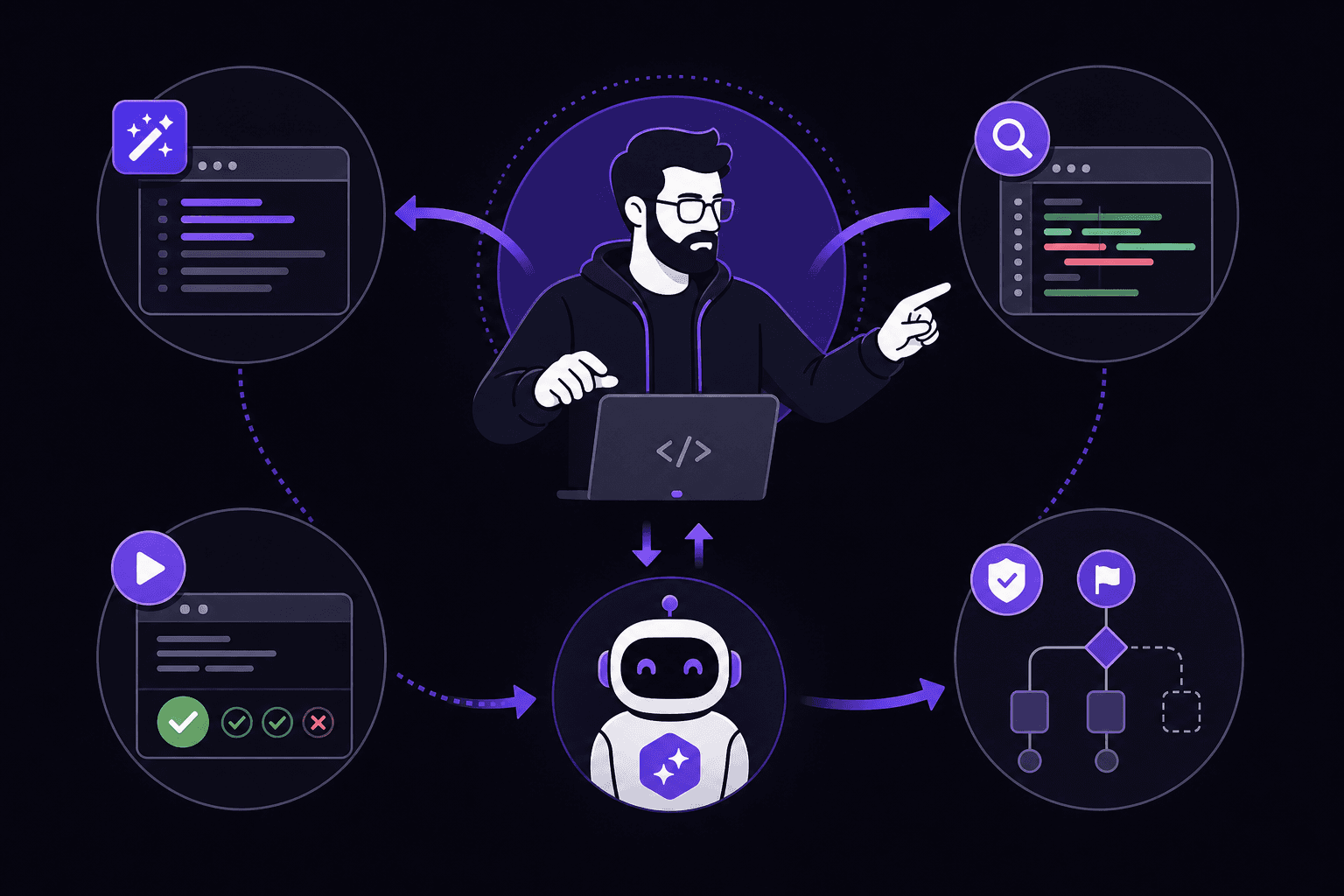
Treat yourself as the senior engineer and AI as a fast but unreliable junior teammate: you set direction, review every line, run tests, and own the result.
The mental model that separates hires: You are the senior engineer. AI is your junior teammate. You delegate boilerplate; you never delegate accountability.
Scenario: AI suggests wrong database index
You explain query patterns to the interviewer, reject the index, and implement a composite index with justification — demonstrating you understand data access, not just accept suggestions.
Scenario: AI generates insecure auth middleware
You spot missing rate limiting and token validation, rewrite the critical path yourself, and ask AI only for boilerplate tests — showing security ownership.
Scenario: Time running out with partial solution
You prioritize a tested happy path plus clear TODOs over a fragile full feature — communicating scope trade-offs like a senior engineer under deadline.
Common Agentic AI Interview Formats
Agentic rounds appear as backend APIs, frontend features, full-stack tasks, CLI tools, bug fixes, system design discussions, data pipelines, AI applications, code reviews, and legacy codebase enhancements.
| Format | Typical task | Interviewer expectations | AI collaboration tip |
|---|---|---|---|
| Backend API | Build REST/GraphQL endpoints with validation and persistence. | Clear resource design, error contracts, basic tests, auth awareness. | Prompt for handler stubs; you own schema, validation rules, and security review. |
| Frontend feature | Implement UI component or page with state and API integration. | Accessible markup, loading/error states, component boundaries. | Use AI for CSS boilerplate; verify a11y and state edge cases yourself. |
| Full-stack task | End-to-end feature spanning API and client. | Contract between layers, consistent types, integration sanity. | Define API contract first; let AI scaffold both sides against your spec. |
| CLI tool | Command-line utility with args, output, and exit codes. | Parse args correctly, helpful --help, handle invalid input. | Prompt with argv examples; test edge cases AI often skips. |
| Bug fixing | Diagnose and fix defect in provided codebase. | Reproduce bug, root-cause analysis, minimal fix, regression test. | Explain bug to AI with stack trace; verify fix does not break neighbors. |
| System design (light) | Design architecture for scale — may include pseudo-code or diagrams. | Components, data flow, bottlenecks, trade-offs; AI for diagrams only if allowed. | Do not outsource capacity estimates; use AI to draft sequence diagrams you validate. |
| Data pipeline | ETL or stream processing snippet — ingest, transform, load. | Idempotency, failure handling, schema evolution awareness. | Specify source/sink formats in prompts; review for data loss paths. |
| AI application | Wire LLM call with prompts, guardrails, and fallbacks. | Prompt structure, timeout handling, PII awareness, eval mindset. | Meta-skill: you are building on AI while being evaluated on AI use. |
| Code review | Review AI-generated or teammate PR; suggest improvements. | Specific line comments, severity, security and style issues. | Optionally use AI to find issues — then prioritize and explain your top 3. |
| Legacy enhancement | Add feature to existing codebase without breaking patterns. | Read before write, match conventions, surgical diffs. | Feed AI relevant file context; reject suggestions that ignore project patterns. |
Sample 60-Minute Interview Workflow
In a 60-minute agentic round, strong candidates spend the first 8–12 minutes clarifying and planning, 30–35 minutes implementing with verified AI assistance, and the final 15 minutes testing and explaining trade-offs.
Task: build a CRUD endpoint for internal tasks with validation. Below is how a strong candidate allocates time — with visible AI use at the right moments.
| Time | Candidate | AI | Interviewer |
|---|---|---|---|
| 0–3 | Read problem; note unknowns | Idle — no prompting yet | Observes whether candidate rushes |
| 3–10 | Asks about auth, pagination, error format | None | Answers 2–3 clarifications |
| 10–15 | Sketches routes, service layer, test plan | Optional: "outline file structure" | May probe plan briefly |
| 15–22 | Prompts for model + repository interface | Generates interfaces | Watches prompt quality |
| 22–30 | Reviews AI code; fixes wrong types | Refines on feedback | Notes ownership |
| 30–40 | Implements handler logic; AI for boilerplate tests | Test scaffolds | Checks verification habit |
| 40–48 | Runs tests; adds missing edge case | Suggests one edge test | May ask about failure modes |
| 48–55 | Manual demo + walkthrough | Idle | Follow-up trade-off questions |
| 55–60 | Summarizes what shipped vs deferred | N/A | Final signal capture |
Poor prompt
Build a task APIGood prompt
Stack: Node + Express + TypeScript.
Add POST /tasks: { title: string (1-120), dueDate?: ISO8601 }.
Return 201 { id, title, dueDate? }. 400 on validation errors.
Files: src/routes/tasks.ts only. No new dependencies.
Improved prompt
Context: existing app in src/app.ts, in-memory store pattern in src/store.ts.
Task: POST /tasks — validate title 1-120 chars, optional ISO8601 dueDate.
Errors: 400 { error: string }. Success: 201 { id: uuid, title, dueDate? }.
Also generate vitest tests: happy path, empty title, invalid date.
Do not add packages beyond what is in package.json.
Adds file context, test expectations, and dependency guardrails.
Run this 60-minute workflow under pressure
Pick a practical task, answer out loud, and get rubric-style feedback — the same dimensions interviewers score in agentic rounds.
Start free scored interviewReal Example: Bad vs Excellent Candidate
Candidates fail agentic rounds by blindly accepting AI output without clarification or tests; they pass by driving the problem with clear prompts, reviewing generated code, and demonstrating ownership.
Task: Build a POST /tasks API that creates tasks with title (required), optional due date, and returns 201 with id. Validate input; persist in memory or SQLite.
Weak approach
Single vague prompt, no tests, cannot explain validation layer.
Strong approach
Structured prompts per layer, edge-case tests, owns trade-offs in discussion.
| Aspect | Weak candidate | Strong candidate |
|---|---|---|
| Clarification | Assumes JSON shape; misses timezone on due date | Asks max title length, date format, id type, and error response schema |
| Planning | Single prompt: "build the API" | Layers: model → validation → route → tests |
| AI prompts | Accepts 200 lines including wrong framework | Specifies stack, existing files, and validation rules per prompt |
| Review | Does not read generated validation | Catches missing 400 on empty title; fixes manually |
| Testing | curl once with valid body | Tests 201, 400 empty title, invalid date format |
| Discussion | "It works on my machine" | Explains in-memory vs DB trade-off for interview scope |
| Outcome | Borderline fail — fragile, unexplained | Strong hire signal — tested, owned, articulate |
Weak prompt
Create a task API endpointStrong prompt
Stack: Node + Express + TypeScript. Existing app in src/app.ts.
Add POST /tasks: body { title: string (1-120), dueDate?: ISO8601 }.
Return 201 { id: uuid, title, dueDate? }. 400 on validation errors as { error: string }.
Generate only src/routes/tasks.ts and src/validation/taskSchema.ts — no new dependencies.
Poor prompt
fix the bugGood prompt
POST /tasks returns 500 when dueDate is omitted (should be optional).
Stack trace: TypeError at validateDueDate (tasks.ts:42).
Expected: 201 with dueDate null/omitted. Actual: 500.
Show minimal fix in validation layer only.
Improved prompt
Bug: POST /tasks 500 when body is { "title": "Ship feature" } (no dueDate).
File: src/validation/taskSchema.ts — validateDueDate treats undefined as invalid.
Constraint: keep optional dueDate; add regression test in tasks.test.ts.
Do not change route handler except if required for error mapping.
Pins file, constraint, and asks for a regression test.
Part III — Preparation & Practice
Train like the rubric
Drill questions, study the scoring matrix, avoid common mistakes, follow structured roadmaps, and run the self-practice loop before your next loop.
50 Agentic AI Interview Questions
Agentic AI interview questions span behavioral ownership, technical depth, architecture, prompting, debugging, testing, AI collaboration norms, trade-offs, communication, and requirement clarification.
Use these for self-practice or interviewer prep. Each includes answer guidance and the signal being probed.
Behavioral
Tell me about a time you disagreed with an AI-generated solution.
Guidance: STAR format: specific bug or design flaw you caught, how you fixed it, outcome.
Describe pressure to ship quickly when AI suggested shortcuts.
Guidance: Show principled scope cut vs unsafe shortcut.
How do you stay accountable when pair-programming with AI?
Guidance: Review checklist, tests, personal sign-off before merge.
When did AI make you faster vs slower?
Guidance: Honest example of prompt thrashing vs structured delegation.
How do you mentor juniors on AI tool use?
Guidance: Teach verification, not copy-paste; cite concrete rules.
Technical
Explain time complexity of your solution and whether AI choice was optimal.
Guidance: Big-O for dominant operation; mention if you overrode AI algorithm.
How would you handle concurrent writes to your in-memory store?
Guidance: Mutex, channels, or DB — match stack; note interview scope.
Design idempotent POST for payment webhook.
Guidance: Idempotency keys, dedup store, retry semantics.
What happens when your AI-suggested regex fails on Unicode input?
Guidance: Test case, fix, discuss limitations of AI for i18n.
Walk through memory lifecycle in your feature.
Guidance: Allocations, closures, connection pools — stack-specific.
Architecture
Why monolith vs services for this interview task?
Guidance: Timebox argument; production migration path.
Where would caching help and what invalidation strategy?
Guidance: Read-heavy paths; TTL vs event-driven invalidation.
How would you scale this to 10M users?
Guidance: Bottleneck identification — DB, stateless app tier, queue.
Draw data flow from client to persistence.
Guidance: Clear diagram narration; mention failure points.
What would you not let AI decide in system design?
Guidance: CAP trade-offs, compliance boundaries, ownership lines.
Prompting
Show how you would prompt for a repository layer only.
Guidance: Include interfaces, error types, no HTTP layer.
How do you reduce hallucinated dependencies in prompts?
Guidance: Whitelist packages, paste package.json excerpt, forbid new deps.
When do you switch models or tools mid-task?
Guidance: Stuck on reasoning vs code gen; cost/latency — practical answer.
How much context do you put in one prompt?
Guidance: Relevant files only; chunking strategy.
Rewrite a vague prompt into a strong one.
Guidance: Live exercise — constraints, examples, output format.
Debugging
This test fails intermittently — your approach?
Guidance: Reproduce, isolate, logging, race hypothesis.
AI introduced off-by-one — how did you find it?
Guidance: Binary search test cases, debugger, or print tracing.
Production error only in one region — hypotheses?
Guidance: Config, latency, data skew, feature flags.
Stack trace points to generated code you do not understand.
Guidance: Read docs, simplify, rewrite critical path yourself.
How do you debug AI-wrong business logic?
Guidance: Compare against requirements doc; table-driven tests.
Testing
What tests did you skip and why?
Guidance: Explicit scope trade-off; what you would add next.
How do you test AI non-determinism in LLM features?
Guidance: Golden sets, eval harness, mock provider.
Unit vs integration for this task?
Guidance: Pyramid appropriate to timebox.
Write a test for invalid date boundary.
Guidance: Live or whiteboard test case.
How would AI help vs hinder TDD here?
Guidance: AI for test list; you assert behavior.
AI collaboration
What tasks do you refuse to give AI in interviews?
Guidance: Security-critical auth, novel algorithm proof, compliance.
How do you document AI assistance in commits?
Guidance: Team policy; honesty; co-authorship norms.
Detect when AI is confidently wrong.
Guidance: Sanity checks, official docs, small experiments.
Collaborate with interviewer vs only AI?
Guidance: Treat interviewer as PM/reviewer; sync at milestones.
Is using ChatGPT on phone during interview cheating?
Guidance: Follow rules; default is in-session tools only unless allowed.
Trade-offs
Speed vs correctness — choice in last 10 minutes?
Guidance: Concrete decision from your session.
Build vs buy for auth in this task?
Guidance: Interview scope favors minimal; discuss OAuth in prod.
SQL vs NoSQL for your schema?
Guidance: Access patterns drive choice; AI bias awareness.
More features vs deeper tests?
Guidance: Prefer tested core — align with rubric.
Refactor now vs ship and ticket tech debt?
Guidance: Interview vs production framing.
Communication
Explain your design to a non-technical stakeholder in 60 seconds.
Guidance: Outcome-focused, no jargon dump.
How did you use the last hint from interviewer?
Guidance: Specific pivot in plan or code.
Summarize what you would do differently with another hour.
Guidance: Prioritized backlog — tests, pagination, auth.
Teach me how your validation layer works.
Guidance: Whiteboard flow; inputs and error paths.
Why should we hire you for an AI-native team?
Guidance: Judgment + fundamentals + learning velocity — not tool brand loyalty.
Requirement clarification
What questions would you ask before building a rate limiter?
Guidance: Limits per user/IP, window, storage, response codes.
Ambiguous "support files" in spec — what do you ask?
Guidance: Size, types, virus scan, storage, CDN.
Interviewer says "make it production-ready" — what changes?
Guidance: Logging, metrics, config, deployment — scoped to time.
How do you record assumptions when PM is unavailable?
Guidance: Comment block or README; state in walkthrough.
Feature creep mid-interview — how do you handle?
Guidance: Reconcile scope with clock; explicit re-prioritization.
Evaluation Rubric & Scorecards
Hiring decisions use a multi-dimensional rubric scoring clarification, planning, ownership, code quality, testing, communication, AI usage discipline, and decision quality on a 1–4 scale per dimension.
| Dimension | Weight | 1 | 2 | 3 | 4 |
|---|---|---|---|---|---|
| Clarification | 15% | No questions; wrong assumptions | Surface questions only | Good coverage of scope and constraints | Excellent edge-case and NFR clarification |
| Planning | 12% | No plan; chaotic execution | Vague mental plan | Clear steps referenced during work | Plan adapts visibly when new info emerges |
| Ownership | 15% | Blames AI; cannot explain code | Partial understanding | Owns decisions and fixes AI errors | Strong accountability and leadership tone |
| Code quality | 15% | Unreadable or broken structure | Works but messy | Clean, idiomatic, maintainable | Production-minded with clear abstractions |
| Testing | 12% | No tests | Manual only | Automated happy path + edge case | Thoughtful coverage tied to requirements |
| Communication | 10% | Silent or confusing | Intermittent updates | Clear narration at milestones | Excellent collaboration with interviewer |
| AI usage | 11% | Chaotic or dishonest use | Under- or over-reliance | Disciplined, iterative prompting | Optimal delegation and verification |
| Decision quality | 10% | Poor prioritization | Adequate but unarticulated | Sound trade-offs explained | Senior-level judgment under time pressure |
Sample: Strong hire — Hire
- Clarification: 4/4
- Planning: 3/4
- Ownership: 4/4
- Code quality: 3/4
- Testing: 4/4
- Communication: 3/4
- AI usage: 4/4
- Decision quality: 3/4
Candidate clarified auth and rate limits upfront, used AI for handler stubs, caught SQL issue in review, shipped tested endpoints with clear narration.
Sample: Borderline — No hire / lean no
- Clarification: 2/4
- Planning: 2/4
- Ownership: 2/4
- Code quality: 3/4
- Testing: 1/4
- Communication: 2/4
- AI usage: 2/4
- Decision quality: 2/4
Working demo but no tests, vague prompts, could not explain middleware; blamed AI for validation bug.
Common Mistakes
The most costly mistakes in agentic interviews are skipping clarification, accepting unreviewed AI code, poor prompting, no tests, overengineering, and failing to explain trade-offs.
#1Blindly accepting AI output
Consequence: Subtle bugs, wrong libraries, or security holes sink the round.
Fix: Read every generated block; run tests before moving on.
#2Skipping requirement clarification
Consequence: Build the wrong feature; no recovery time left.
Fix: Spend 5–10 minutes asking structured questions and stating assumptions.
#3No tests written
Consequence: Interviewer cannot trust the solution works.
Fix: Add at least happy path + one edge case test before calling done.
#4Vague or one-shot prompting
Consequence: Generic code that does not match the stack or constraints.
Fix: Iterate prompts with file context, types, and explicit constraints.
#5Overengineering
Consequence: Time lost on microservices when a module would suffice.
Fix: Match scope to interview timebox; mention production extensions verbally.
#6Not reviewing imports and dependencies
Consequence: AI adds packages not in the project or banned by policy.
Fix: Check package.json and lockfile impact before accepting suggestions.
#7Silent coding for 30+ minutes
Consequence: Interviewer has no signal on your thinking.
Fix: Think aloud at plan transitions, not every keystroke.
#8Using AI for architecture without understanding
Consequence: Cannot answer follow-up "why" questions.
Fix: Design architecture yourself; delegate implementation details to AI.
#9Ignoring security basics
Consequence: Instant fail at security-conscious companies.
Fix: Review auth, input validation, and secrets handling on every AI diff.
#10Copy-pasting without adapting to codebase style
Consequence: Solution feels foreign; review flags inconsistency.
Fix: Match naming, patterns, and folder layout of existing code.
#11Chasing perfect polish over working core
Consequence: Core requirement incomplete at time limit.
Fix: Ship tested MVP first; polish if time remains.
#12Blaming the AI when code fails
Consequence: Signals lack of ownership.
Fix: Own mistakes: "I should have validated that input."
#13Using disallowed tools or external paste
Consequence: Integrity violation; automatic rejection at strict companies.
Fix: Confirm permitted tools at start; stay in approved environment.
#14Not explaining trade-offs in discussion
Consequence: Miss senior-level signal even with working code.
Fix: Prepare 2–3 alternatives you rejected and why.
#15Prompting for entire solution at once
Consequence: Unreviewable 500-line dump with intertwined bugs.
Fix: Incremental prompts per module with verification between steps.
#16Skipping error handling
Consequence: Happy-path-only code breaks on first edge case demo.
Fix: Ask AI for error types; implement handlers you understand.
#17No version control hygiene
Consequence: Messy history; hard to explain changes in review.
Fix: Commit logical chunks with clear messages if git is in scope.
#18Treating AI like search, not collaborator
Consequence: Miss leverage; finish slower than peers.
Fix: Use AI for boilerplate, tests, and refactors — not as Google substitute only.
#19Ignoring interviewer hints
Consequence: Double down on wrong approach.
Fix: Pause, acknowledge hint, adjust plan explicitly.
#20Fabricating metrics or experience in discussion
Consequence: Behavioral red flag when probed.
Fix: Use honest hypotheticals: "In production I would measure…"
#21No post-implementation walkthrough
Consequence: Interviewer unsure what you actually understand.
Fix: Reserve 5 minutes to demo and trace one request through the system.
#22Neglecting fundamentals prep
Consequence: Cannot spot when AI chooses wrong algorithm.
Fix: Maintain DSA and system basics alongside AI tool practice.
Preparation Roadmaps
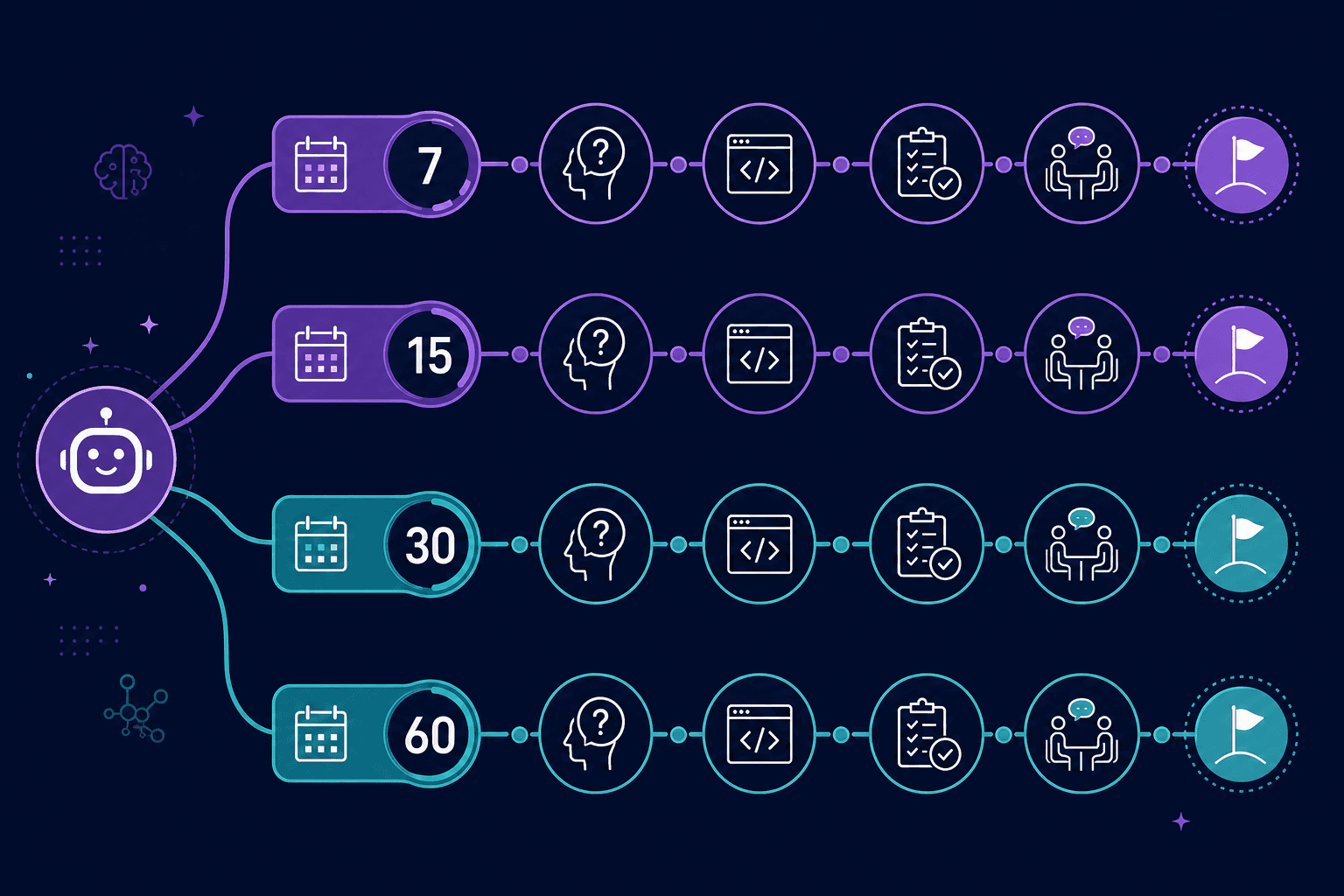
Structured prep follows 7-day fundamentals, 15-day format practice, 30-day rubric-aligned drills, or 60-day comprehensive readiness including mock agentic sessions.
7-Day Crash (7 days)
Fundamentals and one full simulated agentic session.
Day 1
- Read agentic round format; list permitted tools you will use
- Practice 10 clarification questions on ambiguous specs
Day 2
- DSA refresh: arrays, hashing, strings — 3 problems without AI
- Same 3 problems with AI; compare speed and error rate
Day 3
- Prompting drill: 5 incremental prompts for a REST endpoint
- Review and fix one deliberately buggy AI output
Day 4
- Bug-fix exercise in unfamiliar repo (open source or sample)
- Write regression test for the fix
Day 5
- 60-minute timed mock: backend API task with AI allowed
- Self-score against rubric dimensions
Day 6
- Review mistakes list; redo weakest dimension only
- Practice think-aloud narration for 20 minutes
Day 7
- Second full mock; record screen if possible
- Write 5 STAR stories on ownership and AI disagreement
15-Day Builder (15 days)
Cover all major formats with rubric-aligned practice.
Day 1
- Assess baseline: one untimed agentic task
- Identify top 3 weak rubric dimensions
Day 2
- Clarification drills — 3 ambiguous product specs
Day 3
- Backend API mock (60 min)
Day 4
- Frontend component mock (60 min)
Day 5
- Bug-fix mock in legacy snippet
Day 6
- CLI tool mock
Day 7
- Rest day — review rubric and notes only
Day 8
- Light system design: sketch + trade-offs (45 min)
Day 9
- Code review exercise on AI-generated PR
Day 10
- Full-stack thin slice mock
Day 11
- Prompting patterns journal — what worked
Day 12
- Testing focus day: TDD one feature with AI
Day 13
- Timed pressure mock — stricter clock
Day 14
- Behavioral + technical hybrid discussion prep
Day 15
- Final mock; simulate interviewer Q&A for 15 min after
30-Day Professional (30 days)
Weekly format rotation, DSA maintenance, and mock interviews.
Day 1
- Set goals; schedule 4 weekend mocks
- Audit AI tools: Cursor, Claude, ChatGPT workflows
Day 2
- DSA: 2 problems
- Agentic clarification drill
Day 3
- Backend mock
Day 4
- Review + fix weak tests from day 3
Day 5
- Frontend mock
Day 6
- STAR behavioral prep — 3 stories
Day 7
- Week 1 retrospective; update rubric self-scores
Day 8
- DSA: trees/graphs — 2 problems
Day 9
- Bug-fix + data pipeline snippet
Day 10
- AI application mini-task (LLM wrapper)
Day 11
- System design light — caching layer
Day 12
- Code review day
Day 13
- Full mock #2 with peer or platform
Day 14
- Rest and read India adoption section trends
Day 15
- Midpoint: half-length mocks on weak format
Day 16
- DSA: DP — 2 problems
Day 17
- Legacy codebase enhancement task
Day 18
- Security review drill on AI output
Day 19
- Communication: explain design to imaginary junior
Day 20
- Full mock #3
Day 21
- Analyze all mock scorecards
Day 22
- Trade-off deep dive — 5 architecture prompts
Day 23
- Speed run: 45-min scoped API
Day 24
- Behavioral: conflict with AI suggestion story
Day 25
- Full mock #4
Day 26
- Polish: testing patterns cheat sheet
Day 27
- Company research — which loops use agentic rounds
Day 28
- Dry run interview day routine
Day 29
- Light review only
Day 30
- Final dress rehearsal mock + debrief
60-Day Comprehensive (60 days)
Campus-to-product readiness with DSA, formats, and weekly mocks.
Day 1
- Diagnostic mock + goal setting
Day 7
- Week 1 checkpoint — clarification & planning focus
Day 14
- Week 2 — backend + frontend mocks; DSA 10 problems cumulative
Day 21
- Week 3 — bug-fix, CLI, code review rotation
Day 28
- Week 4 — full mock; mid-program rubric audit
Day 35
- Week 5 — system design + AI app tasks
Day 42
- Week 6 — India target companies research; tailor stories
Day 49
- Week 7 — pressure mocks; fix top mistake patterns
Day 56
- Week 8 — taper: review FAQs and rubric
Day 60
- Final mock; interview kit ready (tools, checklist, stories)
Self-Practice Framework
Self-practice loops generate realistic problems, simulate AI collaboration, self-score against the rubric, and iterate — building the same habits evaluated in live rounds.
Live interviews are scarce; reps are not. This loop mirrors what strong candidates do weekly — and what InterviewEra mock sessions reinforce with scored feedback.
1. Generate
Use question generator or pick format-specific task with ambiguous edges.
2. Clarify
Write assumptions and questions you would ask a PM or interviewer.
3. Plan
Module breakdown, test order, and what you will delegate to AI.
4. Collaborate
Iterative prompts; verify each chunk before next.
5. Implement
Integrate AI output; fix issues yourself.
6. Test
Automated tests + manual edge cases.
7. Score
Rate yourself 1–4 on each rubric dimension.
8. Iterate
Redo weakest dimension in a shortened repeat session.
Generate ambiguous tasks with the free question generator, run timed sessions with your AI IDE of choice, then compare self-scores to the rubric above.
Close the feedback loop
Self-scoring is necessary but biased. Run agentic-style mocks on InterviewEra for third-party rubric feedback on communication and ownership.
Start your practice loopPart IV — Future of AI Hiring
India & what comes next
See where agentic rounds are landing in India, which skills stay valuable, and get answers to the forty most-searched candidate questions.
Agentic AI Interview Trends in India
In India, agentic AI rounds are emerging at AI startups, GCCs, and product companies in 2025–2026, with broader campus adoption projected as tools become standard in engineering workflows.
India's hiring market is dual-speed: mass campus OAs remain DSA-heavy, while product hubs and GCCs align with global AI-native engineering. Below we separate confirmed trends from projections.
Why Indian companies adopt agentic-style assessment:
- Engineering teams already use Copilot, Cursor, and ChatGPT in daily delivery — interviews lagging reality mis-hire.
- GCC hiring competes globally for AI-native talent; realistic rounds improve signal.
- Cost of bad senior hires exceeds cost of longer agentic assessments.
- Campus curricula adding GenAI modules — placement offices reporting recruiter questions on AI tool fluency.
- Remote pair interviews normalize screen-sharing with AI IDEs.
| Segment | Status | Timeline | Notes |
|---|---|---|---|
| AI-native startups (Bengaluru, Hyderabad) | Confirmed | 2024–2026 | Reported use of AI-assisted take-homes and live coding with Cursor/Claude in hiring loops. |
| GCCs (Microsoft, Google, Amazon India GCC) | Emerging | 2025–2026 | Internal engineering uses AI tools daily; pilot interview formats align with global policy shifts. |
| SaaS product companies (Freshworks, Zoho, Postman) | Emerging | 2025–2026 | Product engineering culture favors realistic workflows; agentic-style rounds in senior loops. |
| Unicorns (Razorpay, Swiggy, Flipkart tech) | Emerging | 2025–2027 | Mixed loops — DSA remains; plus practical coding with tool policies varying by team. |
| Campus placement (tier-1) | Emerging | 2026 | Awareness rising; most campus OAs still traditional DSA — agentic rounds rare in mass hiring. |
| Service companies (TCS, Infosys, Wipro) | Projected | 2027+ | Large-scale OA infrastructure favors gradual adoption after product-tier normalization. |
| Consulting / SI firms | Projected | 2027+ | Client delivery skills may add AI collaboration modules to technical screens. |
| FAANG India hiring centers | Emerging | 2025–2026 | Follow global bar; tool policies communicated per loop — fundamentals still non-negotiable. |
| Early-stage startups (<50 engineers) | Confirmed | 2024–2026 | Founders hire for shipping speed with AI; practical tasks over LeetCode-only screens. |
| Enterprise IT (banks, telecom) | Projected | 2028+ | Compliance and audit cycles slow format change; AI governance training precedes interview change. |
AI-native startups (Bengaluru, Hyderabad)
Reported use of AI-assisted take-homes and live coding with Cursor/Claude in hiring loops.
GCCs (Microsoft, Google, Amazon India GCC)
Internal engineering uses AI tools daily; pilot interview formats align with global policy shifts.
SaaS product companies (Freshworks, Zoho, Postman)
Product engineering culture favors realistic workflows; agentic-style rounds in senior loops.
Unicorns (Razorpay, Swiggy, Flipkart tech)
Mixed loops — DSA remains; plus practical coding with tool policies varying by team.
Campus placement (tier-1)
Awareness rising; most campus OAs still traditional DSA — agentic rounds rare in mass hiring.
Service companies (TCS, Infosys, Wipro)
Large-scale OA infrastructure favors gradual adoption after product-tier normalization.
Consulting / SI firms
Client delivery skills may add AI collaboration modules to technical screens.
FAANG India hiring centers
Follow global bar; tool policies communicated per loop — fundamentals still non-negotiable.
Early-stage startups (<50 engineers)
Founders hire for shipping speed with AI; practical tasks over LeetCode-only screens.
Enterprise IT (banks, telecom)
Compliance and audit cycles slow format change; AI governance training precedes interview change.
Future of Hiring
Hiring will favor AI-native engineers who combine fundamentals with judgment; durable skills include domain expertise, communication, system design, verification discipline, and accountable AI collaboration.
AI-native engineers will default to collaborative workflows. Autonomous software development is not “no humans”; it is humans supervising agent fleets with merge authority and production accountability.
| Skill | Durability | Why |
|---|---|---|
| Engineering judgment | High | AI amplifies output; humans must decide what to build and ship |
| Domain expertise | High | Context AI lacks — business rules, compliance, user needs |
| Communication | High | Clarification and explanation remain human-differentiated |
| System design | High | Architecture and trade-offs require accountable ownership |
| Verification & testing | High | AI hallucinates; test discipline is the quality gate |
| Raw typing speed | Lower | Less differentiating as AI generates boilerplate |
| Syntax memorization | Lower | IDEs and AI handle syntax; concepts matter more |
Pair this hub with our DSA topic map and AI mock interview guide.
Frequently Asked Questions
What is an agentic AI interview round?
An agentic AI interview round is a technical assessment where candidates use AI coding assistants (such as Cursor, Claude, ChatGPT, or Copilot) while interviewers evaluate engineering judgment, clarification, planning, verification, testing, and ownership — not memorized syntax or typing speed alone.
Is ChatGPT allowed in coding interviews?
It depends on the company. Some loops explicitly permit ChatGPT or similar tools; others restrict you to an in-interview IDE with monitored AI. Always ask at the start which tools are allowed and stay within those rules.
Which AI tools are permitted in agentic interviews?
Common permitted tools include Cursor, GitHub Copilot, Claude, and ChatGPT in browser or IDE integrations. Policies vary — some companies provide a sandbox; others allow only built-in copilots. Confirm before you prompt.
How do interviewers evaluate AI usage?
Interviewers score prompt quality, whether you review and understand generated code, how you test and debug, whether you own decisions, and if AI use accelerated safe delivery — not how many tokens you consumed.
Is coding still important in agentic AI interviews?
Yes. Fundamentals let you spot wrong algorithms, security flaws, and logic errors in AI output. You still implement, debug, and explain code — AI handles boilerplate, not accountability.
Which companies use agentic AI interview rounds in 2026?
AI-native startups, some product companies, and GCCs have reported or piloted AI-assisted technical rounds. Mass campus OAs at service companies remain mostly traditional — check each employer's current process.
Are agentic AI interviews common in India?
They are emerging at AI startups, GCCs, and product firms in 2025–2026 but are not yet standard in mass campus placement OAs. Adoption is faster in Bengaluru and Hyderabad tech hubs.
How should beginners prepare for agentic AI interviews?
Learn one AI tool well, practice clarification on ambiguous specs, run a 7-day roadmap with timed mocks, self-score against a rubric, and maintain basic DSA so you can verify AI suggestions.
What is the difference between AI-assisted and agentic coding?
AI-assisted coding is autocomplete or single-shot suggestions. Agentic coding involves multi-step planning, tool use, and iteration — you orchestrate the agent while retaining ownership.
Can you fail for using AI too much?
Yes, if you over-delegate without review, cannot explain the code, skip tests, or violate tool policy. Disciplined collaboration scores higher than blind dependence.
What is an agentic coding round?
An agentic coding round is synonymous with agentic AI interview round — a live or take-home session where AI agents assist implementation and humans are graded on judgment and verification.
Do I need to pay for Cursor or Claude to practice?
Free tiers are enough for practice. Use consistent tooling before interview day so muscle memory on prompts and IDE integration is ready.
Are LeetCode problems used in agentic rounds?
Some companies still use DSA screens separately. Agentic rounds often use practical tasks — APIs, bug fixes, features — closer to daily work than pure puzzle grinding.
How long is a typical agentic AI interview?
Live sessions are often 45–90 minutes. Take-home agentic assessments may be 2–4 hours with documented AI use policies.
Is pair programming with AI the same as agentic interview?
Similar skills apply. Pair programming emphasizes real-time collaboration; agentic rounds add explicit evaluation of how you delegate to and verify AI output.
What should I ask in requirement clarification?
Ask about auth, input validation, error formats, scale assumptions, edge cases, permitted libraries, and what "done" means for the timebox.
Can interviewers see my AI prompts?
In many setups, yes — screen share or recorded IDE sessions capture prompts. Treat prompts as part of your visible work product.
What is the senior engineer mindset for AI interviews?
You are the senior engineer; AI is a fast junior teammate. You set direction, review code, run tests, and own shipping safely.
How important are tests in agentic rounds?
Very important. Tests prove correctness and catch AI hallucinations. Candidates without automated tests rarely score above borderline.
What mistakes fail candidates most often?
Skipping clarification, accepting unreviewed AI code, no tests, poor prompting, and inability to explain trade-offs in the discussion phase.
Is system design part of agentic interviews?
Senior loops may include light system design alongside implementation. You should articulate components, data flow, and trade-offs even when AI drafts diagrams.
How do campus students in India hear about these rounds?
Through off-campus product company loops, internships at AI startups, GCC hiring, and online communities — not yet standard in most college placement training.
Will TCS or Infosys use agentic AI OAs soon?
Mass adoption at service companies is projected 2027+ as vendors and policies mature. Current campus OAs remain aptitude and traditional coding heavy.
What programming languages work best?
Use the language listed in the job description or interview invite. AI performs best on common stacks (TypeScript, Python, Java, Go) with clear context.
Can I use AI for behavioral questions?
Prepare STAR stories yourself. Using AI live for behavioral answers is usually discouraged and may be considered misrepresentation if undisclosed.
How is plagiarism detected with AI code?
Interviewers probe understanding, ask line-by-line questions, vary requirements, and use proctoring. Identical unexplainable code from common prompts is a red flag.
What is human-AI collaboration in hiring?
Hiring for engineers who combine human judgment, domain knowledge, and communication with AI productivity — the model tested in agentic rounds.
Should freshers learn agentic skills before DSA?
Learn both in parallel. DSA fundamentals help you verify AI; agentic skills help you ship in modern teams. Do not skip DSA for campus OAs.
What is AI-native engineering?
Building software with AI tools integrated into design, implementation, test, and review workflows — default practice at many 2026 product companies.
How do I practice without a real interviewer?
Use timed self-mocks, question generators, record screen, self-score with a rubric, and optionally use mock interview platforms for feedback.
Are take-home agentic assignments proctored?
Some include honor code and AI disclosure; others use time limits and follow-up live reviews where you must explain every decision.
What is a good AI prompt in interviews?
Include stack, file paths, constraints, forbidden dependencies, expected outputs, and test cases. Iterate in small chunks rather than one giant prompt.
Do agentic interviews replace HR rounds?
No. They replace or supplement traditional coding screens. Full loops still include behavioral, culture, and manager rounds.
How do GCCs in India adopt agentic hiring?
GCCs align with global engineering standards; many pilot AI-realistic tasks while maintaining bar-raiser fundamentals and compliance training.
What score do I need on the rubric to pass?
Companies rarely publish cutoffs. Generally you need strong ownership and testing plus no critical dimension at score 1. Aim for 3+ on most dimensions.
Can I use Stack Overflow in agentic rounds?
Only if explicitly allowed. Many agentic policies permit AI but not open web search — treat undocumented browsing as disallowed unless confirmed.
What is the future of autonomous engineering interviews?
Projected formats may assess how engineers supervise AI agents completing multi-hour tasks — human oversight, review, and merge discipline become the core signal.
How does InterviewEra help prepare?
InterviewEra offers mock interviews with scored feedback, question generators for practice tasks, and STAR builders for ownership stories — useful complements to agentic self-practice.
Is copying AI output without license review safe?
Review licenses and company policy on generated code. In interviews, understanding and adapting code matters more than copy-paste volume.
What is the best 7-day prep plan?
Day 1–2: clarification and prompting drills. Day 3–4: bug-fix and API tasks. Day 5–6: full timed mocks with rubric scoring. Day 7: review mistakes and behavioral stories.
Related Preparation Guides
Agentic rounds sit inside full hiring loops — DSA, behavioral, and system design still matter. Cross-train with these InterviewEra resources.
Conclusion
The agentic AI interview round is not a fad filter for prompt engineers — it is the interview format catching up to how software is built in 2026. Companies do not hire you to type faster than Claude; they hire you to think clearly, collaborate responsibly, test ruthlessly, and own what ships.
Start with clarification and planning. Treat AI as a junior teammate. Score yourself honestly against the rubric. Run the 7-day or 30-day roadmap if you are weeks out; run the 60-minute workflow drill if you are days out.
Practice agentic-style interviews with scored feedback
Upload your resume, run AI mock interviews, and sharpen the communication and ownership signals that agentic rounds reward.
Start free practice