Amazon · engineering
Amazon Software Engineer Interview Questions 2026
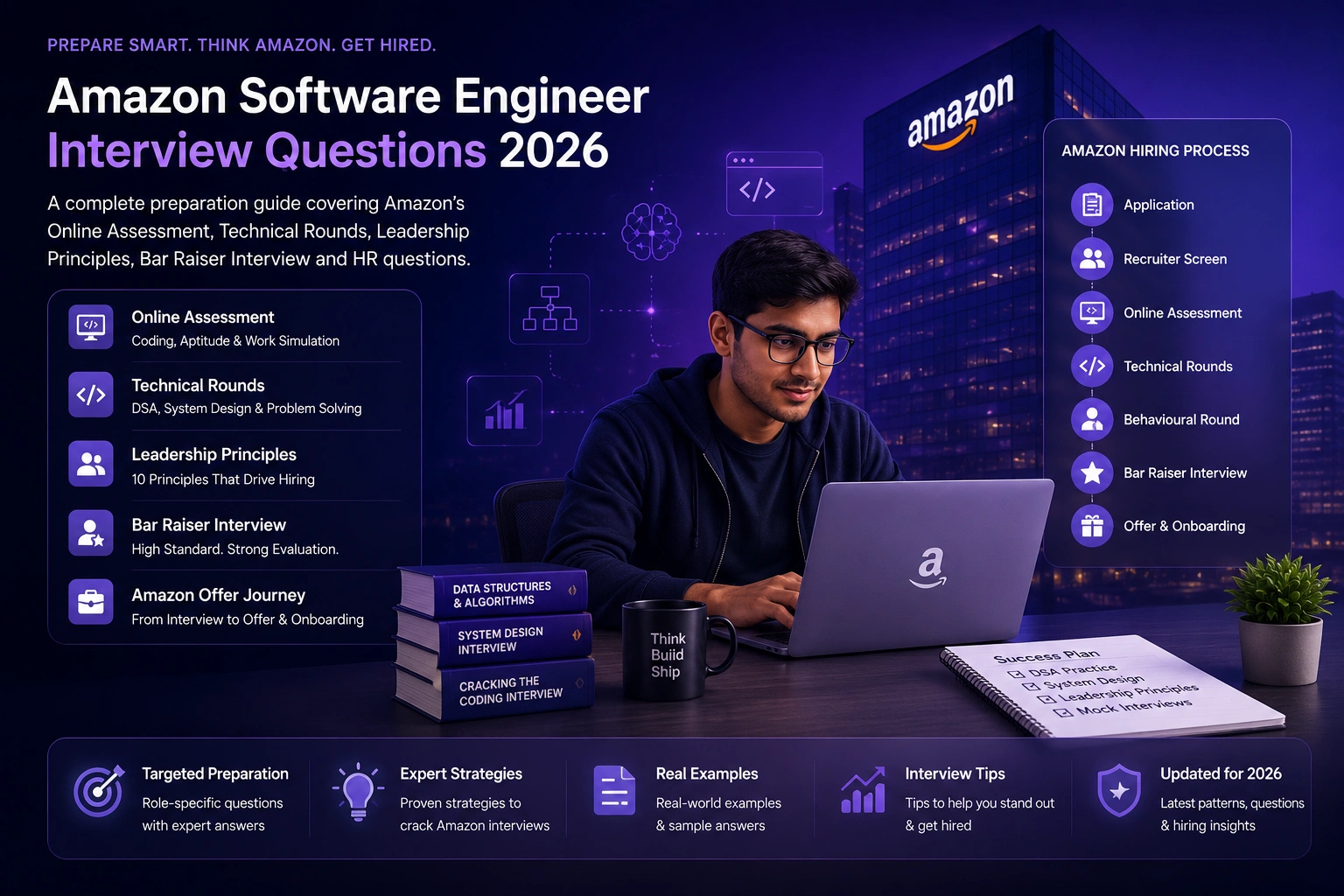
A complete preparation guide covering Amazon's Online Assessment, technical rounds, Leadership Principles, Bar Raiser interview, and offer journey for software engineer roles in India.
On this page
Why Amazon Interviews Are Different
Amazon does not treat interviews as isolated skill checks. Every round — coding, work simulation, behavioural, and Bar Raiser — is designed to answer one question: will this person raise the bar long-term? That is why strong LeetCode performance alone is rarely enough.
Panels grade how you think under ambiguity, how you communicate trade-offs aloud, and whether your past decisions reflect Amazon's Leadership Principles. Technical correctness matters, but ownership, customer impact, and depth of reflection carry equal weight in the loop. Compare patterns across Google SDE interviews and Microsoft SDE interviews, and Apple SWE interview questions to calibrate expectations.
Understanding Amazon Hiring Philosophy
Amazon hiring optimizes for durable builders — engineers who deliver results, dive deep when metrics look wrong, and earn trust while insisting on high standards. Interviewers use Leadership Principles as a shared language so feedback is comparable across teams and levels.
Bar-raising over slot-filling
Hiring managers are encouraged to reject good candidates if they are not clearly better than current team members at the target level.
Principles over personality
Culture fit is evaluated through documented principles and STAR evidence — not vague “team vibe” impressions.
Written feedback discipline
Interviewers submit structured feedback mapped to LPs. Your stories must survive cross-round comparison.
Customer-backward decisions
Strong answers tie engineering choices to customer outcomes, latency, trust, or cost — not internal politics alone.
Amazon Interview Process (2026)
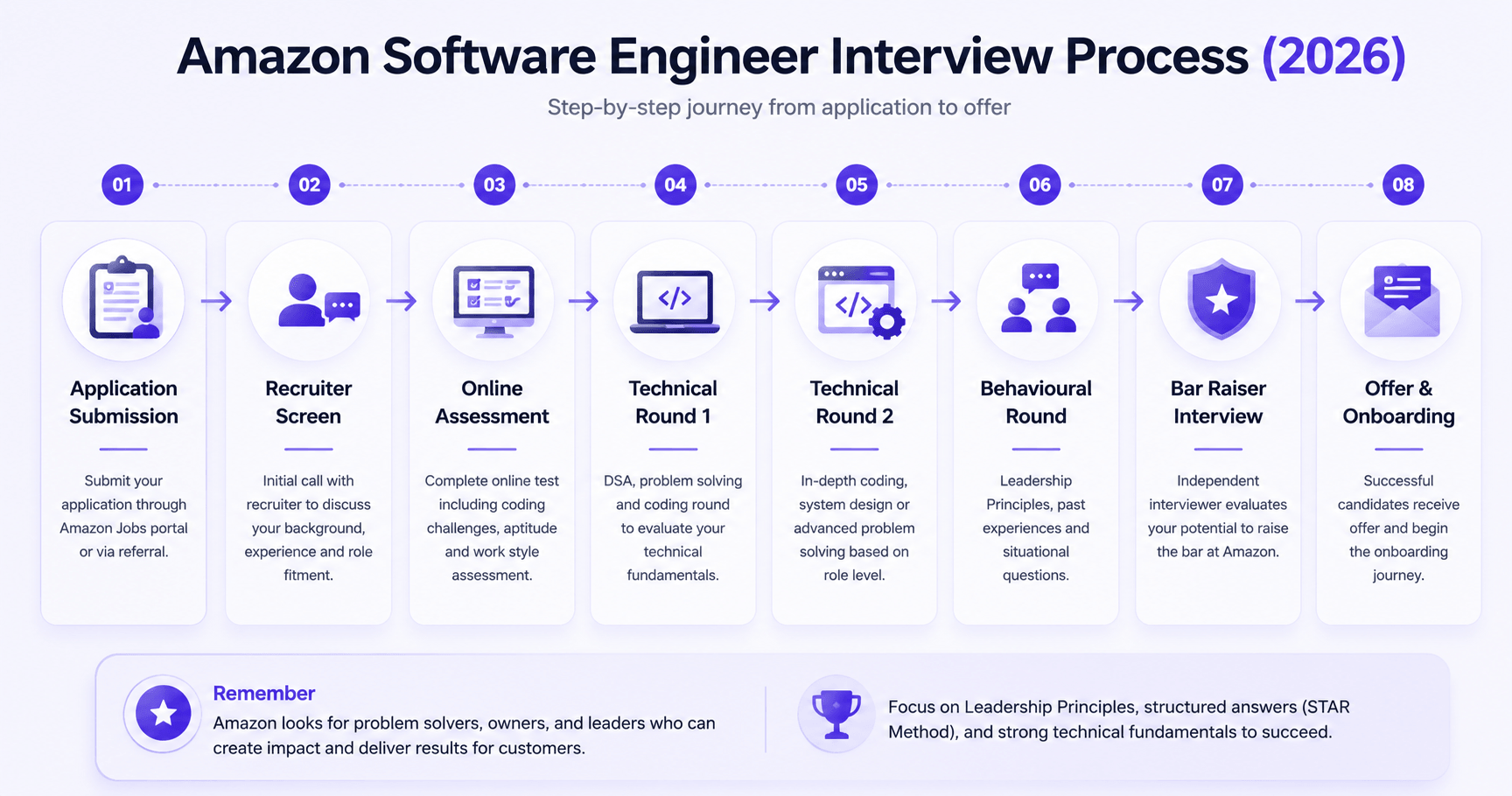
Timelines vary by team and level, but most software engineer loops in India follow the sequence below. Treat each stage as a filter for a different signal — not a repeat of the previous round.
Step 1 — Resume screening
Recruiters scan for relevant impact, project depth, and level alignment. Tailor bullets to measurable outcomes and technologies Amazon teams use (AWS, distributed systems, services at scale).
Step 2 — Recruiter screening
30–45 minutes on background, role fit, location, and timeline. Prepare a crisp “why Amazon / why this team” answer and clarify level expectations early.
Step 3 — Online Assessment
Timed coding logic, work-style simulations, and sometimes debugging-style tasks. Practice under clock pressure and read instructions carefully — OA eliminates many candidates before live panels.
Step 4 — Technical interviews
Usually two rounds: DSA on a shared editor plus CS fundamentals. Experienced candidates may see system design. Explain approach before coding; state complexity; test edge cases aloud.
Step 5 — Behavioural interviews
Leadership Principle questions using STAR format. Expect deep follow-ups on metrics, alternatives considered, and what you would change today.
Step 6 — Bar Raiser round
Independent interviewer assesses long-term bar. Can veto despite strong technical scores. Prepare cross-LP stories and honest reflection — not rehearsed slogans.
Before OA, align your resume narrative with Software Engineer interview questions and AWS interview questions if your projects use cloud services.
Amazon Resume Examples
Amazon recruiters screen for ownership, metrics, impact, and technical depth in every bullet. Weak lines describe tasks; strong lines prove decisions and measurable outcomes recruiters can map to Leadership Principles.
Ownership
Weak resume bullet: “Worked on backend APIs with the team.”
Strong resume bullet: “Owned checkout API reliability for payment retries — designed idempotency keys, on-call runbooks, and post-incident fixes across 3 services.”
Metrics
Weak resume bullet: “Improved application performance.”
Strong resume bullet: “Reduced p99 API latency from 420ms to 180ms (57% drop) by adding Redis caching and query batching on the orders service.”
Impact
Weak resume bullet: “Built a feature users liked.”
Strong resume bullet: “Shipped one-click reorder flow that lifted repeat purchase rate 12% and cut cart-abandon support tickets 23% over 8 weeks.”
Technical depth
Weak resume bullet: “Used AWS and databases in projects.”
Strong resume bullet: “Designed event-driven inventory sync on SQS + Lambda with DynamoDB conditional writes; handled 15k events/min with at-least-once delivery guarantees.”
Online Assessment
The OA is Amazon's scalable first technical filter. It tests whether you can reason clearly under time limits — not whether you have memorized 500 LeetCode problems. Work-simulation sections evaluate judgment, prioritization, and how you handle ambiguous customer-facing scenarios.
- Practice 2–3 timed assessments per week with strict clocks.
- Read every prompt twice — OA often penalizes misinterpretation more than slow coding.
- Review debugging and code-tracing questions, not only algorithm puzzles.
Build OA stamina using DSA interview questions and data structures topic questions under timed conditions.
Technical Rounds
Live technical rounds combine data structures, algorithms, and fundamentals. Interviewers want a narrated problem-solving process: clarify constraints, propose approach, implement cleanly, analyze complexity, and discuss tests. For SDE-2+, add system design vocabulary — APIs, storage, caching, queues, and failure modes.
Pair DSA prep with DSA interview questions, system design interview questions, and algorithms topic questions for broader fundamentals coverage.
Leadership Principles
These ten principles appear most frequently in software engineer loops. Build at least one STAR story per principle — with metrics, trade-offs, and what you learned. Structure stories using our STAR method guide and practise behavioural delivery with behavioural interview preparation tips.
Customer Obsession
Meaning: Start with the customer and work backwards. Decisions should improve customer outcomes even when inconvenient internally.
What interviewers evaluate: Whether you optimize for users and measurable customer impact — not internal shortcuts or vanity metrics.
Sample interview question: Tell me about a time you prioritized customer impact over internal convenience.
Strong answer signal: Names the customer segment, trade-off you rejected, and a quantified outcome tied to user experience.
Weak answer signal: Generic “we cared about users” with no metrics, no personal decision, and no cost accepted.
Ownership
Meaning: Think long-term and act on behalf of the entire company — not just your team or ticket queue.
What interviewers evaluate: End-to-end accountability including what happens after handoff — monitoring, follow-through, and unowned gaps you closed.
Sample interview question: Describe a problem you owned beyond your formal responsibility.
Strong answer signal: Clear “I owned” actions, scope beyond your role, and sustained outcome after delivery.
Weak answer signal: Passive “the team handled it” with no personal agency or long-term follow-up.
Invent and Simplify
Meaning: Find simpler solutions and challenge legacy complexity instead of copying how things were done before.
What interviewers evaluate: Pragmatic invention — simpler design, less operational burden, without over-engineering for show.
Sample interview question: Tell me about a time you simplified a process or system that others accepted as complex.
Strong answer signal: Before/after complexity comparison, why alternatives were rejected, and maintenance or cost saved.
Weak answer signal: Buzzwords about “innovation” with no simplification evidence or trade-off discussion.
Learn and Be Curious
Meaning: Continuously improve and explore new ideas with genuine curiosity, not performative learning.
What interviewers evaluate: Honest reflection after failure or surprise — what you changed in behaviour, not just what you read.
Sample interview question: Tell me about a time you failed and what you changed afterward.
Strong answer signal: Specific failure, root cause you discovered, and concrete habit or process you changed.
Weak answer signal: Sanitized failure with no lesson, or “I always learn from mistakes” without examples.
Hire and Develop the Best
Meaning: Raise the bar through coaching, feedback, and raising standards on teams you influence.
What interviewers evaluate: Mentoring quality, candid feedback delivery, and whether you improved others’ performance measurably.
Sample interview question: How have you helped someone on your team improve their performance?
Strong answer signal: Coaching actions you took, feedback you gave, and measurable improvement in the mentee’s output.
Weak answer signal: Vague “I’m a team player” with no development arc or outcomes for the other person.
Insist on Highest Standards
Meaning: Do not accept “good enough” when quality, reliability, or customer trust is at stake.
What interviewers evaluate: Examples where you caught issues early, blocked risky releases, or raised quality bars others ignored.
Sample interview question: Tell me about a time you refused to ship something that did not meet your standards.
Strong answer signal: Quality criteria you enforced, pushback you faced, and customer or reliability outcome protected.
Weak answer signal: Perfectionism without stakes — or shipping despite known issues with no accountability.
Bias for Action
Meaning: Move decisively when speed matters, while still using judgment — not reckless rushing.
What interviewers evaluate: Decisions under incomplete data, how you de-risked quickly, and how you corrected course if wrong.
Sample interview question: Describe a decision you made with incomplete information.
Strong answer signal: Time pressure stated, options weighed, action taken, and validation or rollback plan.
Weak answer signal: Reckless “move fast” with no risk assessment or learning loop afterward.
Earn Trust
Meaning: Listen carefully, speak candidly, and treat others respectfully to build durable credibility.
What interviewers evaluate: Conflict navigation, transparent communication, and rebuilding trust after disagreement.
Sample interview question: Tell me about a time you earned trust from a skeptical stakeholder.
Strong answer signal: Stakeholder skepticism named, listening and candour shown, and trust rebuilt with evidence.
Weak answer signal: Conflict avoided or blamed on others; no demonstration of respectful disagreement.
Dive Deep
Meaning: Stay connected to details, metrics, and root causes — especially when results look fine on the surface.
What interviewers evaluate: Whether you validated assumptions with data and traced problems to root cause — not symptoms.
Sample interview question: Tell me about a time data changed your understanding of a problem.
Strong answer signal: Metrics investigated, hypothesis overturned, and corrective action tied to root cause.
Weak answer signal: Surface-level fix with no investigation, or “I checked the logs” without conclusions.
Deliver Results
Meaning: Focus on key inputs and deliver timely, high-quality outcomes despite obstacles.
What interviewers evaluate: Measurable delivery against constraints — scope, timeline, quality, or resource limits.
Sample interview question: Tell me about a goal you delivered despite significant constraints.
Strong answer signal: Constraint named, prioritization choices, delivery timeline, and quantified result.
Weak answer signal: Activity list without outcome, or missed goal blamed entirely on external factors.
STAR Method for Amazon Behavioural Rounds
Amazon behavioural interviews expect STAR structure by default. Read the full framework on our STAR method guide, then practise aloud until each story fits in 3–4 minutes with room for follow-ups.
Situation
Set context in 2–3 sentences: team, constraint, stakes.
Task
Your specific responsibility — not the team’s generic goal.
Action
What you did, why you chose it, and what alternatives you rejected.
Result
Quantified outcome plus what you learned or changed afterward.
Good answer example
“Our checkout error rate spiked 18% (Situation). I owned the incident bridge (Task). I segmented failures by payment provider, rolled back a risky deploy, and added guardrail alerts (Action). Errors fell to baseline in 4 hours; repeat incidents dropped 40% over the next quarter (Result).”
Weak answer example
“We had a bug and the team fixed it quickly. I helped where needed and customers were happy.” — No metrics, no personal decision, no trade-offs, and no LP signal.
Common STAR mistakes
- Using “we” for every action — interviewers cannot grade your contribution.
- Skipping numbers — Amazon panels expect measurable impact.
- Choosing stories with no real conflict or trade-off.
- Ending at implementation — always close with customer or business outcome.
Bar Raiser Round
The Bar Raiser is an independent evaluator trained to protect long-term hiring quality. They are not trying to trick you — they are testing whether your judgement, ownership, and standards match Amazon's bar at the target level.
Why Amazon Uses Bar Raisers
Bar Raisers are trained interviewers from outside the hiring team who protect long-term hiring quality. They prevent local team pressure from lowering the bar and provide a consistent, cross-org calibration point for every loop.
What Bar Raisers Evaluate
Leadership Principles depth, decision quality under ambiguity, self-awareness, and whether you raise team standards — not just personal output. They probe follow-ups until your reasoning is explicit.
Common Rejection Reasons
Vague STAR stories, shallow metrics, blame-shifting in failure answers, rehearsed slogans without trade-offs, or strong technical scores with no ownership evidence.
How To Prepare
Prepare 10–12 stories across LPs, practise 3-level follow-ups, and rehearse “what would you do differently today?” for each story. Run at least one mock with LP-heavy behavioural focus before your loop.
Combine Bar Raiser prep with HR interview questions frameworks so your answers stay concise under pressure.
Amazon Interview Preparation Roadmap
Week 1
DSA
- 40 timed medium problems (arrays, trees, graphs)
- Binary search, sliding window, two pointers
- Practice narrating approach before coding
Week 2
Online Assessment
- 2–3 full timed OA simulations per week
- Work-style and debugging-style drills
- Review misread prompts — OA penalizes interpretation errors
Week 3
Leadership Principles
- Write 10 STAR stories mapped to top LPs
- Add metrics, trade-offs, and lessons learned
- Record answers and trim to 3–4 minutes each
Week 4
Mock Interviews and STAR
- Full-loop mocks (technical + behavioural)
- Bar Raiser follow-up drills
- Polish resume bullets to match story evidence
Run full-loop mocks on InterviewEra mock interviews or drill prompts with the free question generator.
Amazon Interview Preparation Resources
Use these curated guides alongside this Amazon SDE hub. Each resource targets a different signal Amazon evaluates — coding depth, design thinking, behavioural structure, or HR communication.
For broader placement context, also review top software engineer interview questions and the Amazon company interview hub.
Amazon vs Google vs Microsoft vs Meta Interviews
Big Tech loops share DSA expectations but weight behavioural signals differently. Use this table to prioritize prep time before you commit to an Amazon-first study plan.
| Dimension | Amazon | Microsoft | Meta | |
|---|---|---|---|---|
| Hiring Difficulty | High — LP depth + Bar Raiser veto | Very High — multi-round DSA + design | High — OA + structured loop panels | High — coding intensity + product sense |
| DSA Depth | High — two live coding rounds | Very High — multiple onsite coding rounds | High — OA + technical panels | High — coding + analytical follow-ups |
| Behavioral Weight | Very High — 16 Leadership Principles | Medium — Googleyness + collaboration | Medium — growth mindset narratives | Medium-High — values + impact stories |
| System Design Weight | Common at SDE-2+; lighter at entry | Dedicated onsite design round | Common at senior levels | Heavy for senior IC tracks |
| Culture Focus | Ownership + customer-backward decisions | Googleyness + intellectual humility | Growth mindset + inclusive collaboration | Move fast + measurable product impact |
| Hiring Process | OA → Tech ×2 → LP → Bar Raiser | Recruiter → Phone → Onsite (4–5) | OA → 4–5 loop rounds | Recruiter → Technical → Behavioural |
| Offer Timeline | 4–8 weeks | 4–8 weeks | 3–6 weeks | 4–10 weeks |
Amazon Software Engineer Interview Questions
Placement-oriented · Updated 2026- 01
What are Amazon Leadership Principles and how many are there?
HREasyView expert answer & prep guide
Expert answer: Amazon has 16 Leadership Principles, and they are not just HR posters—they are used as interview score dimensions. I prepare by grouping them into themes like customer focus, ownership, execution, and trust, then mapping STAR stories to each. Instead of memorizing definitions, I practice explaining trade-offs and measurable outcomes tied to a principle. For India SDE candidates, this matters because behavioral depth can outweigh a marginal coding difference in final hiring decisions, especially in Bar Raiser conversations.
What interviewers evaluate: Whether you understand Amazon's decision language — not just memorized names.
Answer strategy: Group LPs into themes (customer, ownership, standards, speed, trust) and cite one example theme each.
Common mistakes: Listing principles without explaining how they show up in interviews or decisions.
Follow-up questions:
- Which LP is hardest for you to demonstrate?
- Give an example of two LPs conflicting in a real decision.
- 02
Tell me about a time you demonstrated Customer Obsession.
BehavioralMediumView expert answer & prep guide
Expert answer: I worked on a support ticket dashboard where agents struggled with slow filtering during peak hours. Rather than shipping minor UI tweaks, I traced real user pain, optimized backend query paths, and introduced cached filter presets. Response time dropped from around 1.8s to 600ms, and ticket handling throughput improved in internal metrics. I also documented edge-case behavior with support teams to avoid regressions. The key signal was choosing customer pain reduction over lower-effort internal tasks and validating impact with data.
What interviewers evaluate: Customer-backward thinking, trade-off judgment, and measurable impact — not generic “user first” slogans.
Answer strategy: Open with customer pain, state your specific action, end with before/after metrics and what you would improve today.
Common mistakes: Team-only answers (“we fixed it”), no metrics, or stories where the customer benefit is assumed not proven.
Follow-up questions:
- What did you deprioritize to serve the customer?
- How did you validate the customer actually benefited?
- 03
What is the Bar Raiser role in Amazon's interview process?
HREasyView expert answer & prep guide
Expert answer: A Bar Raiser is an independent interviewer trained to protect hiring quality across teams. They are not just another panelist; they evaluate long-term fit, leadership signals, and whether the candidate raises the talent bar. In preparation, I treat this round as deep follow-up territory: decisions, trade-offs, ownership under ambiguity, and lessons from failure. Even with strong coding rounds, weak judgment or shallow behavioral evidence can fail this stage, so I prepare structured STAR stories with metrics and concrete personal actions.
What interviewers evaluate: Process literacy and whether you prepare for independent, cross-LP evaluation.
Answer strategy: Explain purpose (calibration + veto), what they probe (LP depth, self-awareness), and how you prepare (diverse STAR bank).
Common mistakes: Treating Bar Raiser as another technical round or assuming prior rounds guarantee an offer.
Follow-up questions:
- How is Bar Raiser feedback used in the hiring committee?
- Can a strong technical loop still fail at Bar Raiser?
- 04
Given a sorted array with duplicates, find the first and last position of a target element.
TechnicalMediumView expert answer & prep guide
Expert answer: I solve this with two binary searches. The first search finds the left boundary by moving right pointer leftward even when target matches. The second finds the right boundary by moving left pointer rightward on matches. This keeps both operations O(log n). I handle edge cases early: empty array, target absent, and all values equal. In interviews, I explain invariants before coding and run one dry example with duplicates to prove no off-by-one mistakes at boundaries.
What interviewers evaluate: Binary search variants, complexity analysis, and clean boundary handling under time pressure.
Answer strategy: Narrate invariant (“search space always contains answer”), code helper functions, then walk through a duplicate example.
Common mistakes: Off-by-one errors, linear scan on sorted input, or skipping complexity discussion.
Follow-up questions:
- What if the array is rotated but sorted?
- How would you return the count of occurrences?
- 05
Design Amazon's order management system at scale.
TechnicalHardView expert answer & prep guide
Expert answer: I begin with requirements: order placement, payment, inventory reservation, shipment updates, and failure recovery. I model order lifecycle as a state machine and split services by domain boundaries. For asynchronous steps, I use queues and event-driven workflows with idempotent consumers. I add compensation logic for partial failures, like payment success but inventory timeout. Storage combines transactional systems for orders and key-value/cache for quick reads. Finally, I define observability: order success rate, stuck-state alerts, DLQ monitoring, and latency SLOs.
What interviewers evaluate: Requirements gathering, distributed workflow design, consistency trade-offs, and operability.
Answer strategy: Start with entities and state machine, then services, queues, data stores, and observability. Discuss idempotency keys and DLQs.
Common mistakes: Jumping to microservices without order state transitions, or ignoring payment/inventory race conditions.
Follow-up questions:
- How do you handle duplicate checkout clicks?
- What metrics would you alert on in production?
- 06
Tell me about a time you had to make a decision with incomplete data.
BehavioralMediumView expert answer & prep guide
Expert answer: In a release week, we saw rising timeout errors but lacked full root-cause certainty before a campaign. I framed options with risk: proceed unchanged, delay full release, or enable a guarded rollout. I chose a phased rollout with aggressive monitoring and fallback toggles, then coordinated on-call coverage. Error rates stabilized and customer impact stayed minimal. Post-release, we identified an upstream dependency issue and hardened retries. The decision balanced speed and safety, with explicit assumptions and a reversible path.
What interviewers evaluate: Decision quality under uncertainty, risk framing, and learning loops after the decision.
Answer strategy: STAR with explicit “unknowns” list, decision criteria, and retrospective metrics or course-correction.
Common mistakes: Pretending you had full data, or delaying so long that customer/business impact worsened.
Follow-up questions:
- What would you do differently with hindsight?
- Who did you consult and what dissent existed?
- 07
What is Amazon DynamoDB and when would you choose it over RDS?
TechnicalMediumView expert answer & prep guide
Expert answer: DynamoDB is a fully managed NoSQL service optimized for high-scale key-value access with predictable low latency. I choose it when access patterns are known upfront, throughput spikes are expected, and schema flexibility helps—like carts, sessions, or event counters. I prefer RDS when relational joins, richer SQL queries, and strict multi-table transactional workflows are central. In interviews, I compare by access pattern, consistency needs, operational overhead, and cost behavior rather than saying one database is universally superior.
What interviewers evaluate: AWS storage trade-offs and whether you design from access patterns — not brand familiarity.
Answer strategy: Compare access pattern, consistency needs, query flexibility, ops model, and cost drivers with one example each way.
Common mistakes: Calling DynamoDB “always faster” or ignoring hot-partition and GSI design constraints.
Follow-up questions:
- How would you model a time-series workload?
- When is Aurora a better fit than plain RDS?
- 08
Write code to find all permutations of a string.
TechnicalMediumView expert answer & prep guide
Expert answer: I use backtracking: pick one character, recurse on remaining characters, then undo the choice to explore the next branch. This naturally explores all permutations with O(n × n!) time. For duplicate characters, I sort input and skip repeated choices at the same recursion level to avoid duplicate outputs. I explain state clearly—current path, used markers, base condition—and mention memory trade-offs. In interviews, clean recursion plus explicit complexity discussion scores better than rushed code without reasoning.
What interviewers evaluate: Recursion fluency, state management, and ability to optimize space after a brute-force solution.
Answer strategy: Explain decision tree, write clean backtrack helper, state complexity, then mention duplicate-character variant.
Common mistakes: String concatenation in tight loops without explaining complexity, or silent stack-overflow risk on large n.
Follow-up questions:
- How do you handle duplicate characters?
- Can you do this iteratively?
- 09
Tell me about a time you failed and what you learned from it.
BehavioralMediumView expert answer & prep guide
Expert answer: I once merged an optimization without adding realistic load tests, and under traffic it caused queue backlogs and delayed notifications. I owned the rollback, communicated impact quickly, and worked with QA to recreate production-like load scenarios. We fixed the bottleneck and added pre-release performance gates in CI. Personally, I now treat performance assumptions as hypotheses that need measurement. The lesson was not just technical; it was about accountability, transparent communication, and building safeguards so others do not repeat my mistake.
What interviewers evaluate: Self-awareness, accountability, and whether you changed behaviour — not just apologized.
Answer strategy: STAR ending with “what I changed” (process, tests, alerts, communication) and evidence it worked later.
Common mistakes: Blaming others, picking trivial failures, or stories with no lasting behaviour change.
Follow-up questions:
- How did stakeholders react?
- What guardrail exists today because of that failure?
- 10
Implement a function to detect a cycle in a linked list.
TechnicalEasyView expert answer & prep guide
Expert answer: I use Floyd's tortoise-and-hare approach: move slow pointer one step and fast pointer two steps. If they ever meet, a cycle exists; if fast hits null, there is no cycle. This runs in O(n) time and O(1) space, which is better than using a hash set for visited nodes. I also handle empty and single-node lists safely. For follow-up, I can find cycle start by resetting one pointer to head and moving both one step until they meet again.
What interviewers evaluate: Classic pointer technique, edge cases (empty/single node), and explaining follow-up variant.
Answer strategy: State why brute force is O(n) space, draw pointer movement, code iteratively, analyze complexity.
Common mistakes: Null-pointer crashes, infinite loops without cycle check, or unable to explain cycle-start math.
Follow-up questions:
- Find the node where the cycle begins.
- What if node values are unique but next pointers break?
Frequently Asked Questions
What is the Amazon Bar Raiser round?
A Bar Raiser is a trained interviewer from outside the hiring team who evaluates whether you raise Amazon’s hiring bar. They focus heavily on Leadership Principles, decision quality, and long-term ownership — and can veto a hire even if technical rounds were strong.
How many Leadership Principles does Amazon use in interviews?
Amazon uses 16 Leadership Principles company-wide. Interviewers map behavioural questions to specific LPs. For software engineer prep, master STAR stories that cover at least 8–10 principles with real metrics and trade-offs.
How difficult is the Amazon Online Assessment (OA)?
OA difficulty varies by level and region, but expect coding-style logic, work-simulation scenarios, and time pressure. It is designed to filter for structured problem-solving — not just memorized puzzle patterns. Practice under timed conditions.
Does Amazon hire freshers for software engineer roles in India?
Yes, but volume and bar vary by year and team. Campus and early-career pipelines exist, yet the process still includes OA, technical depth, and LP-heavy behavioural evaluation. Strong DSA fundamentals and polished STAR stories are essential.
How much does an employee referral help at Amazon?
Referrals can improve visibility and recruiter response, but they do not bypass the bar. You still complete OA, technical loops, behavioural interviews, and often a Bar Raiser. Treat referrals as momentum, not a guarantee.
How long does the Amazon interview process take?
Typically 4–8 weeks from application to offer, depending on team, level, and scheduling. Bar Raiser and panel coordination often add calendar time even when each round is only 45–60 minutes.
How many technical rounds are there for Amazon SDE roles?
Most loops include two technical interviews (DSA + CS fundamentals, sometimes system design for experienced candidates) plus behavioural LP rounds and a Bar Raiser. Exact count depends on level and org.
When should I negotiate Amazon salary?
After a verbal offer and level confirmation. Anchor on role scope, level, location, and competing offers. Amazon compensation includes base, RSUs, and sign-on — negotiate the full package, not just base salary.
What DSA topics matter most for Amazon technical rounds?
Arrays, strings, trees, graphs, heaps, binary search variants, sliding window, two pointers, recursion/backtracking, and dynamic programming fundamentals. Amazon also values clean communication and correct complexity analysis.
Is system design required for Amazon SDE interviews?
For SDE-2 and above, system design is common. For entry-level roles, focus on strong DSA, object-oriented fundamentals, and structured behavioural answers. Still learn basic scalability vocabulary for hybrid loops.
How should I prepare for Amazon behavioural interviews?
Build 10–12 STAR stories mapped to Leadership Principles. Each story needs context, your specific actions, metrics, and trade-offs. Practice aloud — Bar Raisers probe depth with follow-ups like “what would you do differently?”
Can I reuse stories across different Leadership Principles?
One project can support multiple LPs if you emphasize different decisions in each telling. Avoid repeating the same story verbatim across rounds — interviewers compare notes and depth matters more than volume.