Infosys · engineering
Infosys Software Engineer Interview Questions 2026
A complete Software Engineer preparation hub covering InfyTQ, HackWithInfy, aptitude, DSA, Core CS technical interviews, HR round strategy, resume examples, Infosys vs TCS comparison, and expert answers for Software Engineer roles in India.
On this page
Why Infosys Interviews Are Different
Infosys Software Engineer hiring blends mass-campus efficiency with multi-stage filtering — InfyTQ or HackWithInfy first, then coding assessment, Core CS technical panels, and a dedicated HR round. Unlike product-company loops optimized for hard algorithmic speed alone, Infosys evaluates aptitude consistency, fundamentals breadth, and communication fit.
Compare patterns with TCS SWE questions, Wipro SWE questions, Infosys Java Developer questions, and Infosys Python Developer questions. Cross-check the Software Engineer interview questions hub before you commit to a study plan.
Infosys Hiring Process
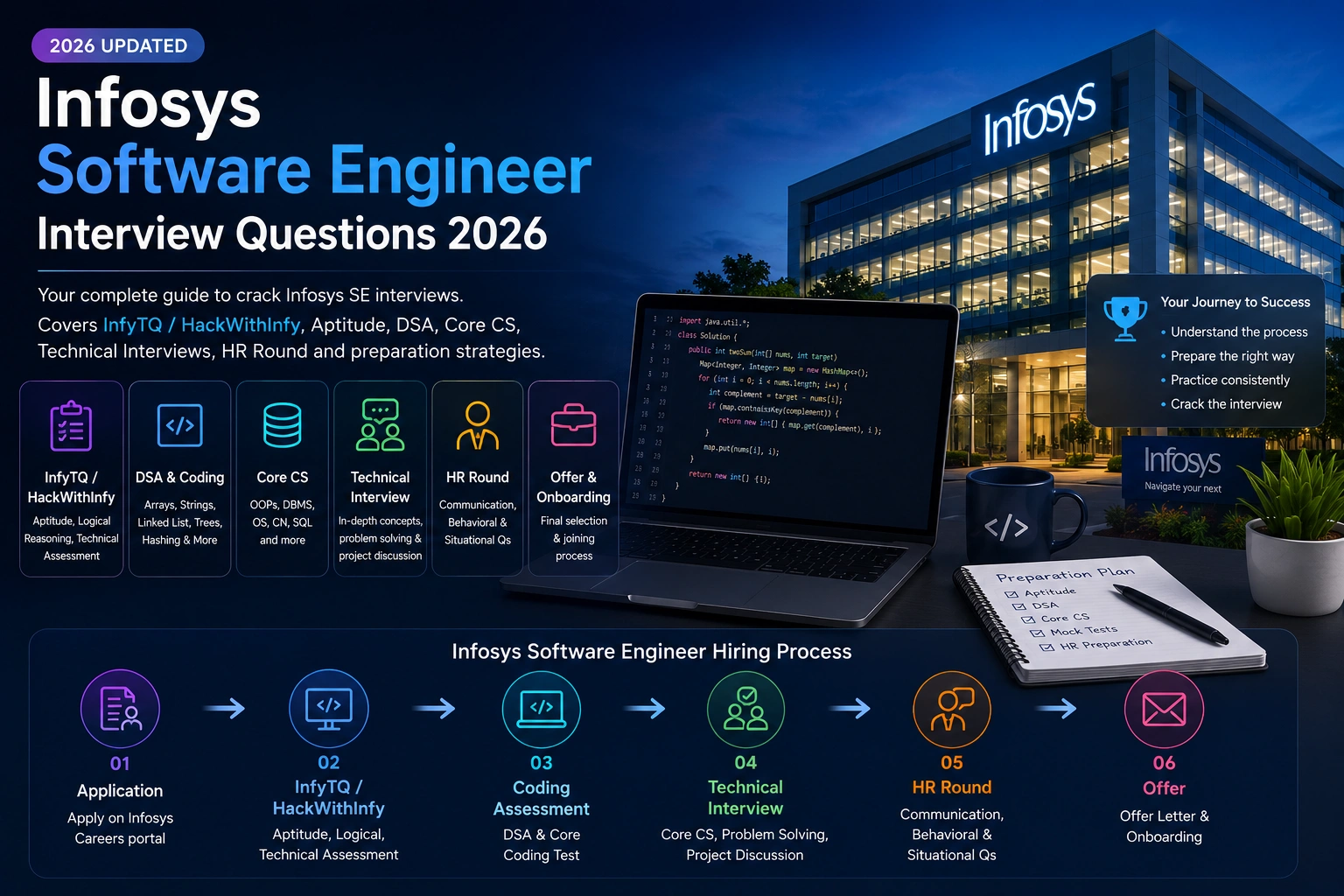
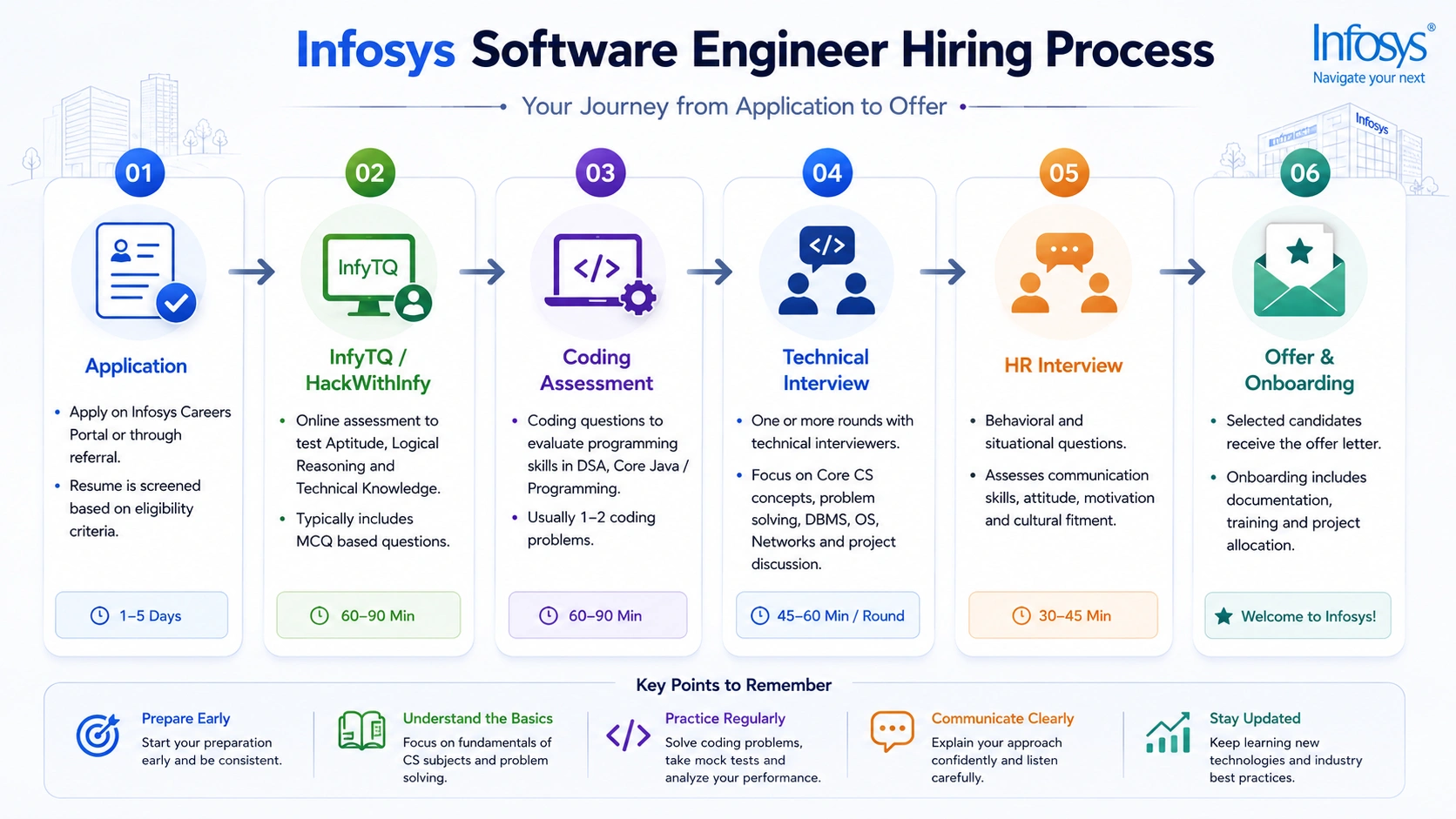
Most Infosys Software Engineer campus and off-campus drives in India follow the sequence below. Each stage filters a different signal — certification readiness, coding speed, Core CS depth, and communication fit.
Step 1 — Resume screening
Recruiters scan for relevant projects, CGPA, internships, and hackathon or InfyTQ certification badges. Tailor bullets to measurable outcomes — not generic “good academic record” lines.
Step 2 — InfyTQ / HackWithInfy
InfyTQ tests aptitude, reasoning, and technical fundamentals for campus shortlists. HackWithInfy is a competitive coding contest — top performers may qualify for the Power Programmer track (₹8–9 LPA).
Step 3 — Technical interview
One or two rounds covering DSA coding, OOP, DBMS, OS, CN, SQL, and project discussion. Panels expect narrated problem-solving — not silent coding or memorized definitions alone.
Step 4 — HR round
Communication, relocation flexibility, salary expectations, and “why Infosys.” Research Springboard, Cobalt cloud practice, and ESG initiatives for credible company-specific answers.
Step 5 — Offer
System Engineer (₹3.6–4.5 LPA), SP track (₹6.5 LPA), or Power Programmer (₹8–9 LPA) for top HackWithInfy performers. Offer includes training period and joining location details.
Research company context on the Infosys interview questions hub before your HR round.
Infosys Freshers Selection Criteria
Beyond InfyTQ scores and coding tests, Infosys interviewers score six soft and technical signals that predict training success and client readiness. Each criterion below explains what panels evaluate — align your mock answers and resume bullets to these expectations.
Communication Skills
What interviewers evaluate: Clarity when explaining technical concepts, structured answers in HR and technical rounds, and active listening — panels reject candidates who ramble or cannot summarize a project in two minutes.
Problem Solving
What interviewers evaluate: Approach narration before coding, breaking problems into steps, and recovering from hints — Infosys values methodical thinking over silent brute-force attempts.
Coding Fundamentals
What interviewers evaluate: Correct syntax, edge-case handling, and Big-O awareness on easy-to-medium DSA problems — not competitive-programming tricks alone.
Learning Ability
What interviewers evaluate: How quickly you absorb feedback during the interview, willingness to learn new stacks in Springboard training, and examples of self-taught skills from coursework or side projects.
Project Understanding
What interviewers evaluate: Ownership of your capstone or internship work — architecture choices, your specific contributions, trade-offs, and what you would improve if you rebuilt the system.
Professional Attitude
What interviewers evaluate: Punctuality, respect for panel time, relocation flexibility, teamwork examples, and honest answers on strengths and weaknesses without arrogance or evasion.
Strengthen coding fundamentals with our DSA interview questions guide and rehearse communication scenarios from the HR interview questions hub before your panel.
InfyTQ & HackWithInfy
InfyTQ is the standard campus entry gate; HackWithInfy is the elite competitive programming fast track. Understand both paths — most candidates focus on InfyTQ, but HackWithInfy unlocks Power Programmer offers.
InfyTQ
What is InfyTQ?
Infosys’s free learning and certification platform for engineering students. Scoring 65%+ can shortlist you for System Engineer roles and unlock higher compensation tracks.
Exam structure
Typically aptitude (quant + logical), verbal/communication, and technical MCQs covering programming fundamentals, DBMS, and OS basics — format varies by campus season.
Difficulty
Moderate for mass-hiring fresher drives — not GATE-level depth, but time pressure and accuracy matter. Weak aptitude performance eliminates candidates before live technical panels.
Preparation strategy
Daily timed aptitude sets, revise OOP and SQL MCQs, complete Infosys official modules on the platform, and take 2 full-length mock InfyTQ simulations in the final week.
HackWithInfy
What is HackWithInfy?
National competitive programming contest by Infosys. Top performers receive Power Programmer offers with harder DSA expectations than standard campus loops.
Contest structure
Multi-round online coding with algorithmic problems — arrays, strings, DP, and graph patterns at medium-to-hard difficulty under strict time limits.
Difficulty
High — comparable to Codeforces Div 2 B/C problems. Standard Infosys SE candidates are not expected to clear this; it is an elite fast-track path.
Preparation strategy
Practice 40+ medium problems on Codeforces/LeetCode, master DP and graph templates, and simulate 90-minute contest conditions weekly for eight weeks before the event.
Technical Topics Infosys Tests
Technical panels probe six Core CS pillars beyond coding alone. For each area: what Infosys evaluates, mistakes that weaken answers, and focused preparation tips. Drill topic banks on DBMS interview questions, operating system interview questions, and SQL interview questions.
DSA
What Infosys evaluates: Problem decomposition, correct complexity analysis, and clean implementation under time pressure.
Common mistakes: Jumping to code without approach, wrong Big-O, or skipping edge-case discussion.
Preparation tips: Practice arrays, strings, hashing, linked lists, and trees — narrate approach before every solution.
OOP
What Infosys evaluates: Inheritance, polymorphism, encapsulation, and abstraction with language-specific examples (Java/Python).
Common mistakes: Textbook definitions without project examples, or confusing abstract class vs interface.
Preparation tips: Prepare one inheritance example and one design decision from your capstone project.
DBMS
What Infosys evaluates: ACID properties, normalization, indexing, and transaction isolation — often via scenario questions.
Common mistakes: Mixing up isolation levels, or unable to explain why normalization reduces redundancy.
Preparation tips: Walk through a bank transfer for ACID; know 1NF–3NF with one table example each.
Operating Systems
What Infosys evaluates: Processes vs threads, scheduling basics, deadlocks, and memory management at fresher depth.
Common mistakes: Confusing process and thread memory models, or vague deadlock answers without four conditions.
Preparation tips: Revise process states, mutex vs semaphore, and one real deadlock prevention technique.
Computer Networks
What Infosys evaluates: OSI/TCP-IP layers, HTTP methods, and basic troubleshooting — Infosys frequently probes layers 3–4.
Common mistakes: Memorizing layer names without knowing which protocol belongs where (TCP vs UDP, IP routing).
Preparation tips: Use the OSI mnemonic and explain GET vs POST with idempotency and caching implications.
SQL
What Infosys evaluates: JOINs, aggregations, subqueries, and basic indexing — often tied to project database work.
Common mistakes: Writing cartesian joins, confusing WHERE vs HAVING, or unable to explain query optimization.
Preparation tips: Practice 10 JOIN patterns and one GROUP BY with HAVING filter; know when indexes help.
Aptitude Round
InfyTQ and many Infosys online assessments start with aptitude — candidates with strong DSA but weak quant or logical reasoning are eliminated before technical panels. Treat aptitude as a first-class prep priority.
Quantitative aptitude
Percentages, ratios, time-speed-distance, profit-loss, and number series. Accuracy under 60–90 second per question targets — use approximation for speed.
Logical reasoning
Seating arrangements, blood relations, syllogisms, and pattern completion. Draw tables for arrangement problems; eliminate wrong options early.
Verbal ability
Reading comprehension, sentence correction, para jumbles, and vocabulary in context. Read the question stem twice before selecting — InfyTQ penalizes careless errors.
Preparation strategy
Block 45 minutes daily: 20 quant, 15 logical, 10 verbal. Track accuracy percentage weekly — aim for 80%+ before InfyTQ. On weak topics, drill 50 problems of one type before moving on.
Coding Round
Infosys coding assessments favour foundational DSA at easy-to-medium difficulty. Master the five topic areas below with difficulty calibration, time management, and mistake avoidance. Drill patterns on our DSA interview questions guide.
Arrays
Difficulty: Easy–Medium
Time management: Clarify constraints in 2 minutes; aim to finish easy array problems in 10–12 minutes with one test walkthrough.
Common mistakes: Off-by-one indices, not handling empty arrays, skipping complexity statement.
Strings
Difficulty: Easy–Medium
Time management: Use StringBuilder for loop concatenation; budget 15 minutes for medium string problems.
Common mistakes: O(n²) brute force when HashMap or two-pointer patterns apply.
Hashing
Difficulty: Medium
Time management: HashMap frequency and complement patterns solve many Infosys problems in O(n) — state the key choice aloud.
Common mistakes: Wrong hash key type, forgetting to handle duplicate keys in grouping problems.
Linked lists
Difficulty: Medium
Time management: Practice reverse and merge until pointer moves are fluent — 15–18 minutes for medium problems.
Common mistakes: Losing head reference, infinite loops in cycle detection.
Sorting
Difficulty: Easy–Medium
Time management: Know when built-in sort suffices vs custom comparator; explain stability and O(n log n) expectation.
Common mistakes: Implementing bubble sort when quicksort/mergesort awareness is enough; wrong comparator for objects.
HR Interview
The HR round is the final filter before offer — communication clarity, company research, and relocation flexibility matter as much as technical scores from prior rounds. Rehearse with our HR interview questions guide.
Tell me about yourself
Structure: Background (30s) → Academic/project highlights (45s) → Why Infosys (30s). End with enthusiasm for learning and relocation flexibility.
Why Infosys?
Mention Springboard training, global client exposure, Cobalt digital practice, and ESG commitments — not generic “brand name” answers.
Strengths and weaknesses
Strength with evidence (project metric). Weakness as growth story with concrete improvement steps — avoid clichés like “perfectionist.”
Relocation and adaptability
Infosys centres: Bengaluru, Mysuru, Hyderabad, Pune, Chennai. Express genuine flexibility and cite hostel/internship adaptability examples.
Resume Examples
Infosys recruiters screen hundreds of resumes per drive. Weak bullets describe tasks; strong bullets prove project impact, metrics, and technical depth interviewers can probe in technical rounds.
Project impact
Weak resume bullet: “Built a college project using Java and MySQL.”
Strong resume bullet: “Shipped attendance-tracking web app used by 200+ students — cut manual record-keeping time 35% with automated reports and role-based access.”
Metrics
Weak resume bullet: “Improved application performance.”
Strong resume bullet: “Reduced API response time from 480ms to 190ms by indexing slow SQL queries and caching frequent reads — 40% fewer DB round-trips per session.”
Technical depth
Weak resume bullet: “Worked on DSA problems and OOP concepts.”
Strong resume bullet: “Implemented BFS shortest-path visualizer in Python with unit tests — explained O(V+E) complexity and demoed to 3 faculty reviewers.”
Project Discussion Questions
Infosys technical panels spend 10–20 minutes on project depth — often more decisive than a single coding problem. Prepare six discussion angles below with narrated examples from your capstone, internship, or personal builds. Java-heavy projects: review Infosys Java Developer questions; Python stacks: Infosys Python Developer questions.
Final year projects
Panels probe whether you built the system or only followed a tutorial. Expect questions on your role, module boundaries, and one technical decision you defended.
Example questions
- Walk me through your final year project architecture — what were the main components?
- Which part of the project did you personally implement, and what would you change today?
Internship projects
Infosys weighs internship experience for off-campus and tier-2 drives. Interviewers check whether you understand production constraints — deployments, code reviews, and team workflows.
Example questions
- Describe your internship project and the business problem it solved.
- What did you learn in your internship that you did not learn in college coursework?
Technology choices
Be ready to justify language, framework, and database picks — Java vs Python, REST vs GraphQL, MySQL vs MongoDB — with trade-offs, not popularity.
Example questions
- Why did you choose this tech stack for your project?
- What alternative technologies did you consider and why did you reject them?
Challenges faced
Strong candidates describe a real blocker — performance bottleneck, integration failure, or team conflict — and the debugging or collaboration steps that resolved it.
Example questions
- What was the hardest technical challenge in your project and how did you solve it?
- Tell me about a bug that took multiple days to fix — what was your debugging process?
Testing strategy
Fresher panels increasingly ask about unit tests, manual test cases, and basic CI awareness. Mention tools you used and what coverage you targeted.
Example questions
- How did you test your application before demo day?
- Did you write unit tests? Which framework and what scenarios did you cover?
Improvements
Interviewers reward self-critique — scalability limits, missing auth layers, or poor error handling you would fix in a v2. Shows growth mindset beyond the demo.
Example questions
- If you had three more months, what would you improve in your project?
- What technical debt did you knowingly accept and how would you pay it down?
Database-heavy projects often trigger follow-ups on DBMS interview questions and SQL interview questions; systems projects may probe operating system interview questions.
Infosys vs TCS Software Engineer
Both are mass-hiring service companies with similar fresher SE expectations — but entry paths and round emphasis differ. Use this table to prioritize prep when targeting both employers.
| Dimension | Infosys | TCS |
|---|---|---|
| Aptitude Difficulty | Moderate — InfyTQ quant + logical + verbal | Moderate–High — TCS NQT with strong aptitude weight |
| Coding Difficulty | Medium — 1–2 easy/medium DSA problems | Medium — NQT coding + technical panel problems |
| Communication Round | Dedicated HR round — relocation and fit | Combined tech + HR or separate MR round |
| Interview Style | InfyTQ → coding test → tech → HR | NQT → technical → HR/MR |
| Offer Process | 2–6 weeks; SP/Power Programmer tracks | 2–8 weeks; Ninja/Digital offer bands |
Also compare TCS SWE questions, Wipro SWE questions, and Infosys Java Developer questions for role-track calibration.
Interview Preparation Resources
Preparation Roadmap
Follow the four-week plan below, then run full-loop mocks on InterviewEra mock interviews.
Week 1
Aptitude + OOP
- Daily quant + logical + verbal drills
- Revise OOP with Java/Python examples
- Complete 2 InfyTQ-style mock tests
Week 2
DSA + DBMS
- 20 medium problems (arrays, strings, hashing)
- ACID, normalization, and JOIN revision
- Practice 5 linked-list implementations
Week 3
OS + CN + SQL
- Process/thread, deadlock, scheduling basics
- OSI model and HTTP methods
- 10 SQL query drills with indexing notes
Week 4
Mock Interviews + HR
- Full Infosys-style tech + HR mocks
- Why Infosys and weakness stories
- Review expanded questions below with follow-ups
Infosys Software Engineer Interview Questions
Expanded expert answers · Updated 2026- 01
What is InfyTQ and how does qualifying for it benefit your Infosys application?
AptitudeEasyView expert answer & prep guide
Expert answer: InfyTQ is Infosys's learning and certification pathway used heavily in campus hiring. A strong score signals readiness beyond generic aptitude and can improve shortlist probability for better tracks. I prepare by combining platform practice modules with timed mocks focused on technical and problem-solving sections. In interviews, I connect InfyTQ prep to practical outcomes: improved coding consistency, structured revision, and better confidence in Infosys-specific hiring expectations across OA and technical rounds.
What interviewers evaluate: Whether you understand Infosys campus entry gates and have a concrete certification prep plan.
Answer strategy: Define InfyTQ, state 65%+ shortlist threshold, mention SP and Power Programmer tracks with package ranges.
Common mistakes: Treating InfyTQ as optional, or unable to name what sections it tests (aptitude + technical).
Follow-up questions:
- How are you preparing for InfyTQ?
- What score are you targeting and why?
- 02
What is the Hackwithinfy contest and what does the Power Programmer track offer?
HREasyView expert answer & prep guide
Expert answer: HackWithInfy is a competitive coding contest where top performers can earn fast-track opportunities into high-paying Power Programmer roles. It typically demands stronger algorithmic depth than standard fresher loops. My preparation would focus on timed DSA practice, contest-style problem solving, and post-contest editorial review to improve speed and pattern recognition. In interviews, I frame participation as evidence of persistence and learning rigor, not just rank, because consistent problem-solving habits matter long-term.
What interviewers evaluate: Awareness of elite fast-track paths vs standard campus hiring — and honest self-assessment of CP readiness.
Answer strategy: Contrast HackWithInfy (contest, hard DSA) with InfyTQ (broader certification); state Power Programmer package.
Common mistakes: Claiming HackWithInfy is the only Infosys entry path, or no preparation plan for algorithmic difficulty.
Follow-up questions:
- Have you participated in competitive programming contests?
- How does HackWithInfy differ from InfyTQ?
- 03
Explain the concept of inheritance and demonstrate it with a Java or Python example.
TechnicalEasyView expert answer & prep guide
Expert answer: Inheritance models an IS-A relationship where a child class reuses and extends parent behavior. In Java, a `SavingsAccount` can extend `Account`, inheriting `deposit()` while overriding `calculateInterest()`. In Python, I use `super()` to reuse base logic cleanly. I also clarify that inheritance should be used when subtype behavior remains substitutable; otherwise composition is safer. In interviews, I pair this with one real project example to show design judgment, not just syntax familiarity.
What interviewers evaluate: OOP fundamentals with language-specific clarity — can you code and explain, not just define?
Answer strategy: Define IS-A relationship, show minimal Java `extends` or Python class example, mention `super()` / MRO.
Common mistakes: Confusing inheritance with composition, or unable to trace method resolution in diamond inheritance.
Follow-up questions:
- What is the difference between inheritance and composition?
- Explain Python MRO for multiple inheritance.
- 04
What is the difference between a stack and a queue? Give a practical use case for each.
TechnicalEasyView expert answer & prep guide
Expert answer: A stack is LIFO, useful when the latest item should be processed first, like undo history or recursive call management. A queue is FIFO, useful when fairness and arrival order matter, like print jobs or task scheduling. I usually explain with one practical scenario from backend systems: request retry stack for rollback contexts versus queue-based worker processing for asynchronous jobs. Mentioning both behavior and use case shows stronger understanding than defining LIFO/FIFO alone.
What interviewers evaluate: Basic data structure literacy and ability to map structures to real systems.
Answer strategy: State LIFO vs FIFO, give one use case each, optionally sketch array implementation approach.
Common mistakes: Swapping use cases, or describing stack as FIFO.
Follow-up questions:
- Implement a stack using an array.
- Where is a queue used in BFS?
- 05
Write code to reverse a linked list iteratively and recursively.
TechnicalMediumView expert answer & prep guide
Expert answer: Iteratively, I use three pointers: `prev`, `curr`, and `next`. I walk through nodes, reverse `curr.next` to `prev`, then advance pointers. This is O(n) time, O(1) space. Recursively, I recurse until tail, then rewire links while unwinding and nullify old head next pointer. Recursive code is elegant but can overflow stack on very long lists. In interviews, I present iterative first for reliability, then add recursive as a follow-up optimization in readability.
What interviewers evaluate: Pointer manipulation fluency and ability to implement two approaches cleanly under time pressure.
Answer strategy: Narrate iterative three-pointer approach first; state O(n) time O(1) space; then recursive base case and relink.
Common mistakes: Losing head reference, infinite loops, or stack overflow on deep recursive chains without mentioning iterative fallback.
Follow-up questions:
- Detect a cycle in a linked list.
- Merge two sorted linked lists.
- 06
What is exception handling? Explain checked vs unchecked exceptions in Java.
TechnicalEasyView expert answer & prep guide
Expert answer: Exception handling is a structured way to recover or fail gracefully when runtime issues occur. In Java, checked exceptions are compiler-enforced and typically represent recoverable conditions like file or DB failures. Unchecked exceptions extend RuntimeException and usually indicate programming errors such as null dereferences. I avoid broad catch blocks, log context-rich errors, and propagate responsibly at service boundaries. In interviews, I emphasize when to handle locally versus rethrow with domain-specific context.
What interviewers evaluate: Error-handling hierarchy literacy and practical judgment on when to catch vs propagate.
Answer strategy: Draw Throwable tree, define checked vs unchecked with examples, mention try-catch-finally flow.
Common mistakes: Catching Exception broadly, or confusing Error with recoverable Exception.
Follow-up questions:
- What is try-with-resources?
- When would you create a custom exception?
- 07
Describe the OSI model and explain the role of each layer.
TechnicalMediumView expert answer & prep guide
Expert answer: The OSI model has seven layers: Physical, Data Link, Network, Transport, Session, Presentation, and Application. I explain each with one responsibility, then focus on commonly tested layers: Network for routing (IP) and Transport for reliability/flow (TCP/UDP). Application protocols like HTTP live at upper layers. In interviews, I avoid memorization-only answers by mapping one real request flow, such as browser-to-server communication, across relevant layers to show practical understanding.
What interviewers evaluate: Computer networks fundamentals — layer purpose and protocol placement, not mnemonic recitation alone.
Answer strategy: List seven layers with one-line role each; emphasize Transport (TCP/UDP) and Network (IP) with examples.
Common mistakes: Mixing up layers 2 and 3, or placing HTTP at wrong layer without explaining TLS termination.
Follow-up questions:
- Difference between TCP and UDP?
- What happens when you type a URL in the browser?
- 08
Tell me about yourself and why Infosys.
HREasyView expert answer & prep guide
Expert answer: I introduce myself with a concise arc: academics, strongest project, and measurable contribution. Then I connect why Infosys specifically—large-scale delivery exposure, structured learning ecosystem, and opportunities across cloud and enterprise modernization in India. I mention skills I can contribute immediately, like Java/Spring and API fundamentals, while showing growth mindset for enterprise engineering standards. A focused 90-second answer with relevant evidence works better than a generic life story or brand-only motivation statement.
What interviewers evaluate: Communication structure, company research depth, and genuine motivation — not rehearsed slogans.
Answer strategy: 90-second pitch: education → top project with metric → why Infosys (Springboard, Cobalt, growth) → close with enthusiasm.
Common mistakes: Life story from childhood, generic “brand name” why Infosys, or no project evidence.
Follow-up questions:
- Why not TCS or Wipro?
- Where do you see yourself in three years at Infosys?
- 09
What are ACID properties in databases? Why are they important for transaction management?
TechnicalMediumView expert answer & prep guide
Expert answer: ACID means Atomicity, Consistency, Isolation, and Durability. Atomicity ensures all-or-nothing execution. Consistency preserves valid state transitions. Isolation prevents concurrent transactions from corrupting each other. Durability ensures committed data survives failures. I usually explain with a bank transfer example because it makes rollback and consistency needs obvious. In enterprise systems like Infosys projects, ACID is critical for financial, inventory, and workflow correctness where partial writes or race conditions can cause costly business errors.
What interviewers evaluate: DBMS transaction literacy — can you explain properties with a concrete scenario?
Answer strategy: One sentence per ACID letter plus bank transfer walkthrough showing rollback on failure.
Common mistakes: Mixing up isolation and consistency, or unable to give a real-world transaction example.
Follow-up questions:
- What are isolation levels?
- How does indexing affect query performance?
- 10
What is your greatest weakness and what steps are you taking to improve it?
HREasyView expert answer & prep guide
Expert answer: One weakness I worked on was over-explaining technical details without first checking audience context. To improve, I started structuring updates into summary, impact, and next actions, then validating understanding before going deeper. I practiced this in project demos and mentorship sessions, and feedback improved noticeably. I still value depth, but now I tune communication to stakeholder needs. This shows a real, improvable weakness with clear actions and measurable progress, which is what interviewers look for.
What interviewers evaluate: Self-awareness and improvement loop — honest reflection without disqualifying yourself.
Answer strategy: Pick real but fixable weakness → specific actions taken → measurable progress → ongoing habit.
Common mistakes: Cliché answers (“perfectionist”), fake weaknesses (“I work too hard”), or no improvement evidence.
Follow-up questions:
- Tell me about a time feedback changed your approach.
- What are you learning right now?
- 11
Explain the difference between GET and POST HTTP methods. When should each be used?
TechnicalEasyView expert answer & prep guide
Expert answer: GET is primarily for retrieval, should be idempotent, and is cache-friendly. POST submits data that typically creates or triggers state changes, so it is generally non-idempotent unless explicitly designed otherwise. GET parameters are visible in URLs, so sensitive payloads should avoid GET. I also mention that modern API design may use PUT/PATCH for updates and DELETE for removals. In interviews, tying method choice to idempotency, caching, and security shows stronger HTTP understanding.
What interviewers evaluate: REST/HTTP fundamentals for API and web discussions in technical rounds.
Answer strategy: Compare idempotency, caching, payload location, and safety; give retrieval vs create examples.
Common mistakes: Using POST for idempotent reads, or ignoring security implications of sensitive data in URL.
Follow-up questions:
- What is idempotency?
- Difference between PUT and PATCH?
- 12
Are you comfortable relocating? How do you handle working in a new city?
HREasyView expert answer & prep guide
Expert answer: Yes, I am comfortable relocating for the role. I have adapted before through hostel life and internships where I had to quickly settle into new routines and teams. My approach is to stabilize basics early—commute, schedule, and support network—so productivity stays high from week one. I also actively engage with team culture to reduce adjustment time. Interviewers usually value clear flexibility and practical planning rather than vague or conditional answers.
What interviewers evaluate: Relocation willingness and adaptability — critical for Infosys mass-hiring placement model.
Answer strategy: State genuine flexibility, name acceptable cities, cite hostel/internship adaptability example.
Common mistakes: Hedging with “depends” without clarity, or refusing relocation for standard SE offers.
Follow-up questions:
- Do you have a location preference?
- How would you handle being away from family?
Frequently Asked Questions
What is InfyTQ and is it mandatory for Infosys campus hiring?
InfyTQ is Infosys’s certification and learning platform for engineering students. Scoring 65%+ can shortlist you for System Engineer roles. Many campus drives treat InfyTQ as the first filter — prepare as if it is mandatory.
What is HackWithInfy and how is it different from InfyTQ?
HackWithInfy is a national competitive coding contest offering Power Programmer tracks (₹8–9 LPA) for top performers. InfyTQ is broader aptitude + technical certification; HackWithInfy targets elite coders with harder algorithmic problems.
How many rounds are in Infosys Software Engineer interviews?
Typically: application, InfyTQ or online assessment, coding assessment, one or two technical interviews, and an HR round. HackWithInfy winners may skip some stages but still face verification.
What technical topics does Infosys test for Software Engineer roles?
DSA, OOP, DBMS, operating systems, computer networks, and SQL — plus project discussion. Coding rounds focus on arrays, strings, hashing, linked lists, and sorting at easy-to-medium difficulty.
How difficult is the Infosys aptitude round?
Moderate for fresher drives — quant, logical reasoning, and verbal sections under time pressure. Weekly timed practice targeting 80%+ accuracy is the most reliable preparation approach.
How difficult is the Infosys coding round?
Usually easy-to-medium — one or two problems, not FAANG hard. Clean explanation, edge cases, and complexity analysis matter as much as working code.
Does Infosys ask system design to freshers?
Rarely at entry level. Focus on DSA, Core CS fundamentals, and project depth. Basic scalability awareness is a plus but not the primary filter.
What CGPA cutoff does Infosys use?
Commonly 6.5–7.5 depending on college tier and hiring season. Strong InfyTQ or HackWithInfy performance can offset borderline CGPA in some cases.
How should I answer “Why Infosys” in the HR round?
Combine Springboard training quality, global client exposure, Cobalt digital practice, and personal fit — relocation willingness and learning goals. Avoid generic brand-name answers.
Infosys vs TCS Software Engineer — which is harder?
Similar overall difficulty for fresher SE roles. Infosys emphasizes InfyTQ certification; TCS routes through NQT with strong aptitude weight. Compare both processes before committing to one study plan.
How long does the Infosys offer process take?
Typically 2–6 weeks from final HR round to offer letter, depending on batch scheduling and background verification.
Can I prepare for Infosys and TCS SE interviews together?
Yes — aptitude, DSA, OOP, DBMS, OS, CN, and SQL overlap heavily. Add company-specific mocks: InfyTQ patterns for Infosys and NQT for TCS in the final week.