Wipro · engineering
Wipro Java Developer Interview Questions and Answers (2026)
Complete Wipro Java Developer preparation for India 2026 — NLTH online test, Core Java, collections, Spring Boot, JVM/GC, REST APIs, salary ranges, 30-day roadmap, and expert sample answers for campus and lateral hiring.
On this page
What Wipro Asks Java Developer Candidates in 2026
Wipro Java Developer interviews test NLTH aptitude first, then Core Java, collections, OOP, exception handling, Spring Boot fundamentals, JVM/GC basics, SQL, and Spring project depth. Fresher drives emphasize fundamentals and narrated answers — not deep microservices architecture. Most successful candidates clear NLTH, explain == vs .equals() with examples, and walk through REST API architecture confidently.
Compare with Wipro Software Engineer questions, Infosys Java Developer questions, and the Java Developer interview questions hub before you lock your study plan.
Wipro Java Developer Hiring Process
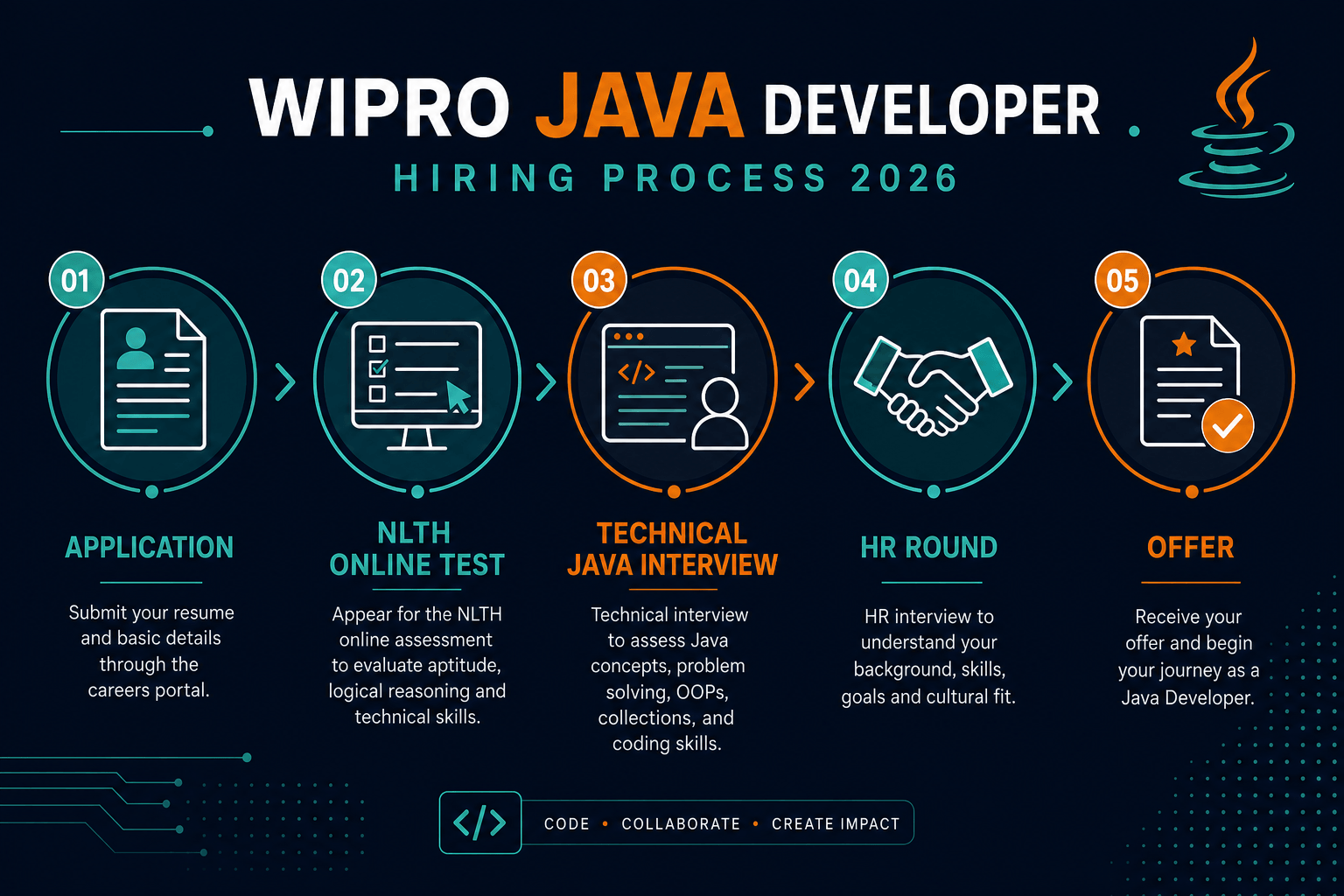
Most Wipro Java Developer campus and off-campus drives follow NLTH online assessment, a technical Java interview covering Core Java and Spring Boot fundamentals, and an HR fit round — often combined into one live session for lateral hires. Each stage filters a different signal: aptitude, Java depth, and communication.
Step 1 — Application & resume screening
Register on Wipro careers or campus portal. Recruiters scan for Java/Spring Boot project depth, internships, CGPA, and measurable API or database outcomes. Highlight REST endpoints built, schema design, and performance fixes — not generic “worked on Java project” bullets.
Step 2 — NLTH (National Level Talent Hunt) online test
Timed assessment covering aptitude (quant, logical, verbal) and technical MCQs (Java fundamentals, OOP, collections, SQL basics). Many drives include one or two easy coding problems. Strong NLTH scores shortlist candidates for live Java technical panels.
Step 3 — Technical Java interview
Live round probing Core Java, collections, OOP, exception handling, multithreading basics, Spring Boot fundamentals, SQL, and coding (arrays, strings, HashMap patterns). Panels expect narrated answers — not silent memorized definitions.
Step 4 — HR round (often combined with technical)
Communication, relocation flexibility, salary expectations, and “why Wipro.” Research Wipro’s digital engineering practice, Java-heavy client accounts, and ILP training structure for credible company-specific answers.
Step 5 — Offer
Selected candidates receive offer with role band and CTC (typically ₹3.5–7.5 LPA for fresher Java tracks), joining location, and ILP training details. Confirm fixed vs variable split before accepting.
Eligibility Criteria
Wipro Java Developer eligibility varies by campus tier and hiring season, but the cards below reflect typical fresher and lateral expectations for Java-track shortlists in India. Strong NLTH scores and quantified project bullets can offset borderline CGPA in some drives.
Educational background
B.Tech/B.E. (CS/IT/ECE), MCA, or B.Sc. Computer Science. Wipro hires Java profiles from engineering backgrounds for campus and off-campus drives. Spring Boot capstone or internship experience strengthens shortlists.
CGPA cutoff
Commonly 60–65% aggregate (or 6.0+ CGPA) with no active backlogs. Strong NLTH scores or a substantive Java API project can offset borderline academics in some seasons.
Core skills
Core Java, collections, OOP, exception handling, multithreading basics, Spring Boot REST APIs, SQL/JDBC, Git, and Agile awareness. JVM/GC overview is a differentiator at fresher level.
Experience level
Freshers via NLTH are the primary entry path. Lateral hires (1–3 years) face deeper Spring, microservices, and production-debugging questions with higher salary bands.
Freshers vs experienced
Freshers: NLTH + Core Java + one Spring Boot project. Experienced: module ownership, OOM triage, framework depth, and client-delivery scenarios. Both tracks value clear communication.
Interview Pattern — Round by Round
Wipro typically runs three evaluation stages for Java Developer roles. Duration and format shift slightly between campus NLTH batches and off-campus lateral hiring, but the skill signals remain consistent.
| Round | Duration | Format | Evaluates |
|---|---|---|---|
| NLTH Online Test | 60–90 min | Aptitude + Java MCQs + optional coding | Speed, accuracy, Java fundamentals, and elimination before live panels. |
| Technical Java Interview | 45–60 min | Core Java, Spring Boot, SQL, coding, project deep-dive | Language depth, framework awareness, and resume authenticity. |
| HR / Managerial | 15–25 min | Behavioral + fit + relocation + salary | Communication, adaptability, motivation for Wipro, and professional attitude. |
Skills Tested at Wipro
Core Java and Spring Boot are the highest-weight skills for Wipro Java interviews, followed by collections and JVM/GC basics. Drill topic banks on Java Developer interview questions and Spring interview questions alongside this guide.
Core Java
High== vs .equals(), String immutability, access modifiers, and tracing simple program output under panel pressure.
Collections
HighArrayList vs LinkedList vs HashMap trade-offs, complexity awareness, and ConcurrentHashMap for threaded contexts.
OOP / SOLID
HighFour pillars with examples, abstract class vs interface, and one-line SOLID application in project design.
Exception Handling
Medium–HighChecked vs unchecked hierarchy, try-with-resources, and when custom exceptions make sense in services.
Multithreading
Mediumsynchronized vs volatile, thread lifecycle, and ExecutorService awareness — not deep lock-free theory at fresher level.
JVM / GC
MediumHeap vs stack, generational GC, minor vs major GC, and OOM triage basics.
Spring Boot
Medium–HighAuto-configuration, REST controllers, dependency injection, JPA basics, and @ControllerAdvice error handling.
SQL / JDBC
MediumJOINs, indexing basics, and connection pooling concept for enterprise Java apps.
REST APIs
MediumHTTP methods, status codes, DTO pattern, and validation on Spring Boot endpoints.
Communication
HighExplaining Spring project architecture in two minutes and structured HR answers.
Latest 2026 Hiring Trends
Wipro Java Developer interviews in 2026 emphasize NLTH aptitude, Spring Boot project depth, JVM troubleshooting awareness, and combined technical plus HR evaluation in single sessions — more than deep microservices architecture at fresher level.
NLTH remains the primary fresher gate
Campus Java shortlists still route through NLTH. Aptitude plus Java MCQ accuracy eliminates candidates before live Spring Boot discussions.
Spring Boot project depth rising
Wipro panels increasingly probe REST API design, layered architecture, and your specific module ownership — not only Core Java definitions.
Combined technical + HR rounds
Many drives compress Java technical and HR into one session. Prepare collections answers and “why Wipro” in the same mock.
JVM troubleshooting awareness
Fresher candidates who can discuss OOM triage and GC basics stand out in lateral and strong fresher panels.
Question Categories
The curated question bank below spans Core Java, collections, Spring Boot, JVM, behavioral, situational, HR, and project categories — matching what Wipro panels probe most frequently in 2026 Java hiring.
Core Java
4 questions
== vs equals, Java 8, collections, HashMap
OOP / Design
2 questions
SOLID, exception hierarchy
Concurrency / JVM
3 questions
Multithreading, GC, OOM triage
Spring Boot
2 questions
Auto-configuration, project architecture
Behavioral / HR
2 questions
Spring project STAR, why Wipro Java
Situational
1 question
Production OOM scenario
Wipro Java Engineering — Company Insights
Understanding Wipro's Java engineering practice helps you answer HR questions credibly and frame Spring project experience in client-delivery language. Research the Wipro interview questions hub for company-wide context beyond the Java track.
Java engineering practice
Wipro’s application development practice spans enterprise Java, Spring Boot microservices, and legacy modernization for BFSI, healthcare, retail, and telecom clients. Java developers work in blended onshore-offshore Agile teams.
Types of projects
Typical engagements: REST API development, ERP integrations, batch processing, cloud migration of Java monoliths, and maintenance of Spring-based client portals. Fresher projects start with supervised feature modules.
Tech stack
Java 8–17, Spring Boot, Spring Data JPA, Maven/Gradle, Oracle or SQL Server, Jenkins, REST/JSON, and occasionally Kafka or Redis on client accounts. Stack varies — adaptability matters.
Work culture
Service-delivery model with sprint deadlines, code review standards, and client reporting. ILP trains freshers before project allocation. Relocation flexibility is frequently tested in HR.
Career progression
Java Developer → Senior Developer → Tech Lead → Architect. Spring and cloud certifications accelerate promotion in Wipro engineering tracks.
Wipro Java Developer Salary in India (2026)
Wipro Java Developer salaries vary by experience band, city, and client account. Use these approximate ranges as interview context — not guarantees. Fresher NLTH offers typically sit in the ₹3.5–7.5 LPA band; lateral hires with proven Spring Boot module ownership command higher packages.
Fresher / campus
₹3.5–7.5 LPA
NLTH campus offers for Java tracks. Spring Boot project evidence can push toward upper band.
1–3 years
₹6–12 LPA
Independent API module ownership, Spring/JPA fluency, and client-facing demos expected.
Senior Java (3–5 years)
₹10–18 LPA
Leads module design, mentors juniors, owns release quality for Java services.
Lead / Architect
₹15–24+ LPA
Solution design, microservices strategy, and cross-team technical ownership. Varies by city and account.
Wipro Java Developer Interview Questions
Expanded expert answers · Reviewed 2026-06-23- 01
What is the difference between `==` and `.equals()` in Java?
TechnicalEasyView expert answer & prep guide
Suggested answer time: 2 min
Why interviewers ask this: Reference vs value equality is a daily Java trap — Wipro panels use this to filter collection and String mishandling early.
Expert answer: In Java, `==` checks whether two references point to the same object in memory, while `.equals()` checks logical equality of content when overridden correctly. For strings and value objects, `.equals()` is usually the right choice. I always connect this with hashCode contract: equal objects must have equal hash codes, especially for HashMap/HashSet correctness. In interviews, I show one example with string literals versus `new String()` to prove I understand both reference and value comparisons.
What interviewers evaluate: Whether you understand reference vs value equality and the equals/hashCode contract.
Answer strategy: Define == first, then .equals(); give String pool vs new String example.
Common mistakes: Using == on wrapper objects or Strings expecting value match.
Follow-up questions:
- Integer cache and ==?
- Why hashCode with equals?
- 02
What are the key features introduced in Java 8?
TechnicalEasyView expert answer & prep guide
Suggested answer time: 2–3 min
Why interviewers ask this: Java 8 modern syntax appears in most Wipro client codebases — panels expect Stream and lambda fluency.
Expert answer: Java 8 introduced lambda expressions, Stream API, functional interfaces, Optional, default/static interface methods, modern date-time API (`java.time`), and CompletableFuture. In interviews, I lead with business value: Streams improve readable data transformations, lambdas reduce boilerplate, and `java.time` fixes old Date/Calendar pain points. I also mention practical caution: streams are expressive but not always faster for every case, so clarity and profiling should guide usage in production systems.
What interviewers evaluate: Modern Java awareness beyond Java 7 syntax.
Answer strategy: List lambda, Streams, Optional, java.time, default interface methods with one-line purpose each.
Common mistakes: Naming Java 7 features as Java 8 or unable to write a basic lambda.
Follow-up questions:
- What is a functional interface?
- Intermediate vs terminal Stream ops?
- 03
What is the difference between ArrayList and LinkedList in Java?
TechnicalEasyView expert answer & prep guide
Suggested answer time: 2 min
Why interviewers ask this: Collection selection judgment is tested in every Wipro Java technical round.
Expert answer: ArrayList stores elements in a dynamic array, so random access is O(1) and usually cache-friendly. LinkedList stores nodes with pointers, making indexed access O(n) but insertions at known node positions efficient. In most production code, ArrayList is the default because reads dominate and memory locality helps performance. I choose LinkedList only for specific queue/deque patterns with frequent head/tail operations. Interviewers expect this practical bias, not theoretical claims that LinkedList is generally faster.
What interviewers evaluate: Big-O reasoning and practical collection choice.
Answer strategy: Compare random access vs insert/delete complexity; default to ArrayList.
Common mistakes: Claiming LinkedList is faster for everything.
Follow-up questions:
- How does ArrayList grow?
- When CopyOnWriteArrayList?
- 04
What are checked and unchecked exceptions in Java? When do you use each?
TechnicalMediumView expert answer & prep guide
Suggested answer time: 3 min
Why interviewers ask this: Exception hierarchy literacy is core to enterprise Java service code at Wipro clients.
Expert answer: Checked exceptions are enforced by compiler and represent recoverable scenarios, such as I/O or SQL failures. Unchecked exceptions are RuntimeException subclasses and often represent programming bugs or invalid assumptions. I use checked exceptions where callers can reasonably recover; otherwise I propagate meaningful unchecked exceptions for invalid states. I avoid catch-all blocks and always log with context. A strong answer also mentions try-with-resources and preserving original stack traces when wrapping exceptions across service boundaries.
What interviewers evaluate: Throwable hierarchy understanding and practical error-handling judgment.
Answer strategy: Draw hierarchy; one checked example (IOException) and one unchecked (NPE); avoid broad catch.
Common mistakes: Swallowing exceptions, catching Exception broadly, confusing Error with Exception.
Follow-up questions:
- try-with-resources?
- Custom exception when?
- 05
What are the SOLID principles? Give a one-line Java example for each.
TechnicalMediumView expert answer & prep guide
Suggested answer time: 3–4 min
Why interviewers ask this: OOP design maturity — Wipro panels connect SOLID to Spring Boot layered architecture questions.
Expert answer: SOLID improves maintainability in growing Java systems. SRP: split `UserService` and `EmailService` responsibilities. OCP: add new pricing strategy via interface implementation, not modifying old logic. LSP: `Square` should not break `Rectangle` expectations. ISP: separate bulky `Worker` into focused interfaces. DIP: controllers depend on repository interfaces, not concrete classes. In interviews, I tie each principle to testability and change safety because that is what matters in real enterprise delivery.
What interviewers evaluate: Design principle application in real Java projects.
Answer strategy: One sentence per principle plus micro Java violation vs fix example.
Common mistakes: Textbook recitation without code examples or mixing up L and I.
Follow-up questions:
- Which principle in your Spring project?
- DI and Dependency Inversion?
- 06
What is multithreading in Java? Explain `synchronized`, `volatile`, and when you use each.
TechnicalHardView expert answer & prep guide
Suggested answer time: 3–4 min
Why interviewers ask this: Concurrency basics surface in Core Java blocks and production follow-ups at Wipro.
Expert answer: Multithreading lets multiple execution paths run concurrently in one process. `synchronized` provides mutual exclusion and memory visibility for critical sections, useful when compound operations must be atomic. `volatile` guarantees visibility of latest value across threads but does not make multi-step updates atomic. I use volatile for status flags and synchronized/locks for shared mutable state updates. In interviews, I also mention higher-level tools like ExecutorService and concurrent collections for safer production concurrency patterns.
What interviewers evaluate: Thread safety mechanisms and limits of volatile.
Answer strategy: Define thread, synchronized monitor lock, volatile visibility — state volatile does not make i++ atomic.
Common mistakes: Claiming volatile makes i++ atomic; nested locks causing deadlock.
Follow-up questions:
- ExecutorService vs raw Thread?
- What is happens-before?
- 07
Explain Spring Boot auto-configuration. How does it work under the hood?
TechnicalHardView expert answer & prep guide
Suggested answer time: 3–4 min
Why interviewers ask this: Spring Boot depth beyond annotations — Wipro Java panels probe framework understanding on resume claims.
Expert answer: Spring Boot auto-configuration uses classpath and environment conditions to create sensible default beans automatically. `@SpringBootApplication` includes `@EnableAutoConfiguration`, which loads configuration classes from starter metadata and applies them when conditions like `@ConditionalOnClass` match. This reduces manual wiring while staying override-friendly through custom beans and properties. In interviews, I explain both convenience and control: defaults speed setup, but understanding conditional loading helps debug unexpected bean behavior in larger applications.
What interviewers evaluate: Convention-over-configuration mechanics and conditional bean registration.
Answer strategy: Trace @SpringBootApplication → @EnableAutoConfiguration → @ConditionalOnClass/MissingBean via starters.
Common mistakes: Saying “everything is automatic” with no mention of conditions or starters.
Follow-up questions:
- Exclude auto-configuration?
- @ConditionalOnProperty example?
- 08
Tell me about a Spring Boot application you built. What design decisions are you most proud of?
BehavioralMediumView expert answer & prep guide
Suggested answer time: 4 min
Why interviewers ask this: Project ownership validation — Wipro panels probe resume Spring claims with architecture follow-ups.
Expert answer: I built a placement-prep backend with layered architecture: controllers, services, repositories, and DTO boundaries. The key decision I am proud of was introducing centralized exception handling and validation so API responses stayed consistent across modules. I also separated persistence entities from response DTOs to avoid tight coupling and accidental data leaks. This reduced bug leakage and made onboarding easier for teammates. In interviews, I present design choices with the specific problem each decision solved and measurable maintenance impact.
What interviewers evaluate: Architectural reasoning and specific technical trade-offs.
Answer strategy: STAR: problem → layered design/DTO/@ControllerAdvice choice → measurable outcome.
Common mistakes: Vague “best practices” without DTO, validation, or error-handling specifics.
Follow-up questions:
- What would you refactor?
- How handle transactions?
- 09
A Java service is throwing OutOfMemoryError in production at peak traffic. What is your approach?
SituationalHardView expert answer & prep guide
Suggested answer time: 3–4 min
Why interviewers ask this: Production debugging maturity — relevant for Wipro client maintenance and lateral Java hires.
Expert answer: I first stabilize service impact with traffic controls, safe restart strategy, and immediate visibility into memory metrics. Then I capture heap dump and GC logs, analyze retained objects in tools like MAT, and identify leak patterns such as unbounded caches or oversized in-memory collections. I avoid only increasing heap without root-cause fix. After patching, I run load tests and add alerts on heap usage and GC pause behavior. This incident flow demonstrates both operational safety and debugging discipline.
What interviewers evaluate: Structured OOM triage vs panic heap tuning.
Answer strategy: Stabilize (heap dump, controlled restart) → analyze retained objects → fix root cause → validate under load.
Common mistakes: Only bumping -Xmx, ignoring GC logs and heap evidence.
Follow-up questions:
- Tools besides MAT?
- Prevent recurrence?
- 10
What is garbage collection in Java? Explain generational GC.
TechnicalMediumView expert answer & prep guide
Suggested answer time: 3 min
Why interviewers ask this: JVM memory model connects to performance questions in Wipro Java panels.
Expert answer: Garbage collection automatically reclaims heap memory of unreachable objects. Generational GC is based on the observation that most objects die young, so JVM separates Young and Old generations. Minor GCs clean young space frequently and quickly, while major/old collection is heavier. Modern collectors like G1 partition heap for predictable pauses. In interviews, I connect this to practical outcomes: latency spikes, allocation patterns, and why reducing object churn often improves performance without touching GC flags first.
What interviewers evaluate: Generational hypothesis and GC impact awareness.
Answer strategy: Explain automatic reclamation, young vs old gen, Eden → Survivor → Old Gen, G1GC as modern default.
Common mistakes: Calling System.gc() as fix; unable to distinguish minor vs major GC.
Follow-up questions:
- What triggers Full GC?
- Tune for low latency?
- 11
What is the difference between HashMap and HashTable in Java?
TechnicalEasyView expert answer & prep guide
Suggested answer time: 2 min
Why interviewers ask this: Map implementation and thread-safety trade-offs — frequent collections follow-up at Wipro.
Expert answer: HashMap is non-synchronized and generally faster in single-threaded usage; it allows one null key and multiple null values. HashTable is synchronized, legacy, and does not allow null key/value. For concurrent scenarios, I prefer ConcurrentHashMap rather than HashTable because it offers better throughput with finer-grained concurrency controls. Interviewers usually expect this recommendation and collision/load-factor awareness. I also mention that map choice should be driven by threading model and performance profile, not old defaults.
What interviewers evaluate: Synchronization policy, null key rules, and modern concurrent alternatives.
Answer strategy: Compare sync, null keys, performance; recommend ConcurrentHashMap for threads.
Common mistakes: Using HashTable “because thread-safe” without performance cost awareness.
Follow-up questions:
- HashMap collision handling?
- Load factor?
- 12
Java vs Python — for a high-throughput, low-latency backend service, which would you choose and why?
HREasyView expert answer & prep guide
Suggested answer time: 2–3 min
Why interviewers ask this: Technology trade-off reasoning — Wipro HR and technical panels test judgment, not language loyalty.
Expert answer: For high-throughput, low-latency core backend paths, I would typically choose Java because JVM JIT optimization, mature concurrency primitives, and predictable long-running service performance are strong advantages. Python can still be excellent for rapid iteration, data-heavy workflows, and I/O-bound APIs with async frameworks. So I choose by workload and team context: Java for latency-critical compute and strongly typed large systems; Python when developer velocity and ecosystem fit are higher priorities.
What interviewers evaluate: Workload-aware language selection.
Answer strategy: Define CPU-bound vs I/O-bound workload, then match Java JVM/concurrency or Python async fit.
Common mistakes: Declaring Java always wins or ignoring GIL/async distinctions.
Follow-up questions:
- When pick Python?
- JVM benefit for long-running services?
- 13
Why do you want to join Wipro as a Java Developer?
HREasyView expert answer & prep guide
Suggested answer time: 2 min
Why interviewers ask this: HR and combined rounds test motivation, relocation fit, and company research for Java track.
Expert answer: Anchor on Wipro’s enterprise Java delivery across industries, structured ILP training, opportunity to grow from Core Java to Spring Boot on client accounts, and alignment with my capstone REST API project. Confirm relocation flexibility and goal to deepen Spring/JPA skills in year one.
What interviewers evaluate: Genuine interest and structured communication.
Answer strategy: Wipro Java project exposure + ILP + your Spring stack fit + year-one skill goal.
Common mistakes: Generic MNC praise without Java practice or ILP mention.
Follow-up questions:
- Willing to relocate?
- Salary expectations?
- 14
Walk me through the architecture of a REST API you built with Spring Boot.
BehavioralMediumView expert answer & prep guide
Suggested answer time: 4 min
Why interviewers ask this: Wipro Java panels verify you can explain layered design — not only run tutorials.
Expert answer: Structure: REST controller exposes /api/resources, validates input with Bean Validation, service layer holds business rules and transactions, JPA repository talks to PostgreSQL. DTOs decouple API from entities. @ControllerAdvice maps exceptions to consistent JSON errors. Mention auth approach (JWT/session) if applicable.
What interviewers evaluate: Controller-service-repository flow, DTO usage, persistence, and error handling.
Answer strategy: Client → Controller → Service → Repository → DB; mention validation, DTOs, exception handler.
Common mistakes: Skipping service layer or unable to explain why DTOs exist.
Follow-up questions:
- How handle pagination?
- Transaction boundaries where?
30-Day Preparation Roadmap
Follow the four-week plan below, then run full-loop mocks on InterviewEra mock interviews. Week 4 should include combined technical + HR practice — matching Wipro's 2026 combined-round trend.
Week 1
Core Java + aptitude
- == vs .equals(), String, collections revision
- ArrayList/HashMap complexity drills
- Daily NLTH aptitude (quant + logical)
Week 2
OOP + exceptions + threads
- SOLID one-liners with examples
- Checked vs unchecked exception scenarios
- synchronized vs volatile concept cards
Week 3
Spring Boot + SQL
- REST controller + DTO + JPA revision
- One JOIN query and indexing basics
- Practice 2 NLTH-style Java MCQ mocks
Week 4
Mocks + HR + projects
- Spring Boot project walkthrough rehearsal
- Why Wipro Java + relocation answer
- Full Wipro-style technical + HR mock on InterviewEra
Common Mistakes Candidates Make
These twelve mistakes eliminate otherwise strong candidates in Wipro Java loops. Review each before your NLTH attempt and technical panel — especially == vs .equals() confusion and weak Spring Boot walkthroughs.
- Ignoring NLTH aptitude — strong Core Java alone cannot save a failed online assessment.
- Using == on String objects expecting value equality.
- Claiming Spring Boot expertise but unable to explain dependency injection.
- Vague “best practices” project answers without DTO or exception-handler specifics.
- Claiming volatile makes i++ atomic in multithreading answers.
- Only increasing -Xmx for OOM without heap dump analysis.
- Using HashTable instead of ConcurrentHashMap without explaining trade-offs.
- Unable to walk through Spring Boot capstone architecture under follow-ups.
- Rambling HR answers without Wipro-specific research.
- Memorizing GC definitions without Eden/Old Gen flow.
- Weak SQL/JOIN answers on otherwise strong Java resumes.
- Copying generic Java answers without Wipro/NLTH context.
Last-Minute Checklist
Run through this checklist 24 hours before your NLTH or live panel. Every item maps to a real elimination reason observed in Wipro Java hiring drives.
- 01NLTH registration confirmed with correct academic details
- 02Resume lists Java version, Spring Boot modules owned, and API endpoints built
- 03== vs .equals() with String pool example rehearsed
- 04ArrayList vs HashMap use-case answer ready
- 05One Spring Boot project architecture diagram prepared
- 06SOLID principles with micro Java examples
- 07synchronized vs volatile distinction crisp
- 08Generational GC Eden → Old Gen flow explained
- 09STAR Spring project story with design decision
- 10“Why Wipro Java” answer with ILP and digital engineering research
Recommended Resources
Wipro vs TCS vs Infosys — Java Developer
All three service giants hire Java profiles at similar difficulty for freshers — but entry assessments and Spring Boot depth expectations differ. Use this table when preparing for multiple employers simultaneously.
| Dimension | Wipro | TCS | Infosys |
|---|---|---|---|
| Entry assessment | NLTH (aptitude + Java MCQs + coding) | TCS NQT (strong aptitude) | InfyTQ + HackWithInfy |
| Core Java depth | High — collections, OOP, exceptions | High | High |
| Spring Boot expectation | Medium–High for fresher Java | Medium–High | Medium–High |
| JVM / GC probes | Growing at fresher level | Moderate | Moderate to high |
| Typical fresher package | ₹3.5–7.5 LPA Java band | ₹3.3–7 LPA (track dependent) | ₹3.6–9 LPA (track dependent) |
| Interview difficulty | Easy to medium | Easy to medium | Easy to medium |
Frequently Asked Questions
What does Wipro ask in Java Developer interviews?
Wipro Java interviews typically cover NLTH online assessment (aptitude + Java MCQs + optional coding), Core Java (collections, OOP, exceptions), Spring Boot basics, SQL, JVM/GC overview, coding problems, and Spring project discussion. Fresher drives emphasize fundamentals over advanced microservices architecture.
Is Spring Boot mandatory for Wipro Java freshers?
Strongly recommended. Most Java panels expect REST API basics, dependency injection, and JPA awareness even for freshers. A small Spring Boot project on your resume significantly improves technical round depth.
What is NLTH and is it mandatory for Wipro Java hiring?
NLTH (National Level Talent Hunt) is Wipro’s online assessment for campus and off-campus fresher drives. It includes aptitude, Java technical MCQs, and sometimes coding. Most Java campus shortlists treat NLTH as mandatory.
How many rounds are in Wipro Java Developer interviews?
Typically three: NLTH online test, technical Java interview (Core Java + Spring + project), and HR round — sometimes combined into one live session for off-campus hires.
What is the salary for Wipro Java Developer freshers?
Fresher campus offers typically range ₹3.5–7.5 LPA depending on college tier and NLTH performance. With 1–3 years Spring experience, expect ₹6–12 LPA. Senior and architect roles reach ₹10–24+ LPA depending on city and client account.
Can freshers crack Wipro Java interviews?
Yes. NLTH is designed for mass fresher hiring. Strong aptitude, Core Java fundamentals, a Spring Boot capstone project, and clear communication are the primary success factors.
Wipro vs Infosys Java — which is harder?
Similar overall difficulty for fresher Java roles. Wipro routes through NLTH; Infosys uses InfyTQ/HackWithInfy. Both test Core Java and Spring Boot depth — compare both processes if applying to multiple employers.
What Java topics are most asked at Wipro?
Core Java (OOP, collections, exceptions), multithreading basics, JVM/GC overview, Spring Boot fundamentals, SQL joins, and coding on arrays, strings, HashMap, and linked lists.
How difficult is the Wipro Java coding round?
Easy to medium for mass-hiring fresher roles — usually one or two problems, not FAANG hard. Narrated approach and edge-case handling matter as much as optimal solutions.
Does Wipro ask microservices questions to freshers?
At introductory depth — REST API design, service boundaries, and basic API gateway purpose. Deep distributed systems design is uncommon at entry level but differentiates strong candidates.
What projects should I prepare?
Prepare one Spring Boot capstone with REST APIs, database layer, validation, and exception handling where you owned specific modules. Panels probe architecture and your personal contributions.
Does Wipro combine technical and HR rounds?
Yes, frequently. Many drives use a single combined session covering Java questions followed by HR fit and relocation discussion.
Which Java version should I mention?
Java 8 features (lambdas, Streams) are still common interview fodder; many Wipro client projects run Java 11 or 17. Match your resume and explain features you have actually used.
How do I prepare for Wipro Java in 30 days?
Week 1: Core Java + aptitude. Week 2: OOP + exceptions + threads. Week 3: Spring Boot + SQL. Week 4: project walkthrough, Why Wipro, and full mocks. Follow the roadmap in this guide.
What is Wipro ILP for Java freshers?
Initial Learning Program — structured training covering technology fundamentals, soft skills, and client-readiness before project allocation. Mention ILP positively in “why Wipro” answers.
Are CGPA cutoffs strict at Wipro for Java roles?
Commonly 60–65% aggregate or 6.0+ CGPA with no active backlogs. Strong NLTH scores or Java internships can offset borderline academics in some drives.
Should I learn Hibernate or JPA for Wipro?
Spring Data JPA is the modern default on Spring Boot projects. Understand entity mapping, repository interfaces, and lazy-loading pitfalls — panels rarely ask raw Hibernate XML configuration at fresher level.
How long until offer after final round?
Typically 2–6 weeks from final HR round to offer letter, depending on batch scheduling and background verification.
Practice answering, not just reading
Reading Core Java theory is not the same as performing under panel pressure. Run a Wipro-style mock covering NLTH aptitude recall, collections and Spring Boot answers, project architecture walkthrough, and HR follow-ups — with immediate AI feedback on structure and clarity.