Complete Solera interview and careers guide for India 2026 — cognitive assessment, Java/SQL technical rounds, hiring calendar, salary estimates for Bengaluru and Hyderabad, curated Q&As with expert answers, and 7/15/30-day prep roadmaps.
Solera is actively hiring engineering talent in India through off-campus drives and lateral referrals in 2026, with primary engineering centers in Bengaluru and Hyderabad. Fresher Associate Software Engineer roles typically follow a cognitive assessment, Java coding, two technical rounds, and HR — with estimated fresher packages around ₹5–8 LPA per job board aggregates.
Solera India off-campus hiring for Associate Software Engineer roles runs in periodic batches through Workday, with peak activity in Q1 and Q3 2026. Campus presence is limited compared to IT services giants — most fresher intake flows through open applications and employee referrals. Lateral hiring for mid-level engineers continues year-round in Bengaluru and Hyderabad.
Monitor Solera's Workday careers portal and LinkedIn India page for Q1 and Q3 off-campus batch announcements. Competition per batch is intense — start cognitive assessment prep before registration opens.
About Solera
What Solera Does
Solera Holdings is a global vehicle lifecycle management SaaS company — software that powers insurance claims, collision repair estimating, fleet management, and automotive data services across 100+ countries. Engineers build platforms that connect insurers, repair shops, OEMs, and fleet operators through cloud-native applications processing billions of vehicle events annually.
Industries Served
Primary verticals include automotive insurance (claims adjudication, total-loss valuation), collision repair (estimating, parts sourcing, shop management), fleet and mobility (telematics integration, maintenance scheduling), and aftermarket services (diagnostics, repair data). India engineering teams contribute to global product lines serving North American and European markets.
Global Presence
Headquartered in the United States with operations across North America, Europe, and Asia-Pacific. Solera serves thousands of insurance carriers, repair networks, and fleet operators. India is a strategic engineering hub — not a back-office support center — with ownership of product modules used globally.
India Engineering Centers
Primary engineering offices in Bengaluru and Hyderabad host product development, QA, and data teams building claims platforms, repair estimation engines, and integration services. Corporate presence in New Delhi supports business operations. Fresher hiring concentrates on Associate Software Engineer roles mapped to Bengaluru or Hyderabad delivery centers.
Brands & Products
Automotive Products
Flagship brands include Audatex (collision repair estimating and claims workflow), Identifix (OEM repair information and diagnostics for shops), and additional portfolio solutions for vehicle valuation, salvage auctions, and data analytics. Products integrate with insurer core systems, shop management software, and OEM parts catalogs — demanding reliable APIs and high data accuracy.
AI & Data Intelligence
Solera invests in AI-driven damage assessment, image recognition for vehicle photos, predictive analytics for repair costs, and automated claims routing. India teams work on machine-learning pipelines, data engineering for vehicle history databases, and intelligent workflow automation — product engineering with domain depth, not generic IT outsourcing.
Hiring in India
Primary engineering offices in Bengaluru and Hyderabad host product development, QA, and data teams building claims platforms, repair estimation engines, and integration services. Corporate presence in New Delhi supports business operations. Fresher hiring concentrates on Associate Software Engineer roles mapped to Bengaluru or Hyderabad delivery centers.
India Engineering Centers
Primary engineering offices in Bengaluru and Hyderabad host product development, QA, and data teams building claims platforms, repair estimation engines, and integration services. Corporate presence in New Delhi supports business operations. Fresher hiring concentrates on Associate Software Engineer roles mapped to Bengaluru or Hyderabad delivery centers.
Why Engineers Join Solera
Candidates choose Solera for domain-rich product engineering (automotive + insurance SaaS), global product impact from India, stable product-company culture versus body-shopping rotations, and exposure to enterprise-scale data systems. Trade-off: smaller fresher intake than TCS or Infosys — competition per batch is intense and off-campus timelines are less predictable.
Hiring Channels
Solera India hiring flows through off-campus Workday drives, selective campus partnerships, referrals, internships, and year-round lateral product engineering — each channel follows a distinct pipeline and timeline.
Fresher Hiring — Associate Software Engineer
Solera hires B.Tech and B.E. graduates as Associate Software Engineers through off-campus drives in India. The standard pipeline: Workday application → resume screen → cognitive assessment (~30 min aptitude + personality) → Java coding → two technical rounds → HR. Estimated fresher CTC: ₹5–8 LPA (job board aggregates — verify on offer letter).
Associate Software Engineer is Solera's primary fresher role in India. Unlike mass campus recruiters, Solera does not visit hundreds of colleges — most fresher intake flows through Workday open applications and periodic off-campus batches announced on LinkedIn and Naukri. Register early, upload a Java-focused resume, and monitor email for cognitive assessment slots.
The cognitive assessment combines quantitative aptitude, logical reasoning, and personality profiling — similar in spirit to NLTH-style filters at IT services firms but shorter (~30 minutes). Shortlisted candidates face Java coding (arrays, strings, OOP basics) followed by two technical panels probing Core CS, SQL, and project depth.
Fresher offers map to Bengaluru or Hyderabad engineering centers. Relocation flexibility strengthens HR evaluation — both cities have active Solera product teams. Treat every stage as elimination: weak aptitude performance ends candidacy before any live interview, regardless of strong GitHub profiles.
Estimated CTC: ₹5–8 LPA (job boards — not official)
Primary locations: Bengaluru, Hyderabad
Experienced / Lateral Hiring
Solera hires lateral software engineers, QA engineers, and data professionals with 2–8 years experience year-round in Bengaluru and Hyderabad. Process: resume screen, 2–3 technical rounds (coding + system discussion), manager fit, HR — no cognitive assessment for most lateral loops.
Lateral hiring bypasses the fresher cognitive assessment. Recruiters and employee referrals drive most experienced pipelines. Expect online coding assessments, deep Java/Spring or Python probes, SQL and API design questions, and scenario discussions on production debugging in SaaS environments.
Solera lateral bands reflect product engineering levels — engineers own feature modules in claims, repair estimation, or integration services. Cloud exposure (AWS/Azure), microservices architecture, and domain knowledge (insurance workflows, automotive data models) strengthen offers. Counter-offers are evaluated against current pay and skill scarcity.
Interview loops include a manager round assessing ownership, cross-team collaboration, and stakeholder communication — critical for global product delivery from India time zones. Lateral candidates should research Solera's Audatex and Identifix products and articulate why automotive SaaS fits their career versus generic IT services.
2–8 YOE typical lateral range
No cognitive assessment — coding + system rounds
Estimated CTC: ₹8–18 LPA band (varies by skill/city)
Year-round via Workday and referrals
Campus Placement (Limited)
Solera maintains selective campus partnerships at tier-1 engineering colleges in Bengaluru and Hyderabad regions — not a mass campus recruiter like TCS or Wipro. When campus drives occur, process mirrors off-campus: cognitive assessment plus technical rounds.
Campus hiring volume is significantly smaller than IT services giants. Placement cells at partner colleges may announce Solera visits for specific graduating batches — eligibility, CGPA cutoffs, and registration deadlines vary per drive notice. Missing registration disqualifies you; Solera rarely accepts late entries.
Campus candidates face the same cognitive assessment and Java-focused technical pipeline as off-campus applicants. Offers are identical in employment terms — Associate Software Engineer band with Bengaluru or Hyderabad joining location. Advantage of campus: smaller applicant pool per batch versus national off-campus competition.
If your college has no Solera visit, off-campus Workday application is the primary path. Do not wait for campus placement season alone — monitor Solera careers LinkedIn and Naukri alerts for parallel off-campus batches.
Selective tier-1 campus partnerships only
Same pipeline as off-campus when drives run
Smaller batches vs national off-campus pools
Confirm drive notice via placement cell
Off-Campus / Open Workday Drives
Solera conducts periodic off-campus hiring via Workday careers portal for 2024–2026 graduates. Open registration, cognitive assessment, and virtual technical interviews — timelines stretch 4–8 weeks with national applicant pools and competitive shortlists.
Off-campus is the highest-volume fresher channel for Solera India. Apply at Solera's Workday careers portal with accurate academic details, Java-focused resume, and degree documents. Monitor email and spam folders for cognitive assessment slot assignments — missed deadlines are rarely extended.
Competition is fierce: thousands apply per batch nationally. Cognitive assessment percentile thresholds are strict because the applicant pool is open. Virtual interviews demand stable internet, quiet environment, and proctored test discipline; technical glitches are rarely retried.
Off-campus offers match campus offers at the same band — Associate Software Engineer with estimated ₹5–8 LPA CTC. Joining dates may batch later due to cohort scheduling and background verification. Follow Solera India LinkedIn page and Naukri Solera employer alerts for Q1 and Q3 drive announcements.
Apply via Workday careers portal
Virtual cognitive assessment + virtual tech/HR
Higher competition vs selective campus batches
Monitor LinkedIn and Naukri for drive alerts
Internship Programs
Solera offers summer and project internships for pre-final and final-year engineering students at Bengaluru and Hyderabad centers. Duration 2–6 months with stipends (estimated ₹20,000–35,000/month). Strong performers may receive pre-placement offers aligned to Associate Software Engineer band.
Internship programs provide lower-risk evaluation before full-time offers. Interns work on supervised modules — API development, test automation, data pipeline tasks — under mentor oversight in claims or repair estimation product teams. Performance reviews at internship end determine PPO eligibility; treat every sprint demo as an extended interview.
Apply through campus internship drives at partner colleges, Workday internship postings, or employee referrals. Technical expectations match junior engineer tasks: Java or Python development, Git workflow, Jira updates, code reviews, and daily standups. Domain curiosity about automotive insurance strengthens panel confidence.
PPO offers may shorten or waive parts of the cognitive assessment depending on internship year policies — confirm with recruiter. Even without PPO, Solera internship experience on your resume strengthens off-campus shortlisting and technical panel credibility. Document quantified outcomes: APIs built, test coverage added, latency improvements.
Stipend estimate: ~₹20,000–35,000/month
2–6 month duration at Bengaluru/Hyderabad
PPO pathway to Associate SWE band
Apply via Workday or campus internship drives
Employee Referral Program
Employee referrals accelerate resume screening at Solera India — referred candidates often skip initial ATS filters and receive faster cognitive assessment slots. Referrer must submit through internal Workday referral workflow with candidate details.
Referrals are the strongest lateral and experienced hiring channel. Connect with Solera engineers on LinkedIn — Bengaluru and Hyderabad employees frequently post referral openings. Ask for referral only after aligning your resume to Java/SQL requirements and researching Solera's automotive SaaS domain.
Referred fresher candidates follow the same interview pipeline — referral does not bypass cognitive assessment or technical rounds. Value of referral: faster recruiter response, priority resume review, and sometimes insider prep guidance on assessment format.
When requesting referral, share tailored resume, graduation year, preferred location (Bengaluru/Hyderabad), and concise motivation for automotive SaaS. Generic mass referral requests get ignored — demonstrate you have already applied on Workday and started aptitude prep.
Faster resume screen via internal referral
Same interview pipeline — no round skipping
Strongest channel for lateral hiring
Network on LinkedIn with Solera India engineers
Lateral Product Engineering
Lateral hiring targets engineers with production SaaS experience — Java/Spring microservices, REST API design, SQL optimization, and Agile delivery. Typical 3–4 round loop: coding, system design (mid-level), manager, HR.
Lateral roles span backend engineering, frontend (React/Angular), QA automation, and data engineering on Solera's global product stack. Panels expect framework depth, debugging production incidents, and articulation of trade-offs in API design and database schema evolution.
Solera lateral CTC is estimated at ₹8–18 LPA depending on YOE, city, and specialization — cloud and data engineering skills push upper range. Negotiate after level confirmation; product companies often have narrower bands than IT services but stronger equity or bonus components on some levels.
Prepare domain stories: integrating third-party insurer systems, handling high-volume claims data, or building estimation engines. Lateral candidates who demonstrate automotive or insurance curiosity differentiate from generic backend engineers.
3–4 round loop for experienced hires
Java/Spring, APIs, SQL depth expected
Estimated CTC: ₹8–18 LPA (varies)
Domain curiosity about automotive SaaS helps
Recruitment Calendar 2026
Month-by-month hiring intensity for Solera off-campus, campus, internship, and lateral pipelines in India.
Solera recruitment calendar 2026 — month, activity, and intensity
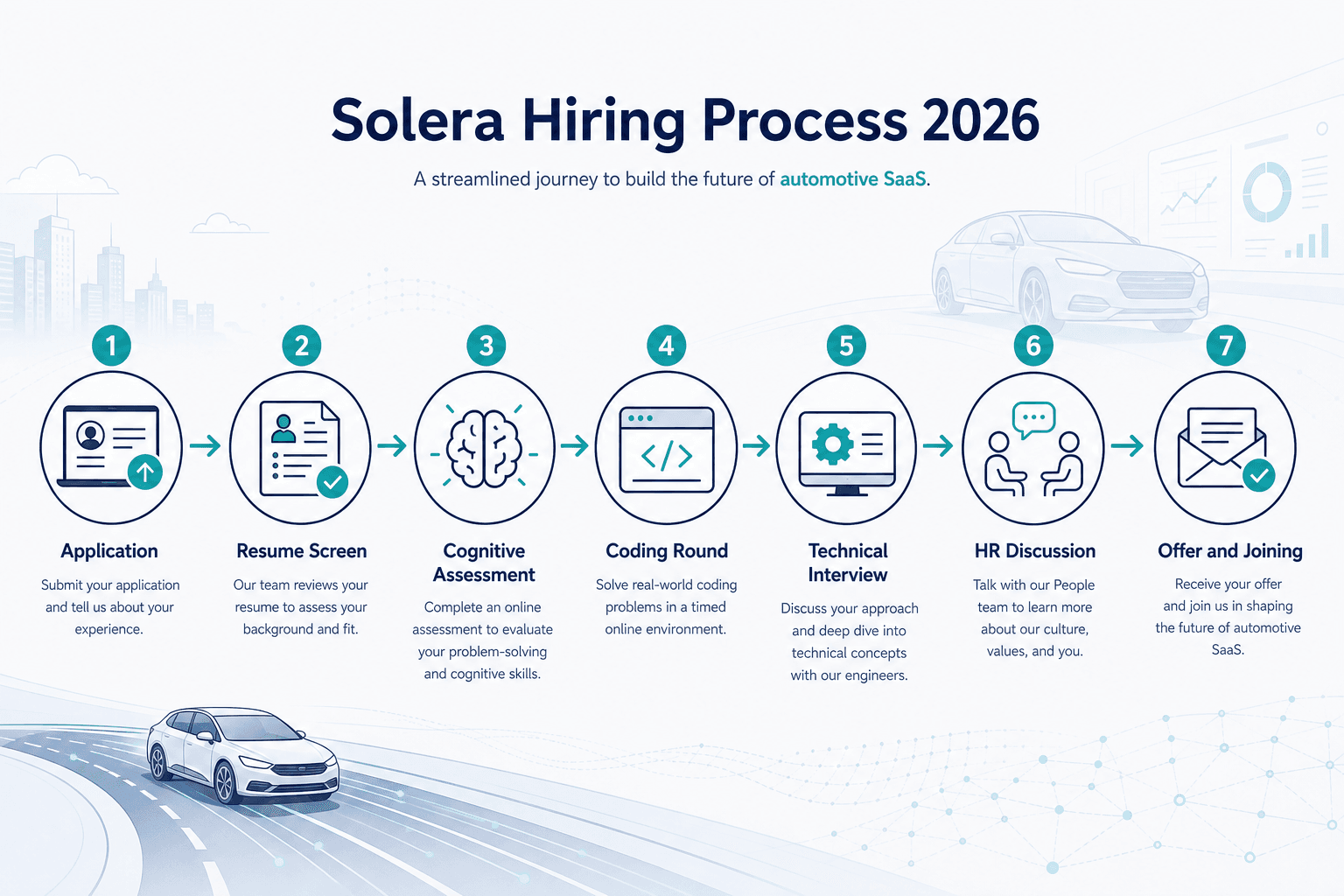
From Workday application through onboarding — the standard Solera Associate Software Engineer pipeline for India fresher and off-campus hiring in 2026.
Solera hiring process 2026 — Workday application, resume screen, cognitive assessment, Java coding, technical interviews, manager and HR rounds, offer and joining for India engineering roles
Step 1 — Application via Workday
Register on Solera's Workday careers portal with accurate academic records, Java-focused resume, and degree documents. Verify eligibility: typically 60%+ aggregate, no active backlogs, and graduation year matching drive criteria. Upload resume highlighting projects, internships, and Java/SQL stack — recruiters screen before cognitive assessment slots are assigned.
Step 2 — Resume screening
Recruiters and ATS filters scan for relevant degree (CS/IT/ECE), CGPA threshold, internship experience, and Java project depth. Tailor bullets to measurable outcomes — APIs built, test coverage, database queries optimized. Referrals accelerate this stage but do not guarantee shortlist.
Step 3 — Cognitive assessment (online)
Timed ~30-minute assessment covering quantitative aptitude, logical reasoning, and personality profiling. Duration and section weights may vary by batch — read test invitation email carefully. Failed assessment ends the pipeline; no appeal round at most drives. Personality section evaluates consistency — avoid contradictory responses.
Step 4 — Coding + technical rounds
Shortlisted candidates face Java coding (arrays, strings, OOP) and two technical panels probing Core CS, SQL, REST APIs, and deep project discussion. Panels expect narrated problem-solving, complexity analysis, and honest ownership of resume claims. Virtual format demands stable internet and quiet environment.
Step 5 — Manager + HR evaluation
Manager round assesses ownership mindset, collaboration fit, and domain curiosity for automotive SaaS. HR probes relocation to Bengaluru/Hyderabad, salary band acceptance, career goals, and "Why Solera." Weak company research fails HR even after strong technical performance.
Step 6 — Offer & background verification
Selected candidates receive offer letter with Associate Software Engineer title, CTC breakdown (fixed vs variable), joining date, and location. Background verification checks academic credentials, identity, and prior employment. Offer acceptance deadlines are strict — typically 5–10 days.
Step 7 — Joining & onboarding
Report to Bengaluru or Hyderabad engineering center with original documents. Complete onboarding via Workday, security training, and product domain orientation. Freshers receive structured mentorship on claims/repair platform codebase before independent module ownership.
Recruitment Process
Solera's India fresher pipeline follows a predictable sequence — each round eliminates candidates before the next stage invests panel time. Lateral hires typically skip the cognitive assessment.
Resume Screening — Filter applicants for degree relevance, CGPA, Java/SQL project depth, and internship credibility before investing assessment slots.
Cognitive Assessment — Eliminate candidates weak in aptitude, logical reasoning, or personality consistency before live technical interviews.
Coding Round (Java) — Verify hands-on Java programming ability — syntax, collections, OOP, and clean problem-solving under time pressure.
Technical Interview 1 — Deep probe of Core CS fundamentals, SQL, Java concepts, and capstone project ownership.
Technical Interview 2 — Second panel validates consistency, probes debugging mindset, and tests problem-solving depth beyond first round.
Manager Round — Assess ownership, collaboration fit, learning agility, and motivation for automotive SaaS product engineering.
HR Round — Final behavioral screen: relocation, salary acceptance, background check initiation, and cultural fit confirmation.
Workday Applications
Register on Solera's Workday careers portal with accurate academic records, Java-focused resume, and degree documents. Verify eligibility: typically 60%+ aggregate, no active backlogs, and graduation year matching drive criteria. Upload resume highlighting projects, internships, and Java/SQL stack — recruiters screen before cognitive assessment slots are assigned.
Yes — Solera's careers portal runs on Workday. Create account, upload resume, apply to specific requisitions, and track status in portal. Assessment invitations arrive via email linked to Workday application.
Interview Rounds
Detailed breakdown of every Solera evaluation stage — purpose, topics, rejection patterns, and preparation tips grounded in 2026 candidate reports.
Resume Screening
N/A — gate · 3–7 business days
Purpose: Filter applicants for degree relevance, CGPA, Java/SQL project depth, and internship credibility before investing assessment slots.
Evaluates: Basic fit, resume authenticity, and alignment with Associate SWE requirements.
Signals intent to leave for higher studies within 12 months
Generic "good company" answers without Solera-specific research
Preparation tips
Express flexibility for Bengaluru or Hyderabad joining
State awareness of ₹5–8 LPA estimate and willingness to accept offered band
Prepare "Why Solera" with automotive SaaS and global product angle
Confirm full-time commitment and realistic joining date
Cognitive Assessment
The ~30-minute cognitive assessment is the highest-leverage elimination stage — balance quantitative aptitude, logical reasoning, and personality consistency rather than coding prep alone.
Solera updates cognitive assessment formats periodically. Always verify the latest pattern on your Workday test invitation email before assessment day. Section weights and personality modules may vary by batch.
Solera cognitive assessment section breakdown with focus areas and typical weight
Percentages, ratios, time-speed-distance, profit-loss, simple/compound interest, and basic data interpretation. Cognitive assessment quant is time-pressured — mental math shortcuts and option elimination matter more than lengthy calculations. Weak quant eliminates candidates before Java coding regardless of strong GitHub profiles.
Prep tip: Drill 30 timed quant questions daily for two weeks. Maintain a mistakes log for TSD and percentage trap questions.
Logical Reasoning
Blood relations, seating arrangements, syllogisms, coding-decoding, series, and direction sense. This section separates shortlists from mass elimination — accuracy under clock pressure is critical. Practice standard notation for linear and circular arrangements.
Prep tip: Practice 15 reasoning sets under 20-minute timers. Learn elimination strategies for syllogism problems.
Personality Profiling
Situational judgment questions evaluating work-style consistency, teamwork preferences, and professional ethics. Contradictory answers across similar scenarios may flag unreliable profiles. Answer honestly and consistently — there is no "gaming" personality tests without detection.
Prep tip: Complete one full personality practice module to understand question style. Avoid extreme responses on every item.
Verbal Ability
Some batches include reading comprehension, sentence correction, and vocabulary — especially for roles with client communication exposure. Professional English clarity supports global product team collaboration across US and European stakeholders.
Prep tip: Solve 10 RC passages weekly; review grammar for subject-verb agreement and tense consistency.
Coding Interview
Easy to medium for Associate Software Engineer — arrays, strings, HashMap patterns, basic OOP. Not competitive-programming Hard.
Platforms: HackerRank-style shared editor · CoderPad or similar live coding environment · Occasionally take-home for lateral roles
Panel expectations
Java is the primary language — Python may be accepted on resume but Java coding is standard in fresher loops
Solve 1–2 problems with narrated approach and stated time/space complexity
Handle edge cases: empty input, duplicates, single element, negative numbers where applicable
Clean variable naming and modular structure — not one-liner golf code
Panels may ask to refactor or optimize after initial solution — prepare follow-up depth
Common problems
Reverse a string or array in-place
Find duplicate elements using HashMap
Two-sum or complement pair in sorted/unsorted array
Check palindrome string with two-pointer
Count character frequency and find first non-repeating
Merge two sorted arrays
FizzBuzz with OOP variant (print numbers 1–n with divisibility rules)
Technical Topics
Sixteen topic areas weighted by Solera panel frequency — prioritize High-weight skills before framework depth.
DSA
High
Arrays, strings, two-pointer, HashMap frequency, binary search basics. Easy-medium with narrated approach and complexity stated aloud.
Java
High
Collections hierarchy, exception handling, OOP pillars with examples, String immutability, equals vs ==.
Python
Low–Medium
Syntax awareness if listed on resume — Java dominates fresher coding rounds.
JavaScript
Low–Medium
Basics for frontend-leaning candidates — closures, promises, DOM awareness if applying FE track.
SQL
High
JOINs, GROUP BY, indexing basics, normalization. Expect one live or verbal query on claims/repair data schema.
Career goals incompatible with product engineering path
Poor communication — rambling or one-word answers
Preparation tips
Prepare STAR story showing initiative beyond coursework
Research Audatex and Identifix — mention one product insight
Frame career goals around building global SaaS from India
Ask thoughtful questions about team structure and mentorship
HR Round
Final behavioral screen covering relocation, salary acceptance, and cultural fit — weak company research fails candidates after strong technical performance.
HR Round
Easy to medium · 20–30 minutes
Purpose: Final behavioral screen: relocation, salary acceptance, background check initiation, and cultural fit confirmation.
Evaluates: Professionalism, relocation willingness, salary realism, and commitment signal.
Signals intent to leave for higher studies within 12 months
Generic "good company" answers without Solera-specific research
Preparation tips
Express flexibility for Bengaluru or Hyderabad joining
State awareness of ₹5–8 LPA estimate and willingness to accept offered band
Prepare "Why Solera" with automotive SaaS and global product angle
Confirm full-time commitment and realistic joining date
Project Discussion
Both technical rounds probe capstone and internship depth — prepare architecture diagrams, your specific modules, and honest ownership claims before any live panel.
Technical Interview 1
Medium · 45–60 minutes
Purpose: Deep probe of Core CS fundamentals, SQL, Java concepts, and capstone project ownership.
Evaluates: Fundamentals depth, project authenticity, and structured technical communication.
Solera hires B.Tech and B.E. graduates as Associate Software Engineers through off-campus drives in India. The standard pipeline: Workday application → resume screen → cognitive assessment (~30 min aptitude + personality) → Java coding → two technical rounds → HR. Estimated fresher CTC: ₹5–8 LPA (job board aggregates — verify on offer letter).
Associate Software Engineer is Solera's primary fresher role in India. Unlike mass campus recruiters, Solera does not visit hundreds of colleges — most fresher intake flows through Workday open applications and periodic off-campus batches announced on LinkedIn and Naukri. Register early, upload a Java-focused resume, and monitor email for cognitive assessment slots.
The cognitive assessment combines quantitative aptitude, logical reasoning, and personality profiling — similar in spirit to NLTH-style filters at IT services firms but shorter (~30 minutes). Shortlisted candidates face Java coding (arrays, strings, OOP basics) followed by two technical panels probing Core CS, SQL, and project depth.
Fresher offers map to Bengaluru or Hyderabad engineering centers. Relocation flexibility strengthens HR evaluation — both cities have active Solera product teams. Treat every stage as elimination: weak aptitude performance ends candidacy before any live interview, regardless of strong GitHub profiles.
Figures are job-board aggregates — not officially published by Solera. Confirm fixed vs variable split on your offer letter before accepting.
Intern
₹20,000–35,000/month (estimate)
Summer internship stipend estimate from job board aggregates — not official. Bengaluru/Hyderabad centers. PPO may align to Associate SWE band.
Graduate / Associate SWE
₹5–8 LPA (estimate)
Fresher Associate Software Engineer band from Naukri/Glassdoor aggregates — verify fixed vs variable on offer letter. Not officially published by Solera.
Software Engineer (1–3 YOE)
₹8–12 LPA (estimate)
Mid-level product engineering band for Bengaluru/Hyderabad. Varies by module ownership and cloud specialization.
Senior Software Engineer
₹12–18 LPA (estimate)
Senior engineers owning feature modules in claims or repair platforms. Upper range for cloud/architecture specialists.
Lead / Tech Lead
₹16–24 LPA (estimate)
Technical leadership over squads building global SaaS modules. Wide band reflects team size and product criticality.
QA Engineer
₹5–10 LPA (estimate)
Fresher QA at lower band; automation specialists with Selenium/API testing at upper band. Estimates only.
Data Analyst
₹6–11 LPA (estimate)
SQL-heavy analytics roles supporting claims and repair data insights. Fresher DA toward lower band.
DevOps Engineer
₹10–18 LPA (estimate)
CI/CD, cloud infrastructure, and monitoring for global SaaS deployment. Requires 2+ YOE typically.
Eligibility Criteria
Degree, CGPA, and backlog rules vary by Workday drive — verify the specific posting before applying.
Solera eligibility criteria by degree and program
Degree / Program
Streams Accepted
CGPA / %
Backlogs
Notes
B.Tech / B.E.
CS, IT, ECE, EEE (CS-heavy preferred)
60%+ aggregate / 6.0+ CGPA
No active backlogs
Primary Associate SWE pipeline
MCA
Recognized university
60%+ aggregate
No active backlogs
Technical rounds match B.Tech depth
B.Sc. Computer Science
CS / IT specialization
60%+ aggregate
No active backlogs
Off-campus primary path; strong projects required
BCA
Computer Applications
60%+ aggregate
No active backlogs
QA and support tracks more common than core SWE
M.Tech (lateral)
CS, IT, relevant engineering
60%+ aggregate
Cleared
Lateral hiring — experience required
Diploma + B.Tech
Engineering with diploma
Per drive notice
Cleared
Case-by-case; off-campus with strong Java projects
B.Tech / B.E.
Degree / Program
B.Tech / B.E.
Streams Accepted
CS, IT, ECE, EEE (CS-heavy preferred)
CGPA / %
60%+ aggregate / 6.0+ CGPA
Backlogs
No active backlogs
Notes
Primary Associate SWE pipeline
MCA
Degree / Program
MCA
Streams Accepted
Recognized university
CGPA / %
60%+ aggregate
Backlogs
No active backlogs
Notes
Technical rounds match B.Tech depth
B.Sc. Computer Science
Degree / Program
B.Sc. Computer Science
Streams Accepted
CS / IT specialization
CGPA / %
60%+ aggregate
Backlogs
No active backlogs
Notes
Off-campus primary path; strong projects required
BCA
Degree / Program
BCA
Streams Accepted
Computer Applications
CGPA / %
60%+ aggregate
Backlogs
No active backlogs
Notes
QA and support tracks more common than core SWE
M.Tech (lateral)
Degree / Program
M.Tech (lateral)
Streams Accepted
CS, IT, relevant engineering
CGPA / %
60%+ aggregate
Backlogs
Cleared
Notes
Lateral hiring — experience required
Diploma + B.Tech
Degree / Program
Diploma + B.Tech
Streams Accepted
Engineering with diploma
CGPA / %
Per drive notice
Backlogs
Cleared
Notes
Case-by-case; off-campus with strong Java projects
Hiring Locations
Solera maps freshers to Bengaluru or Hyderabad engineering centers. Relocation flexibility during HR improves offer probability.
Bengaluru
Primary Solera India engineering hub — claims platform, repair estimation, and API integration teams. Highest fresher intake volume.
Hyderabad
Major product development center for data services and QA engineering. Strong Associate SWE joining cohorts.
New Delhi
Corporate and business operations presence — limited engineering hiring versus Bengaluru/Hyderabad. Verify role location on offer letter.
Engineering Culture
Product Ownership
Meaning: Engineers own feature modules end-to-end — from API design through deployment and monitoring — not ticket-closing in isolation.
Why at Solera: Global SaaS products require India teams to ship independently to US/EU customers with minimal hand-holding.
Sample signal: Capstone story showing you owned a module from design through deployment with measurable outcome.
Domain Depth
Meaning: Curiosity about automotive insurance, claims workflows, and repair estimation distinguishes strong candidates from generic coders.
Why at Solera: Audatex and Identifix solve specialized industry problems — engineers who learn domain context ship better features faster.
Sample signal: Mention researching how collision estimates flow from photos to insurer approval during HR answer.
Global Collaboration
Meaning: Work across time zones with US and European product, QA, and support teams — async communication and clear documentation matter.
Why at Solera: India engineering centers build for global markets; offshore coordination is daily reality, not occasional.
Sample signal: Example of async collaboration: detailed PR descriptions, recorded demos, or documentation that unblocked remote teammates.
Quality & Reliability
Meaning: Insurance and repair platforms demand high data accuracy and uptime — testing discipline and production mindfulness expected early.
Why at Solera: Incorrect claim valuations or repair estimates have direct financial impact on insurers and shops.
Sample signal: Testing story: caught edge case before release, added regression test, prevented production incident.
Continuous Learning
Meaning: Automotive technology evolves — EV repair data, AI damage assessment, telematics integration require ongoing skill growth.
Why at Solera: Product roadmap includes AI/ML and data platform investments; learning agility is a hiring signal.
Sample signal: Self-taught skill applied to project: learned REST API integration, Docker basics, or SQL optimization with outcome.
Agile Delivery
Meaning: Sprint-based development with Jira tracking, code reviews, and CI/CD pipelines — standard product engineering cadence.
Why at Solera: SaaS release cycles demand predictable delivery; familiarity with Agile ceremonies strengthens fresher onboarding.
Sample signal: Internship or capstone using sprints, standups, and Git pull request workflow with peer review.
Resume Tips
Lead with Java and SQL
Solera fresher panels code in Java and probe SQL heavily. Place Java, Spring (if used), and SQL in the first third of your skills section — not buried below unrelated tools.
Quantify capstone outcomes
Replace "built a web app" with "built REST API serving 500 daily requests with 200ms p95 latency" or "reduced manual data entry by 40% through automation." Numbers signal ownership.
One page for freshers
Recruiters screen hundreds of Workday applications per batch. One crisp page with project bullets, internship, and education beats multi-page templates with filler coursework lists.
Name your modules explicitly
In team projects, state "I owned authentication module and payment API integration" — panels probe individual contribution and reject vague team credit claims.
Include GitHub with README
Link one polished repository with setup instructions and architecture overview. Empty GitHub or fork-only profiles weaken credibility when resume claims coding depth.
Highlight REST API experience
Solera products are API-centric SaaS platforms. Mention endpoints designed, HTTP methods used, JSON schemas, and error handling patterns from capstone or internship.
Add internship metrics
Internship bullets should include deliverables: "shipped 3 API endpoints," "wrote 50 unit tests," "fixed 12 production bugs" — not generic "learned technologies."
Match degree to drive criteria
Verify graduation year, CGPA, and backlog status match the specific Workday posting. Mismatched academic details trigger ATS rejection before human review.
Tailor for automotive SaaS angle
If you have any insurance, logistics, or automotive project — highlight it. Domain-adjacent experience differentiates in a specialized SaaS company versus generic e-commerce capstones.
Common Mistakes
16 elimination patterns reported by Solera candidates in 2026 — each with a concrete fix.
Ignoring cognitive assessment aptitude
Why it fails: Solera eliminates 50–70% of applicants at the ~30-minute assessment before any Java coding — strong GitHub alone cannot recover a failed aptitude score.
Fix: Allocate 50% of Week 1 prep to timed quant and reasoning drills mirroring assessment section clocks.
Preparing only in Python when panel expects Java
Why it fails: Associate SWE coding rounds standardize on Java — Python-only prep leads to syntax errors under pressure in shared editor.
Fix: Rewrite your top 20 DSA solutions in Java; practice collections API and String methods daily.
Inconsistent personality assessment answers
Why it fails: Contradictory situational responses flag unreliable profiles and trigger automated rejection on personality modules.
Fix: Answer honestly and consistently — complete one practice personality module to understand question style.
Silent coding without narration
Why it fails: Panels evaluate communication alongside correctness — silent typing fails even when final code works.
Fix: Practice stating approach, complexity, and edge cases aloud before writing code in every mock.
Weak SQL fundamentals
Why it fails: JOIN confusion and inability to write GROUP BY query are common elimination reasons in Technical Round 1.
Fix: Practice 10 JOIN queries and 5 aggregation queries on claims/repair-themed sample schemas.
Generic "Why Solera" HR answer
Why it fails: HR panels reject candidates who cannot articulate automotive SaaS motivation beyond "good product company."
Fix: Research Audatex, Identifix, and vehicle lifecycle management — tie to your interest in domain-rich engineering.
Inflexible relocation stance
Why it fails: Offers map to Bengaluru or Hyderabad — refusing both locations effectively disqualifies candidacy at HR stage.
Fix: Express flexibility for either city; research cost of living and team presence before the HR round.
Unrealistic fresher salary demands
Why it fails: Demanding product-company CTC above estimated ₹5–8 LPA band signals misalignment — HR may close candidacy.
Fix: State awareness of estimate range and willingness to accept offered band; focus on growth and global product exposure.
Cannot explain capstone architecture
Why it fails: Two technical rounds probe project depth — vague "we used Java and MySQL" answers fail under follow-up.
Fix: Prepare architecture diagram, your specific modules, API endpoints, DB schema, and one trade-off you would change.
Claiming full team project credit
Why it fails: Panels ask "what did YOU build?" — inability to isolate personal contribution signals resume inflation.
Fix: Document individual modules before interview; use "I built X; teammate built Y" language consistently.
Skipping Git basics
Why it fails: Resume lists team projects but candidate cannot explain branching or pull requests — credibility gap.
Fix: Review Git flow: clone, branch, commit, push, PR, merge conflict resolution with one concrete example.
Last-minute one-week cram
Why it fails: Aptitude speed and Java syntax fluency require muscle memory — cramming fails for most candidates.
Fix: Follow the 30-day roadmap starting four weeks before expected assessment slot.
Poor virtual interview setup
Why it fails: Background noise, camera off, or unstable internet during proctored assessment or live panels causes disqualification.
Fix: Test setup 24 hours before; use wired internet, quiet room, and backup hotspot.
OOP definitions without examples
Why it fails: Textbook pillar recitation without Java class examples signals shallow understanding.
Fix: Prepare one example per pillar: encapsulation (private fields + getters), inheritance (IS-A), polymorphism (method override), abstraction (abstract class/interface).
No questions for the panel
Why it fails: Declining "any questions?" signals low engagement — manager round especially weights curiosity.
Fix: Prepare 3 questions: team structure, mentorship for freshers, product roadmap exposure for India engineers.
Applying once and waiting passively
Why it fails: Solera batches are periodic — single application without follow-up may miss the next open window.
Fix: Set LinkedIn/Naukri alerts; reapply when new Workday postings appear; pursue referral in parallel.
Freshers vs Experienced
Fresher Hiring — Associate Software Engineer
Solera hires B.Tech and B.E. graduates as Associate Software Engineers through off-campus drives in India. The standard pipeline: Workday application → resume screen → cognitive assessment (~30 min aptitude + personality) → Java coding → two technical rounds → HR. Estimated fresher CTC: ₹5–8 LPA (job board aggregates — verify on offer letter).
Estimated CTC: ₹5–8 LPA (job boards — not official)
Primary locations: Bengaluru, Hyderabad
Experienced / Lateral Hiring
Solera hires lateral software engineers, QA engineers, and data professionals with 2–8 years experience year-round in Bengaluru and Hyderabad. Process: resume screen, 2–3 technical rounds (coding + system discussion), manager fit, HR — no cognitive assessment for most lateral loops.
2–8 YOE typical lateral range
No cognitive assessment — coding + system rounds
Estimated CTC: ₹8–18 LPA band (varies by skill/city)
Year-round via Workday and referrals
Behavioral Preparation
Manager and HR rounds weight STAR stories, domain curiosity, and relocation flexibility — not additional coding depth.
Behavioral
High
STAR stories for deadline, conflict, learning agility; domain curiosity for automotive SaaS.
Structure answers with the STAR method. Prepare three stories: deadline pressure, team conflict, and learning agility — each tied to measurable outcomes from capstone or internship work.
7-Day Crash Roadmap
Compressed cognitive assessment and Java coding sprint when your Solera drive is one week away — aptitude first, then Core CS and HR.
1
Days 1–2
Aptitude crash
30 quant + 15 reasoning problems daily
1 timed cognitive-style mock (30 min)
Review mistakes log for TSD and percentages
2
Days 3–4
Java coding sprint
10 easy array/string problems in Java
HashMap frequency and two-pointer patterns
Narrate approach + complexity for each solution
3
Days 5–6
Core CS + SQL
OOP four pillars with Java examples
5 JOIN queries + 2 GROUP BY queries
Capstone 3-minute walkthrough rehearsal
4
Day 7
Full mock loop
1 timed aptitude mock
1 Java coding mock with spoken narration
HR: Why Solera + Bengaluru/Hyderabad flexibility
15-Day Preparation Roadmap
Two-week Solera prep plan — cognitive assessment foundation, Java coding, Core CS depth, and full mock loops.
1
Days 1–3
Cognitive assessment prep
30 quant + 15 reasoning daily
Personality module practice for consistency
1 full 30-min timed assessment mock
2
Days 4–6
Java coding + collections
20 easy array/string problems in Java
Collections hierarchy and exception handling review
2 coding mocks in shared editor environment
3
Days 7–9
Core CS depth
SQL JOIN + ranking query practice
TCP vs UDP + process vs thread answers
REST API verbs, status codes, JSON flow
4
Days 10–12
Project + behavioral
Capstone architecture one-pager with diagram
3 STAR stories: deadline, conflict, learning agility
Research Audatex and Identifix products
5
Days 13–15
Full mocks
1 cognitive assessment simulation
1 combined technical mock (coding + CS)
1 HR mock: salary, relocation, Why Solera
30-Day Deep Prep Roadmap
Four-week plan for early starters — aptitude mastery, Java coding, Core CS + SQL + REST, and full-loop mocks with domain research.
Solera product research document (Audatex, Identifix)
Salary band awareness (₹5–8 LPA estimate)
Document checklist and Workday application review
Offer & Joining
From offer letter through Bengaluru or Hyderabad onboarding — verify CTC breakdown and joining location before accepting.
Step 6 — Offer & background verification
Selected candidates receive offer letter with Associate Software Engineer title, CTC breakdown (fixed vs variable), joining date, and location. Background verification checks academic credentials, identity, and prior employment. Offer acceptance deadlines are strict — typically 5–10 days.
Step 7 — Joining & onboarding
Report to Bengaluru or Hyderabad engineering center with original documents. Complete onboarding via Workday, security training, and product domain orientation. Freshers receive structured mentorship on claims/repair platform codebase before independent module ownership.
2026 Hiring Trends
Off-campus batches in Q1 and Q3
Solera India off-campus hiring for Associate Software Engineer roles runs in periodic batches through Workday, with peak activity in Q1 and Q3 2026. Campus presence is limited compared to IT services giants — most fresher intake flows through open applications and employee referrals. Lateral hiring for mid-level engineers continues year-round in Bengaluru and Hyderabad.
Cognitive assessment as primary filter
Solera updates cognitive assessment formats periodically. Always verify the latest pattern on your Workday test invitation email before assessment day. Section weights and personality modules may vary by batch.
Java and SQL over framework buzzwords
Easy to medium for Associate Software Engineer — arrays, strings, HashMap patterns, basic OOP. Not competitive-programming Hard.
AI and data intelligence on the roadmap
Solera invests in AI-driven damage assessment, image recognition for vehicle photos, predictive analytics for repair costs, and automated claims routing. India teams work on machine-learning pipelines, data engineering for vehicle history databases, and intelligent workflow automation — product engineering with domain depth, not generic IT outsourcing.
What is Solera and what products does the company build?
HREasy
View expert answer & prep guide
Suggested answer time: 2–3 min
Why interviewers ask this: Panels verify genuine company research — generic answers signal low motivation for specialized automotive SaaS.
Expert answer: Solera Holdings is a global vehicle lifecycle management SaaS company serving automotive insurance, collision repair, and fleet industries. Flagship products include Audatex for claims and repair estimating, and Identifix for OEM repair information and diagnostics. India engineering teams in Bengaluru and Hyderabad build cloud platforms processing vehicle claims and repair data for global markets — product engineering with domain depth, not generic IT outsourcing.
What interviewers evaluate: Product awareness, domain curiosity, and preparation quality.
Answer strategy: Name vehicle lifecycle management SaaS, cite Audatex and Identifix, mention India engineering in Bengaluru/Hyderabad.
Common mistakes: Calling Solera an IT services company, unable to name any product, or generic "good company" praise.
Follow-up questions:
What is Audatex specifically?
How does India engineering contribute globally?
02
What is the Solera cognitive assessment and how should I prepare for it?
AptitudeEasy
View expert answer & prep guide
Suggested answer time: 2–3 min
Why interviewers ask this: Assessment is the primary elimination gate — recruiters verify candidates understand the pipeline before investing interview slots.
Expert answer: Solera's cognitive assessment is a timed ~30-minute online test covering quantitative aptitude, logical reasoning, and personality profiling. It filters candidates before Java coding and live technical interviews — similar in purpose to NLTH at Wipro but shorter. Prepare with daily timed quant and reasoning drills plus honest personality consistency practice. Failed assessment ends the pipeline at most drives.
What interviewers evaluate: Awareness of assessment sections, time limits, and preparation strategy.
Answer strategy: Name sections (quant, reasoning, personality), state ~30 min duration, mention elimination before Java coding.
Common mistakes: Ignoring aptitude prep, attempting to game personality sections, or not reading test invitation for section details.
Follow-up questions:
What quant topics appear most?
Is there negative marking?
03
What is the difference between abstract class and interface in Java? When do you use each?
TechnicalEasy
View expert answer & prep guide
Suggested answer time: 3 min
Why interviewers ask this: Core Java OOP question — Solera Java panels test practical design judgment on API and service class hierarchies.
Expert answer: Abstract class can have state, constructors, and partial implementations — use for "is-a" relationships with shared behavior (e.g. BaseClaimProcessor with common validation fields). Interface defines a contract — use for "can-do" capabilities (Exportable, Validatable). A class extends one abstract class but implements multiple interfaces. Java 8+ interfaces allow default methods for backward-compatible API evolution.
What interviewers evaluate: OOP design understanding and Java language rules.
Answer strategy: Contrast state/constructors (abstract class) vs contract-only (interface). Give claims-service or payment example.
Common mistakes: Ignoring default methods, or using inheritance when composition fits better.
Follow-up questions:
Composition vs inheritance?
When prefer interface default methods?
04
Write a Java program to find duplicate elements in an array.
TechnicalEasy
View expert answer & prep guide
Suggested answer time: 4–5 min
Why interviewers ask this: Standard warm-up coding problem — tests HashMap usage, Java collections fluency, and complexity narration.
Expert answer: Use HashSet: iterate array, if element already in set it is duplicate; else add. O(n) time O(n) space. Alternative: HashMap for frequency count returning elements with count > 1. Handle empty array (no duplicates). Narrate approach before coding — Solera panels evaluate communication alongside correctness.
What interviewers evaluate: HashMap pattern, edge-case handling, and spoken problem-solving.
Answer strategy: HashSet for detection or HashMap for frequency. State O(n) time O(n) space. Handle empty array.
Common mistakes: O(n²) nested loop without optimization discussion, forgetting empty array edge case.
Follow-up questions:
Find duplicate without extra space?
Find first repeating element?
05
Explain the difference between INNER JOIN and LEFT JOIN with an example.
TechnicalEasy
View expert answer & prep guide
Suggested answer time: 3 min
Why interviewers ask this: SQL is heavily tested — Solera products run on relational claims and repair data requiring JOIN fluency.
Expert answer: INNER JOIN returns only rows with matching keys in both tables — e.g. claims INNER JOIN repair_orders returns claims that have repair orders. LEFT JOIN returns all rows from left table plus matching right rows; unmatched right columns are NULL — useful for finding claims without repair orders yet. Solera panels may ask you to write a query finding unprocessed claims.
What interviewers evaluate: SQL query construction and understanding of result set differences.
Answer strategy: Define both JOINs, use claims + repair_orders example schema, state which rows appear in each result.
Common mistakes: Confusing LEFT vs RIGHT JOIN, or unable to write syntactically correct query.
Follow-up questions:
Write query for claims without repairs?
What is indexing on JOIN columns?
06
What is REST API and how would you design a simple claims submission endpoint?
TechnicalMedium
View expert answer & prep guide
Suggested answer time: 3–4 min
Why interviewers ask this: Solera products are API-centric SaaS — panels test HTTP literacy and practical API design thinking.
Expert answer: REST uses HTTP verbs on resource URLs with stateless JSON communication. Claims endpoint: POST /api/v1/claims with body {vehicleId, incidentDate, description, photos[]}. Return 201 Created with claimId on success, 400 Bad Request for validation failures, 401 for auth issues. Use idempotency key for duplicate submission prevention. GET /api/v1/claims/{id} for status retrieval.
What interviewers evaluate: REST principles, HTTP verbs, status codes, and JSON payload structure.
Answer strategy: Define REST, then design POST /api/v1/claims with request body, validation, 201/400 responses.
Common mistakes: Using GET for mutations, ignoring status codes, or no validation/error handling mention.
Follow-up questions:
How handle authentication?
What is idempotency?
07
What is the difference between process and thread?
Expert answer: Process is an independent execution unit with own memory space — isolated but heavier to create. Thread is a lightweight unit within a process sharing memory — faster context switch but risks race conditions. Multithreading pros: concurrency for I/O-bound API handlers. Cons: race conditions, deadlocks, harder debugging. Solera API servers use thread pools to handle concurrent claim submissions.
What interviewers evaluate: Concurrency concepts and practical implications for server applications.
Answer strategy: Define both, contrast memory isolation vs shared memory, mention pros/cons of multithreading.
Common mistakes: Saying threads are completely isolated, or unable to mention race conditions.
Follow-up questions:
What is a deadlock?
Thread pool in Java?
08
Explain MVC architecture pattern with a web application example.
TechnicalEasy
View expert answer & prep guide
Suggested answer time: 3 min
Why interviewers ask this: Architecture literacy for enterprise web apps — Solera client applications commonly use MVC or MVC-inspired patterns.
Expert answer: Model holds data and business logic (Claim entity, validation rules, database persistence). View renders UI (HTML templates, React components showing claim status). Controller handles user input and orchestrates Model + View (form submit → validate claim → save to DB → redirect to confirmation view). Example: user submits collision claim — Controller receives data, Model validates and persists, View shows success or error page.
What interviewers evaluate: Separation of concerns with concrete web app mapping.
Answer strategy: Define Model, View, Controller with a claims submission web app example.
Common mistakes: No concrete example, or confusing MVC with three-tier deployment architecture.
Follow-up questions:
MVC vs MVVM?
Where does REST API fit?
09
Describe a situation where you had a conflict with a team member and how you resolved it.
BehavioralEasy
View expert answer & prep guide
Suggested answer time: 3 min
Why interviewers ask this: Solera values collaboration in global product teams — STAR conflict stories test emotional intelligence.
Expert answer: Use STAR. Example: disagreed on API response format in capstone. I scheduled a comparison session listing trade-offs for mobile client vs web admin needs, invited mentor input, and we chose the format with better extensibility. Both learned to document API contracts upfront. Solera panels value empathy and data-driven resolution over winning arguments.
What interviewers evaluate: Empathy, communication, escalation judgment, and learning outcome.
Answer strategy: STAR format: understand perspective, seek common ground, escalate only when needed, end with mutual learning.
Common mistakes: Blaming teammate, no resolution, or heroics without collaboration.
Follow-up questions:
What if conflict escalated to manager?
How prevent future conflicts?
10
What are your salary expectations and are you aware of the Solera package structure?
HREasy
View expert answer & prep guide
Suggested answer time: 2 min
Why interviewers ask this: HR verifies realistic expectations and willingness to accept offer without misaligned negotiation.
Expert answer: I understand Solera Associate Software Engineer packages are estimated at ₹5–8 LPA based on job board aggregates — I would verify fixed vs variable on the offer letter. I am willing to accept the offered band at this career stage and focus on learning automotive SaaS domain and global product engineering exposure from Bengaluru or Hyderabad.
What interviewers evaluate: Package awareness, flexibility, and growth-oriented framing.
Answer strategy: State estimated ₹5–8 LPA band, express willingness to accept, focus on product engineering growth.
Common mistakes: Demanding ₹15+ LPA as fresher, unaware of estimate range, or refusing relocation.
Follow-up questions:
What is the variable pay component?
When can salary be renegotiated?
11
Why do you want to work at Solera instead of an IT services company?
HREasy
View expert answer & prep guide
Suggested answer time: 2–3 min
Why interviewers ask this: Tests genuine career fit for product engineering versus IT services consulting path.
Expert answer: Solera offers product engineering on global automotive SaaS platforms — I would own features in claims or repair systems used by insurers worldwide, not rotate across unrelated client accounts. The domain richness of vehicle lifecycle management interests me, and India teams build core product modules, not peripheral support. I value depth over breadth at this career stage and want to grow as a product engineer in a specialized industry.
What interviewers evaluate: Authentic motivation, domain interest, and alignment with Solera culture.
Answer strategy: Product ownership, automotive SaaS domain, global impact from India — personal and specific.
Common mistakes: Generic "product company is better," sounding like placeholder until TCS offer.
Follow-up questions:
Why not Freshworks or Zoho?
Where in 5 years at Solera?
12
What is vehicle lifecycle management and how does Solera fit in the automotive industry?
HRMedium
View expert answer & prep guide
Suggested answer time: 3 min
Why interviewers ask this: Domain literacy differentiates prepared candidates — Solera hires engineers who understand the industry they build for.
Expert answer: Vehicle lifecycle management covers software and data services across a vehicle's life — insurance claims after accidents, collision repair estimating and parts sourcing, fleet maintenance scheduling, valuation, and aftermarket diagnostics. Solera powers these workflows through Audatex (claims/estimating) and Identifix (repair information). Engineers build platforms ensuring accurate, fast data flow between insurers, repair shops, and fleet operators — financial impact of errors makes quality engineering critical.
What interviewers evaluate: Industry awareness and ability to connect software to automotive workflows.
Answer strategy: Define lifecycle stages, map Solera products to claims/repair/fleet phases, mention data accuracy importance.
Common mistakes: Vague "car software" answer without naming lifecycle stages or Solera products.
Follow-up questions:
What is a collision repair estimate?
How does AI fit in damage assessment?
13
How would you design a database schema for storing vehicle insurance claims?
Expert answer: Core tables: Policyholder(id, name, contact), Vehicle(id, vin, make, model, policyholder_id FK), Claim(id, vehicle_id FK, incident_date, status, description, estimated_amount), RepairOrder(id, claim_id FK, shop_id, status, total_cost), ClaimPhoto(id, claim_id FK, url, uploaded_at). Status enums: SUBMITTED → UNDER_REVIEW → APPROVED/REJECTED. Index on claim.status and vehicle.vin for lookup. Normalize shop data to separate Shop table. Consider audit log table for status transitions — critical for insurance compliance.
What interviewers evaluate: Entity modeling, relationships, normalization, and practical schema decisions.
Answer strategy: Name entities (Claim, Vehicle, Policyholder, RepairOrder), define keys and relationships, mention status workflow.
Common mistakes: Single flat table with redundant data, no FK relationships, or ignoring status workflow.
Follow-up questions:
How handle claim photos at scale?
What indexes would you add?
14
What is the difference between Audatex and Identifix in Solera's product portfolio?
HRMedium
View expert answer & prep guide
Suggested answer time: 2–3 min
Why interviewers ask this: New Solera-specific question testing product portfolio depth — distinguishes candidates who researched beyond homepage.
Expert answer: Audatex is Solera's collision repair estimating and insurance claims workflow platform — insurers and body shops use it to calculate repair costs, process claims, and source parts. Identifix provides OEM repair information, wiring diagrams, and diagnostic trouble-shooting for automotive technicians in repair shops. Audatex focuses on the financial/claims workflow; Identifix focuses on technical repair knowledge. Both serve the vehicle lifecycle but at different points — post-accident claims processing vs in-shop repair execution.
What interviewers evaluate: Product line awareness and ability to articulate business value of each brand.
Answer strategy: Audatex = claims/estimating for insurers and shops. Identifix = repair information/diagnostics for technicians.
Common mistakes: Treating them as identical products, or unable to explain who the end user is for each.
Follow-up questions:
Which product would a fresher engineer likely work on?
How do these integrate?
Frequently Asked Questions
What is Solera and what does the company do?
Solera Holdings is a global vehicle lifecycle management SaaS company serving automotive insurance, collision repair, fleet, and aftermarket industries. Products include Audatex (claims and repair estimating) and Identifix (OEM repair information). India engineering teams in Bengaluru and Hyderabad build cloud platforms processing vehicle claims and repair data worldwide.
Does Solera hire freshers in India in 2026?
Yes — Solera hires B.Tech/B.E. graduates as Associate Software Engineers through off-campus Workday drives and selective campus partnerships. Hiring volume is smaller than IT services giants; off-campus application is the primary path for most candidates.
What is the Solera cognitive assessment?
A timed ~30-minute online assessment covering quantitative aptitude, logical reasoning, and personality profiling. It filters candidates before Java coding and technical interviews — similar in purpose to NLTH or NQT at IT services firms but shorter. Section weights may vary by batch.
How many rounds are in the Solera interview process?
Typically: Workday application → resume screen → cognitive assessment → Java coding → two technical rounds → manager round → HR → offer. Experienced lateral hires may skip cognitive assessment and face 3–4 technical plus HR rounds.
What is the Solera fresher salary in 2026?
Estimated ₹5–8 LPA for Associate Software Engineer based on Naukri and Glassdoor aggregates — not officially published by Solera. Confirm fixed vs variable split on offer letter. Figures vary by batch and location (Bengaluru/Hyderabad).
Which programming language does Solera test in coding rounds?
Java is the primary language for Associate Software Engineer coding rounds. Prepare arrays, strings, HashMap patterns, and OOP in Java. Python on your resume may be discussed but Java coding is standard in fresher loops.
What CS fundamentals does Solera test?
OOP, DBMS/SQL (JOINs, normalization), OS (process vs thread, deadlock), networking (TCP vs UDP, HTTP/REST), Java collections, and deep project discussion. Expect 1–2 follow-up probes per topic in technical rounds.
Where does Solera hire in India?
Primary engineering centers in Bengaluru and Hyderabad. Corporate presence in New Delhi. Offer letter states joining location — express flexibility for both Bengaluru and Hyderabad during HR to improve offer probability.
How do I apply for Solera jobs in India?
Apply through Solera's Workday careers portal with accurate academic details and Java-focused resume. Monitor email for cognitive assessment slots. Employee referrals accelerate resume screening — network with Solera India engineers on LinkedIn.
What is the Associate Software Engineer role at Solera?
Entry-level product engineering role building and maintaining modules in claims, repair estimation, or integration platforms. Responsibilities include Java/API development, SQL queries, unit testing, code reviews, and Agile sprint participation under senior mentorship.
Does Solera conduct campus placements?
Solera has selective campus partnerships at tier-1 colleges — not mass campus visits like TCS or Wipro. If your college has no Solera drive, off-campus Workday application is the primary fresher path.
What is Audatex in the Solera portfolio?
Audatex is Solera's collision repair estimating and insurance claims workflow platform used globally by insurers and repair shops. India engineers contribute to estimation engines, API integrations, and data services powering Audatex workflows.
What is Identifix in the Solera portfolio?
Identifix provides OEM repair information, diagnostics, and technical service bulletins for automotive repair shops. Engineering work includes data pipeline management, search relevance, and integration with shop management systems.
What aptitude topics matter for Solera cognitive assessment?
Percentages, ratios, time-speed-distance, profit-loss, blood relations, seating arrangements, syllogisms, and data interpretation. Personality consistency matters — avoid contradictory situational answers.
Does Solera ask DSA questions in interviews?
Yes — easy to medium array, string, and HashMap problems in Java coding rounds and technical panels. Heavy dynamic programming is uncommon for Associate SWE — fundamentals and project depth matter more than LeetCode Hard volume.
How should I prepare for Solera HR round?
Prepare STAR stories, research Audatex/Identifix, articulate why automotive SaaS interests you, confirm Bengaluru/Hyderabad relocation flexibility, and state realistic salary expectations aligned to estimated ₹5–8 LPA fresher band.
Can I prepare for Solera and TCS together?
Yes — aptitude, reasoning, OOP, DBMS, and OS overlap heavily. Add company-specific mocks: cognitive assessment format for Solera and NQT for TCS in your final prep week. Solera adds domain curiosity about automotive SaaS.
What CGPA cutoff does Solera require?
Commonly 60%+ aggregate or 6.0+ CGPA with no active backlogs. Cutoffs vary by drive notice. Strong assessment scores and Java projects can offset borderline academics in some batches.
How long does Solera hiring take?
Off-campus: typically 4–8 weeks from application to offer due to batch scheduling and background verification. Campus drives at partner colleges may compress timelines to 2–4 weeks for on-site batches.
Are backlogs allowed in Solera hiring?
No active backlogs at interview time for most drives. Cleared backlogs with proof may be accepted in some off-campus batches — verify per Workday posting. Aggregate CGPA must still meet threshold.
Does Solera have a referral program?
Yes — employee referrals accelerate resume screening through internal Workday workflow. Referral does not bypass cognitive assessment or technical rounds but improves response time and shortlist probability.
What is Solera off-campus hiring process?
Register on Workday, complete cognitive assessment if shortlisted, attend virtual Java coding and technical interviews, then manager and HR. National applicant pool — prepare for competitive percentile cutoffs.
How do I prepare for Solera in 30 days?
Week 1: aptitude. Week 2: Java coding. Week 3: Core CS + SQL + REST. Week 4: full mocks + HR + domain research. Follow the 30-day roadmap in this hub. Use 7-day crash plan if assessment is imminent.
Does Solera negotiate fresher salary?
Rarely. Freshers should accept stated Associate SWE band and focus on global product exposure and growth. Negotiation leverage increases at lateral (2+ YOE) levels with competing offers.
What documents are needed for Solera joining?
Government ID, all mark sheets, degree/provisional certificate, class 10/12 certificates, photographs, resume, BGV address proof, and bank details. Laterals add relieving letters and experience certificates.
Is Solera a product company or IT services?
Product company — Solera builds and sells its own automotive SaaS platforms (Audatex, Identifix, etc.) rather than staffing engineers on client accounts like TCS or Wipro. Culture emphasizes product ownership and domain depth.
What makes Solera interviews different from TCS?
Solera uses shorter cognitive assessment plus Java coding with product-domain curiosity probes. TCS routes through NQT with mass campus scale. Solera fresher intake is smaller with higher per-seat competition and automotive SaaS context in HR/manager rounds.
Does Solera offer internships with PPO?
Solera offers internships at Bengaluru/Hyderabad with estimated stipends ₹20,000–35,000/month. Strong performers may receive pre-placement offers aligned to Associate SWE band — treat internship as extended interview.
What SQL questions does Solera ask?
JOIN types (INNER, LEFT), GROUP BY with aggregation, basic indexing awareness, and sometimes schema design for claims or repair data. Practice writing queries on paper without IDE autocomplete.
How should I answer "Why Solera"?
Anchor on global automotive SaaS impact, domain-rich engineering (insurance + repair), product ownership from India, and interest in Audatex/Identifix platforms. Tie to your Java/API project experience and relocation flexibility.
Does Solera use Workday for applications?
Yes — Solera's careers portal runs on Workday. Create account, upload resume, apply to specific requisitions, and track status in portal. Assessment invitations arrive via email linked to Workday application.
What manager round questions does Solera ask?
Ownership stories beyond coursework, collaboration examples, domain curiosity about automotive/insurance, career goals in product engineering, and conflict resolution using STAR format. Prepare thoughtful questions about team and mentorship.
How should I use mock interviews for Solera prep?
Run at least 3 mocks: one timed cognitive assessment simulation, one Java coding with spoken narration, one combined technical + HR. InterviewEra scores communication, structure, and technical depth across rubric dimensions.
Solera vs Freshworks vs Zoho — which is harder for freshers?
Similar Core CS depth but different entry filters. Solera: cognitive assessment + Java + domain curiosity. Freshworks/Zoho: often stronger coding and product rounds with higher estimated CTC. Solera fresher band is lower but domain is more specialized (automotive SaaS).
What projects impress Solera technical panels?
REST API backends with SQL databases, authentication flows, CRUD with validation, and any insurance/logistics/automotive angle. Panels probe architecture, your modules, and trade-offs — not framework buzzwords without depth.
Is personality test important in Solera hiring?
Yes — cognitive assessment includes personality profiling evaluating consistency and situational judgment. Contradictory answers may flag unreliable profiles. Answer honestly; do not attempt to game the assessment.
Practice beats passive reading
Run a full Solera mock interview — cognitive assessment, coding, and HR
Practice aptitude recall, narrated Java coding, Core CS fundamentals, and HR STAR answers with AI-generated follow-ups. Get rubric-based feedback on communication, technical depth, structure, confidence, and relevance.
Resume-aware technical + HR questions for Associate SWE roles
Timed answers with filler-word analysis on voice mode